







Buying guide
Electric bike – a wide range of e-bikes for commuting, leisure and heavy loads
Wheelyshop offers one of the widest ranges of electric bikes – from light folding city bikes and comfortable step-through models to powerful fat bikes, cargo bikes and long-range e-bikes. Compare range, motor power, battery and weight directly in the filter, choose from brands like ENGWE, VARUN, DYU, OneSport and KOOLUX, and find the right model for your everyday life. Every electric bike ships with free delivery, a 2-year warranty (in addition to your statutory rights) and the option to pay in instalments.
In short
- Across the EU an electric bike counts as a bicycle when the motor has at most 250 W, only assists while you pedal and cuts out at 25 km/h – then normal bicycle rules apply.
- Calculate range on your real return journey and add a margin for cold, hills and load – the stated range is a test value.
- Motor position, battery capacity in Wh and frame type matter more in daily use than peak power.
- Pick the type of electric bike by need: city, folding e-bike, women's, men's, fat bike, cargo or electric trike.
- Compare the last two candidates on the same data before you decide.
How to choose the right electric bike
A large range is easier to navigate when you start from your everyday life rather than maximum performance. Note how far you ride on a normal day, whether you meet hills, where the bike will be stored and whether it has to be carried up stairs or taken on a train. You can then remove models that are too heavy, too large or in the wrong class before comparing prices. Torn between an e-bike and a scooter? Read our comparison of the two.
1. Electric bike rules – check that the model counts as a bicycle
In the EU an e-bike is a bicycle (pedelec) when the motor has at most 250 W continuous rated power, only assists while you pedal and stops assisting at 25 km/h. No licence, registration or insurance is then required and you may use cycle paths. Vehicles with a throttle that works without pedalling, or assistance above 25 km/h, are classed as mopeds with entirely different requirements. National details differ – see Your Europe's country-by-country road rules. Always check the exact version's specification – a riding mode or app setting does not decide the classification. What the law says about pedal assistance, throttles and speed limits is explained in our guide to the rules across Europe.
2. Electric bike range – allow a margin
The stated range is measured under the manufacturer's test conditions, often in the lowest assist mode. Temperature, hills, headwind, rider weight, load and tyre pressure all affect the result, and a cold winter day can cut range considerably. Start from your return journey between charges and add a margin. Our practical tips to get more range from every charge apply to e-bikes too.
3. Motor and battery – how to compare e-bikes the right way
- Battery capacity in Wh (volts × amp-hours) says more about range than Ah alone.
- A removable battery is practical if the bike is stored somewhere without a socket.
- A mid-drive motor gives even power on hills and a natural bike feel; a hub motor is simpler and often cheaper.
- Torque (Nm) decides how easily the bike climbs – more important than peak power if you live in a hilly area or ride with load.
4. Choose frame and fit for your body
Recommended rider height, saddle height and handlebar height must suit the person riding. A low step-through makes getting on and off easier in city traffic, while a straight frame feels stiffer at higher speed. Check the maximum load – luggage and a child seat count towards the total.
5. Women's, men's, folding or fat tyre electric bike – pick the type by need
- Women's step-through e-bikes – low step-through and a comfortable, upright position.
- Men's e-bikes – straight frame, sportier position and stability at speed.
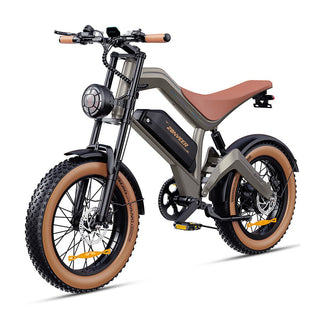
- Fat bikes – wide tyres for gravel, snow and uneven roads all year round.
- Tricycles – three wheels for maximum stability and large load capacity.
- Folding electric bikes – for train commuters and small storage spaces.
6. Cheap electric bike or premium – count the cost over time
An e-bike that replaces a car or public transport often pays for itself quickly. Charging costs very little per hundred kilometres, and wear parts such as tyres, brake pads and chain are replaced as on any bicycle. Check that spare parts are available for the model – our spare-parts portal shows what exists for each model. A good lock and a helmet are the two accessories most riders need from day one.
The right electric bike for you – compare the last two candidates
When only two candidates remain, record the same information for both:
- Motor power, torque and motor position
- Battery capacity in Wh, charging time and whether the battery is removable
- Stated range and test conditions
- Weight, frame type, step-through height and recommended rider height
- Tyres, brakes, gears and maximum load
Mark missing information instead of guessing. The model with the highest figure is not automatically the right one – choose the one whose whole package works for your journey, storage and servicing. For a smaller selection, start with our e-bike top list, and current offers are gathered under e-bike deals.
Frequently asked questions
What range does an electric bike have on one charge?
It depends on battery capacity, assist mode, terrain, temperature and load. Most e-bikes in our range state 40–120 km, and some long-range models more. Expect real-world range to be lower than stated, especially in winter and hilly terrain.
Do I have to pedal, or can an e-bike ride by itself?
To count as a bicycle in the EU you must pedal – the motor may only amplify your pedalling and stops assisting at 25 km/h. A bike that can be driven by a throttle without pedalling, or that assists above 25 km/h, is classed as a moped and requires a helmet, insurance and a licence in most countries.
Do I need a helmet, licence or insurance for an e-bike?
A pedelec (max 250 W, assistance up to 25 km/h) needs no licence, registration or compulsory insurance in most EU countries. Helmet rules differ by country and age, so check the national rules where you ride – we recommend a helmet for everyone. Home insurance often covers theft, but check the conditions and limits.
How long does an electric bike battery last, and can it be replaced?
A lithium-ion battery normally handles several hundred full charge cycles before capacity drops noticeably, which for most riders means several years of use. The battery is the most expensive wear part on an e-bike, so check that a replacement battery can be bought separately for the model. Store the battery at room temperature, charge before it is completely empty and keep it around half charge during long storage.
Can I ride an electric bike in winter?
Yes. Expect shorter range in the cold, charge the battery indoors and check tyres, brakes and lights more often. Studded or wide tyres give better grip on snow and ice, and salt should be rinsed off after riding. A fat bike is often the safest choice for winter cycling.