







Buying guide
VIPCOO electric bike – fat bike, electric dirt bike and tricycle at Wheelyshop
VIPCOO electric bikes at Wheelyshop are a small but distinct collection of four vehicles: the VM6 fat bike with 20 x 4.0-inch tyres, the two electric dirt bikes H2 and H3 with a 3500 W motor, and the R1 tricycle with dual batteries and 100 km of stated range. Range 70–100 km, weight 42–91 kg, rated motor output 250–3500 W and batteries of 874–1920 Wh. The brand suits you if you prioritise power and comfort over low weight – commuting on a fat bike, off-road riding on enclosed land or a stable tricycle with high load capacity. At Wheelyshop you get free delivery on all electric vehicles, a 1-year warranty and spare parts.
In short
- Four vehicles from VIPCOO: the VM6 electric bike, the electric dirt bikes H2 and H3 and the R1 tricycle – 70–100 km of range, 42–91 kg and batteries of 874–1920 Wh.
- Heavy-duty technology: a 3500 W mid-drive motor with 220 Nm in the H3, dual 20 Ah batteries and a differential in the R1, fat tyres and full suspension on the VM6.
- VM6 for commuting and gravel roads, H2 and H3 for off-road on private land, R1 when you want stability and a load capacity of up to 200 kg.
- Rules: no VIPCOO electric bike in the collection is pedelec class – all four are formally moped class under EU rules.
- Wheelyshop offers free delivery on all electric vehicles, a 1-year warranty and spare parts for your VIPCOO.
Choosing the right VIPCOO electric bike – a guide to the four models
The collection is genuinely mixed: one fat bike, two electric dirt bikes and one tricycle. Here we go through what sets them apart and what applies on European roads.
VIPCOO electric bike, dirt bike or tricycle – the models in brief
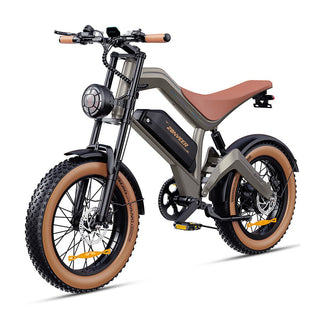
The VM6 is the only pure electric bike: a fat bike with 20 x 4.0-inch off-road tyres, a rear motor rated at 250 W with 750 W peak, 60 Nm, a 48 V 18.2 Ah battery (874 Wh), 7 Shimano gears, full suspension, cruise control and a 150 kg maximum load. Weight 42 kg. The H2 is an electric dirt bike with a 3500 W motor, 140 Nm, a 48 V 23 Ah battery (1104 Wh), a 14-inch front and 12-inch rear wheel, hydraulic disc brakes and a 55–63 km/h top speed, for riders of 140–180 cm. The H3 has the same battery but a mid-mounted 3500 W motor with 220 Nm, climbs 45-degree gradients, has three speed modes (23, 38 and 63 km/h) and weighs 57 kg. The R1 is a tricycle with 750 W rated and 1050 W peak output, 85 Nm, dual 20 Ah batteries (1920 Wh), three hydraulic disc brakes, 5 gears, reverse, a differential and a 200 kg load capacity.
Range and battery in a VIPCOO electric bike
Stated range is 70 km for the H2 and H3, 75 km for the VM6 (53 km in pure electric mode according to the manufacturer) and 100 km for the R1 with both batteries. Count on 60–75 % of that in real-world riding: around 45–55 km for the VM6, 40–50 km for the dirt bikes and 60–75 km for the R1. A low assistance level and steady speed give more, while the throttle, hills, cold and load bring the figure down. All batteries are removable with a key lock, so you can charge indoors. Charging takes 7–9 hours for the H3 and 8–9 hours for the others; the R1 has dual charging ports so both batteries charge at the same time.
Motor, torque and weight
The VM6 with 60 Nm climbs 20-degree gradients and, at 42 kg, is the only model you can lift up a staircase. The R1 has 85 Nm but weighs 91 kg, which in practice calls for a ramp or ground-level storage. The H2 delivers 140 Nm and the H3 220 Nm from its mid-drive motor, with a stated 45-degree climbing ability for the H3 – figures for terrain, not the cycle lane. All four have three riding modes, and the H2 also has reverse assist.
Frame, comfort and brakes
No VIPCOO model folds and none has a step-through frame, so compare the recommended rider height with your own. The VM6 has an aluminium and steel frame, a long moped-style saddle, front and rear suspension, two disc brakes, an IP54 rating and a lock, bell and pump in the box. The H2 and H3 have a hydraulic front fork, a rear shock, two hydraulic disc brakes and IPX4. The R1 has an adjustable front shock absorber, three hydraulic disc brakes, front and rear mudguards and 20-inch off-road tyres on all three wheels. Compare with other brands under electric bikes, electric dirt bikes and tricycles.
Rules in Europe for a VIPCOO electric bike
Under the EU-wide pedelec (EPAC) definition a vehicle only counts as a bicycle if the motor is rated at no more than 250 W, only assists up to 25 km/h and any throttle gives at most 6 km/h. Then you can use the cycle lane without registration, and the helmet rules for cyclists in your country apply. None of the four VIPCOO models meets that. The H2 and H3 have a 3500 W motor and up to 63 km/h, the R1 has 750 W rated and 40 km/h, and the VM6 is rated at 250 W but has 750 W peak output, a 40 km/h top speed and a throttle for pure electric riding. All four are therefore formally speed pedelecs or mopeds, which on public roads typically means registration, insurance, a helmet and a driving licence, with the exact rules varying by country. The adjustable 25 km/h limiter does not automatically turn the vehicle into a pedelec. Without registration, they belong on enclosed private land. Check the EU road rules and safety overview for your country.
Service, warranty and spare parts
Every electric vehicle at Wheelyshop ships with free delivery and a 1-year warranty. Wear parts such as tyres, inner tubes, brake pads and chargers are in our spare parts portal, and the batteries on every model are removable and can be replaced separately. Charge at room temperature and check the brakes and tyre pressure before each season. If you like the brand but want something lighter, we also carry VIPCOO electric scooters.
Frequently asked questions
Is a VIPCOO electric bike legal in Europe?
None of the four models counts as a bicycle under the EU pedelec rules. The H2 and H3 have a 3500 W motor and up to 63 km/h, the R1 has 750 W and 40 km/h, and the VM6 has 750 W peak output, 40 km/h and a throttle. All are therefore formally speed pedelecs or mopeds and on public roads typically require registration, insurance, a helmet and a driving licence, depending on the country – otherwise they are for enclosed private land.
How far does a VIPCOO electric bike go on a charge?
Stated range is 70 km for the H2 and H3, 75 km for the VM6 and 100 km for the R1 with dual batteries. In real-world riding you should count on 60–75 % of that, depending on assistance level, throttle use, hills, load and temperature.
Which VIPCOO model is best for commuting?
The VM6 is the natural choice: the lightest in the collection at 42 kg, fat tyres that absorb bumps, front and rear suspension, 7 gears, cruise control and an 874 Wh battery good for around 45–55 km in practice. Bear in mind that it is formally moped class and needs to be registered for public roads.
Does a VIPCOO electric bike have fat tyres and suspension?
The VM6 has 20 x 4.0-inch fat tyres and suspension both front and rear. The dirt bikes H2 and H3 have a hydraulic front fork and rear shock with 14- and 12-inch off-road tyres respectively, while the R1 tricycle has an adjustable front shock and 20-inch tyres. No model folds.
Are spare parts available for VIPCOO?
Yes. Tyres, inner tubes, brake pads, chargers and other wear parts are in Wheelyshop's spare parts portal, and the batteries on all four models are removable and can be replaced separately. Every electric vehicle also comes with a 1-year warranty.