







Buying guide
Throttle electric bike – 58 models at Wheelyshop
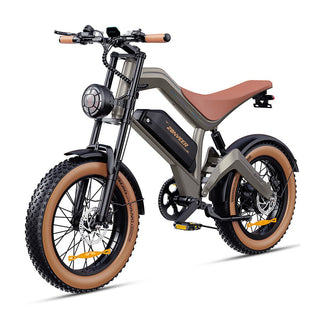
A throttle electric bike has a pure electric mode: you twist or press the throttle and the bike rolls without you pedalling. Most models let you switch freely between pure electric, ordinary pedal assist and a hybrid mode where pedalling and motor work together. The collection gathers the 58 electric bikes and tricycles that have a pure electric mode according to their specification – from light folding city bikes and fat bikes to tricycles for carrying loads. The span is wide: 250–5,000 W rated power, 40–220 km of stated range and 17–91 kg. All electric vehicles ship with free delivery, a 1-year warranty and spare parts that can be ordered.
In short
- 58 models with a pure electric mode – electric bikes and tricycles from ENGWE, DYU, OneSport, KOOLUX, Duotts, Hidoes and Fafrees, among others.
- The throttle gives you speed without pedalling; most also have pedal assist, many have cruise control and nearly all have a removable battery.
- Compact folding throttle electric bike for commuting (DYU, OneSport), fat bike for terrain (ENGWE, Duotts) and tricycle for loads and stability (Hidoes, Fafrees).
- In the EU a bike ridden on the throttle above 6 km/h formally counts as a moped – only models with max 250 W and walk assist up to 6 km/h are pedelec class; more powerful models are vehicles for private enclosed land.
- Wheelyshop: free delivery on all electric vehicles, a 1-year warranty and spare parts for the whole range.
Choosing the right throttle electric bike – a guide
The throttle lets you rest your legs in a headwind or simply enjoy the ride, but it affects range, weight and how the bike is classified in Europe. Below we go through subtypes, technology and rules – and if you want to see every model with pedal assist, the whole electric bike range is in one place.
Throttle electric bike – models and subtypes
Compact and folding: the DYU D3F (250 W, 14-inch, 17 kg, 48 km of stated range, 20 km/h) and DYU C2 (250 W, 16-inch, 40 km, throttle limited to 6 km/h in electric mode) are the easiest to take on the train. The OneSport OT16-2 (250 W, 48 V 15.6 Ah, 120 km of stated range, 20-inch, folding) is a good-value choice with a big battery. Fat bike: the ENGWE M20 (750 W, 48 V 13 Ah, 100 km, limited to 25 km/h) and Duotts F26 Pro with dual motors of 1,500 W in total and 120 km of stated range. Long distance: the KOOLUX X8 with 48 V 65 Ah, 3,120 Wh and 220 km of stated range – the biggest battery in the range. Tricycle: the Hidoes ET1 (750 W, 95 km, folding, 150 kg maximum load) and Fafrees F20 Mate (500 W, 115 km, basket, 180 kg maximum load). You will find more models under tricycles and fat bikes.
Range and battery when you ride without pedalling
The range in the specification usually applies to pedal assist in a low mode. If you ride entirely on the throttle, expect 60–75 % of the stated figure, and even less in a headwind or cold weather. Watt-hours (volts times amp-hours) are the simplest measure to compare: the DYU C2 has 360 Wh, the ENGWE M20 624 Wh, the OneSport OT16-2 749 Wh, the Duotts F26 Pro 960 Wh and the KOOLUX X8 3,120 Wh. The whole collection spans from 120 to 3,120 Wh. If you commute 20 km each way entirely on electric power, 600–900 Wh is a good starting point; for longer rides or heavy loads, 1,000 Wh and up is better. Nearly all models have a removable battery, which makes indoor charging easy, and charging times are typically 4–8 hours.
Motor, weight and performance in pure electric mode
The motor decides how the bike feels when you let go of the pedals. 250 W rated power is enough for flat city riding and gentle hills, 500–750 W gives punch on climbs and with a load, and above 1,000 W you are looking at pure private-land vehicles. Weight follows battery and motor: 17–30 kg for compact models, 30–55 kg for fat bikes and 43–91 kg for tricycles. Many of the more powerful models ship limited to 25 km/h. Four models have dual motors, among them the Duotts F26 Pro and APEFOX RH20 – choose them if you need grip on both wheels in snow or sand.
Comfort and equipment on a throttle electric bike
When you ride without pedalling you sit more still, so suspension, saddle and tyres matter more than on an ordinary bike. 56 models in the range have full suspension and 84 have fat bike tyres that absorb bumps. Cruise control is available on more than 40 models (among them the DYU C6, ENGWE M20 and Duotts F26 Pro) and holds a steady speed without you having to hold the throttle. Hydraulic disc brakes are fitted to 72 models and e-ABS to nine. Rear rack, basket, lights and indicators vary by model – the Fafrees F20 Mate has a basket and indicators as standard and the Hidoes ET1 has a basket. Check the IP rating (IP54 is most common, up to IP67) if the bike will be kept outdoors.
Rules in Europe for a throttle electric bike
The EU definition of a pedelec (EPAC) is clear: a motor of max 250 W rated power, assistance only while you pedal and up to 25 km/h, and throttle only up to 6 km/h (walk assist). A bike that rides on the throttle faster than 6 km/h is therefore formally not a bicycle but a speed pedelec or moped – with requirements for registration, a driving licence, a helmet and insurance on public roads, and the details vary by country. Without registration it may only be ridden on private enclosed land. This also applies to models with a 250 W motor if the throttle works at higher speed, so we never claim that such a model may be ridden on the cycle lane. The DYU C2 is an example of pedelec class: 250 W and a throttle limited to 6 km/h in electric mode. Powerful fat bikes with 750–1,500 W are vehicles for private land and the track. Read the road rules in your country before you choose.
Service, warranty and spare parts
All electric vehicles at Wheelyshop come with a 1-year warranty and free delivery. Spare parts such as batteries, chargers, brakes, tyres and displays are ordered through our spare parts page. Store the battery at room temperature and check brakes and tyre pressure regularly – a bike that is ridden a lot on the throttle wears its brakes more than one that is pedalled.
Frequently asked questions
Which throttle electric bike is best?
It depends on how you ride. For commuting and public transport the folding DYU D3F (17 kg) and OneSport OT16-2 (120 km of stated range) are good choices, for terrain a fat bike such as the ENGWE M20 and for long distances the KOOLUX X8 with 3,120 Wh. If you need stability and load capacity, the tricycles Hidoes ET1 and Fafrees F20 Mate are the strongest.
Is a throttle electric bike legal in Europe?
Only if the throttle works up to 6 km/h and the motor is max 250 W – then it is a pedelec and counts as a bicycle. If it rides on the throttle at higher speed it is formally a speed pedelec or moped and requires registration, a driving licence, a helmet and insurance on public roads, with the exact rules varying by country. Without registration it may only be used on private enclosed land.
How far does an electric bike go on one charge without pedalling?
Expect 60–75 % of the stated range, which is usually measured with pedal assist. A model with 600–700 Wh typically manages 40–60 km entirely on the throttle on flat ground, and the KOOLUX X8 with 3,120 Wh goes considerably further. Cold weather, headwind, hills and heavy loads reduce the figure.
Is a throttle electric bike suitable for commuting?
Yes, if you want to be able to rest your legs on parts of the route. Choose a model with at least 600 Wh, cruise control and a removable battery so you can charge at work. Bear in mind that commuting on public roads with the throttle above 6 km/h requires the vehicle to be registered as a moped.
Are there spare parts and accessories for throttle electric bikes?
Yes, batteries, chargers, brakes, tyres and displays are ordered through our spare parts page, and all electric vehicles come with a 1-year warranty. Helmets, locks and bags are among the accessories.