
























Buying guide
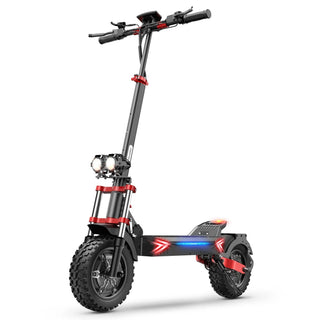
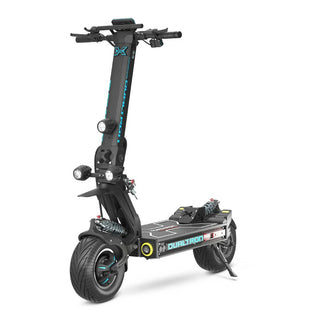
Off-road electric scooter – all-terrain e-scooter with knobbly tyres and suspension
The off-road collection at Wheelyshop brings together electric scooters with pneumatic off-road tyres and front and rear suspension – from light trail models under 25 kg to dual-motor Kaabo Wolf Warrior, Teverun and Nanrobot models with up to 200 km of claimed range. Compare weight, wheel size, range and brakes directly in the filter and find the model that handles your terrain. Every electric scooter comes with free delivery, a 2-year warranty (in addition to your statutory rights) and the option to pay in instalments.
In short
- An off-road electric scooter here means pneumatic trail tyres and dual suspension – not that every model handles all terrain. Check the manufacturer's intended use.
- Start with the surface you actually ride on: mostly tarmac with some gravel calls for something different from forest trails and muddy tracks.
- The collection spans roughly 19.5 to 83 kg. Choose a weight class according to how the vehicle will be stored and moved.
- Pneumatic tyres need the right pressure and regular checks – too little pressure hurts both handling and range.
- Powerful off-road models are often built for more than the 20–25 km/h and 250–500 W allowed on public roads in most EU countries, and may then only be ridden on private land or in enclosed areas. Always check your national rules.
How to choose the best off-road electric scooter 2026
Knobbly tyres and suspension make a big difference on gravel, roots and broken tarmac, but the off-road label does not tell you everything about grip, braking distance, ground clearance, wheel size or water resistance. Start from three questions: what surface do you actually ride on, how often does the vehicle have to be moved by hand, and how much range margin do you need? Then narrow down the models using the answers as your filter.
1. What is an off-road electric scooter?
Every model here has pneumatic off-road tyres and front and rear suspension according to the product information. The tyres' aggressive tread gives grip on looser surfaces and the suspension absorbs shocks. Why air-filled tyres are usually the first choice on gravel and roots is explained in our guide to solid vs pneumatic tyres. The differences between models lie in wheel size (often 10–13 inches), ground clearance, suspension type, brakes, motor power and the terrain the manufacturer allows. Read the usage limits in the manual – the category does not replace them.
2. All-terrain electric scooter for trails, gravel or city – start with your surface
- Tarmac with some gravel and kerbs: a lighter off-road model with 10-inch tyres gives comfort without unnecessary weight.
- Gravel roads and trails: larger wheels, higher ground clearance and dual suspension with longer travel make a real difference.
- Mud, sand and hilly forest: calls for dual motors, powerful brakes and a frame that takes the strain – plus a plan for cleaning after every ride.
If most of your journey is smooth tarmac, low weight and easier storage may matter more than the off-road label – in that case you will find more options among all electric scooters.
3. Light or powerful off-road electric scooter – choose a weight class
- Under 25 kg: easiest to lift and load, often 30–70 km of claimed range. Ideal when the vehicle is sometimes carried.
- 25–35 kg: the widest choice, often 50–110 km. Rolled rather than carried, but can be lifted when needed.
- 35–50 kg: more battery and power, often 90–120 km. Plan for ground-level storage.
- 50–83 kg: specialised heavy models with up to 200 km of claimed range. Requires a plan for storage, charging and transport to servicing.
4. Knobbly tyres on an electric scooter – pressure and maintenance
Pneumatic off-road tyres need the right pressure and regular checks for wear and damage. Too little pressure hurts handling, reduces range and increases the risk of snakebite punctures against edges, while too much pressure reduces grip. Follow the model's recommended pressure, check the tyres after rides over rocks and roots and replace them with the correct size. If you want to skip tyre pressure altogether there are puncture-proof electric scooters, and the right tyres and inner tubes for your model are among our electric scooter tyres. Tyre pressure, speed and charging habits all matter – see our guide on how to increase your range.
5. Suspension, brakes and lighting on an all-terrain e-scooter
Front and rear suspension is common to the whole selection, but type, travel and adjustability vary. Hydraulic shock absorbers and adjustable preload give the best control on rough terrain. The brakes are at least as important: hydraulic disc brakes give shorter stopping distances and more consistent power than mechanical ones when the vehicle is heavy and the surface is loose. Also check lighting, IP rating against water and dust, and maximum load – and expect real-world range on rough terrain to be noticeably shorter than claimed. If range is your main priority there are long range electric scooters, and if you want to ride seated there are electric scooters with seat. A model's IP rating tells you how well sealed it is – we explain the numbers in our guide to riding an electric scooter in the rain.
6. Rules for off-road electric scooters
On public roads, cycle paths and terrain open to the public, the same rules apply as for other e-scooters: in most EU countries e-scooters are limited to 20–25 km/h and 250–500 W on public roads; many countries require a minimum age (often 14), third-party insurance and/or a plate, and some require a helmet. Many off-road models have considerably more power and speed and may then only be ridden on private land or in enclosed areas with the landowner's permission. Remember that access to nature does not automatically include the right to ride motorised vehicles off-road. Always check your national rules before riding – read more at Your Europe and check the exact version, ride mode and documentation on the product page.
Best off-road electric scooter – final comparison
When you are down to two models, write down the same details for both:
- Wheel size, tyre size and ground clearance
- Front/rear suspension type and whether it is adjustable
- Brake type, motor power and number of motors
- Weight, folded dimensions and maximum load
- Claimed range, battery capacity in Wh, charging time and IP rating
Mark any missing data rather than assuming a value, and choose the model whose overall package suits your surface, storage and servicing. Wear parts and tyres for every model are in the spare parts portal, and the current best-selling models are in our electric scooter top list.
Frequently asked questions
What is an off-road electric scooter?
In this collection it means electric scooters with pneumatic trail tyres and front and rear suspension. That makes them suitable for gravel, broken tarmac and trails, but each model has its own limits for terrain, water and load, which are set out in the manual.
Can I ride an off-road electric scooter in the forest or in the cycle lane?
On cycle paths and public roads the vehicle must meet your country's limits – in most EU countries 20–25 km/h and 250–500 W, often with a minimum age, insurance or a plate. More powerful models may only be ridden on private land or in enclosed areas with the landowner's permission, and access to nature does not include motorised vehicles off-road. Always check your national rules.
What tyre pressure should I run in off-road tyres?
Follow the manufacturer's recommendation, often 2.5–3.5 bar for 10–11-inch tyres. Lower pressure gives more grip on loose surfaces but increases the risk of punctures against edges and reduces range. Check the pressure weekly and after rides over rocks and roots.
How far does an off-road electric scooter go on rough terrain?
Gravel, mud, hills and knobbly tyres increase rolling resistance considerably, so expect the range on rough terrain to be noticeably shorter than the manufacturer's figure, which is measured on a smooth surface. Choose a model with a good margin and keep the right tyre pressure to get the most out of it.
How do I look after the e-scooter after mud and water?
Wipe the vehicle down, keep the charging port and display dry and check the tyres, brakes and fixings. Do not use a pressure washer on bearings, the motor or electronics. Check the IP rating on the product page – it tells you what the model tolerates, not that it is waterproof.