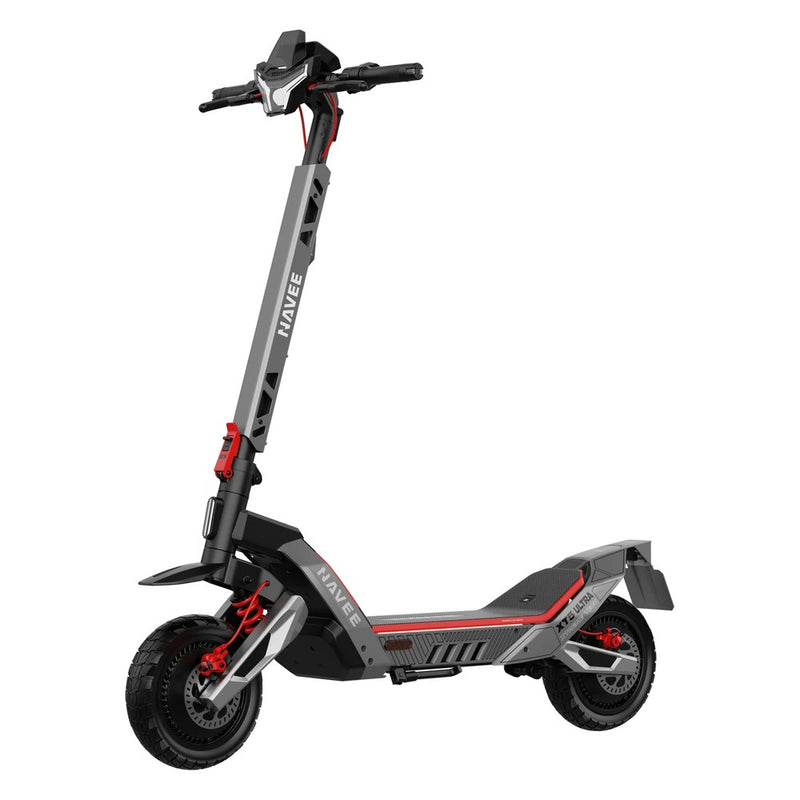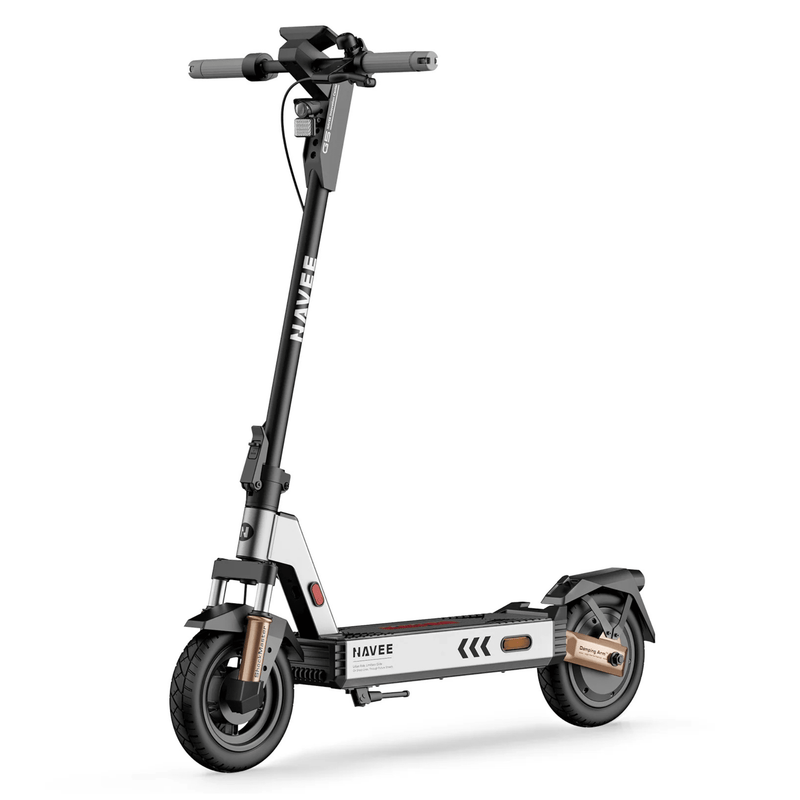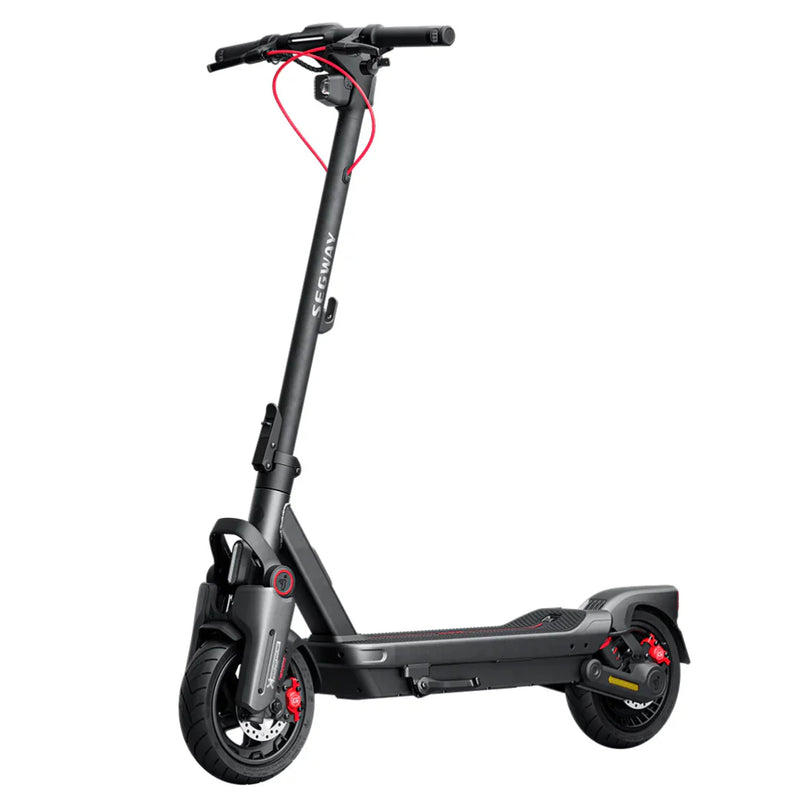

An off-road electric scooter has to cope with what an ordinary city model cannot: gravel shifting under the tyres, roots, potholes and hills where the wheel wants to spin. That takes knobbly pneumatic tyres, suspension on both wheels and a motor with power in reserve. Here we compare six models from our range, with figures from our own product data, and go through what really decides how an electric scooter behaves once the tarmac ends.
Which off-road electric scooter? The short answer
For gravel roads and park paths, a rear-wheel drive model with 10-inch off-road tyres and dual suspension is enough: iScooter W10, iENYRID M4 Pro S+ Max or KuKirin G2. For steep hills, loose gravel and heavier riders, dual motors give better grip: OOTD T10 Pro, KuKirin G2 Master or iScooter W12. Always weigh power against weight.
What makes an electric scooter an off-road model?
There is no official definition, but three things recur on every model that works on uneven ground.
Knobbly pneumatic tyres
The tyre is the only contact with the ground. An air-filled tyre moulds to the surface and bites into gravel in a way a hard, solid tyre does not. TechRadar sums it up in its guide to the best electric scooters: pneumatic tyres give better stability, cushioning, climbing and traction than solid ones, while solid tyres need less upkeep and cannot puncture. We go through the difference between the tyre types in the guide to solid vs pneumatic tyres.
Suspension front and rear
Suspension is not only about comfort. It keeps the wheels on the ground over bumps, and a wheel in the air neither drives nor brakes. On a smooth cycle path you can get by without it; on a rutted gravel road you will soon wish you had picked a model with suspension, pneumatic tyres or both.
Larger wheels
Small wheels get caught in what larger wheels roll over. In its article on scooter safety, TechRadar notes that large air-filled tyres make for a comfortable, stable ride, and that disc or drum brakes work best, since electric brakes do not deliver the strongest stopping power. All six models here have wheels of 10 or 11 inches.
Comparison table: six off-road electric scooters
| Model | Drive | Range | Top speed | Weight | Max load | Price class |
|---|---|---|---|---|---|---|
| iScooter W10 | Rear wheel, 1 200 W | 60 km | 50 km/h | 24.8 kg | 150 kg | under 750 € |
| iENYRID M4 Pro S+ Max | Rear wheel, 800 W | 75 km | 45 km/h | 25.4 kg | 150 kg | 750–1 100 € |
| KuKirin G2 | Rear wheel, 800 W | 55 km | 45 km/h | 26 kg | 120 kg | 750–1 100 € |
| OOTD T10 Pro | Dual motor, 1 800 W | 70 km | 65 km/h | 40.5 kg | 150 kg | 750–1 100 € |
| iScooter W12 | Dual motor, 3 000 W | 100 km | 70 km/h | 37.8 kg | 150 kg | 1 100–1 500 € |
| KuKirin G2 Master | Dual motor, 2 000 W | 70 km | 60 km/h | 33.5 kg | 120 kg | 1 100–1 500 € |
Source: Wheelyshop product data, November 2026. Range and top speed are the figures stated for each model, and motor power is the nominal rating. The price classes refer to the regular price in November 2026 and change during promotions. Top speed applies to riding on enclosed private land; what you may ride on public roads is covered in our overview of electric scooter laws in Europe.
Who is each model for?
iScooter W10
The lightest and cheapest model in the comparison: 24.8 kg, a 1 200 W rear motor and 10-inch off-road tyres. It also has the highest water rating, IPX6, and a max load of 150 kg. It suits you if you mostly ride gravel roads and park paths and want to be able to lift the scooter into a car. The battery is 720 Wh.
iENYRID M4 Pro S+ Max
The model with the largest battery among the rear-wheel drive ones, 960 Wh, and a stated range of 75 km. With an 800 W motor it is not the strongest on hills, but 25.4 kg and a max load of 150 kg make it a good choice for longer rides on gravel and forest roads in moderate terrain.
KuKirin G2
A proven all-rounder: an 800 W rear motor with 1 200 W peak power, dual suspension, two disc brakes with E-ABS and IP54. It suits you if you commute on mixed surfaces and want a model that can take the shortcut across the gravel yard. The max load is 120 kg, so count your luggage in. You can see how it measures up against its sibling models in the comparison KuKirin G2 Pro vs G4 vs G2 Master.
OOTD T10 Pro
The cheapest route to dual motors in the comparison. Two 900 W motors, 11-inch tyres, hydraulic disc brakes and a 1 217 Wh battery. The stated climbing ability is 35 degrees, the highest of the six. It suits you if you have steep hills and do not need to lift the scooter: it weighs 40.5 kg.
iScooter W12
The most powerful model here, and the one with the longest range: two 1 500 W motors, a 1 300 Wh battery and a stated range of 100 km. It has 11-inch tyres and a max load of 150 kg. It suits you if you ride long routes on forest tracks and want power left at the top of the hill. The weight is 37.8 kg.
KuKirin G2 Master
Dual motors in a lighter package: 33.5 kg, two 1 000 W motors and a 1 082 Wh battery. It is the most manageable of the three dual motor models and suits you if you want the grip of two driven wheels but still a scooter you can handle. The max load is 120 kg.

Rear-wheel drive or dual motors off-road?
On hard-packed gravel and dry paths, one motor in the rear wheel is enough. Your weight rests on the rear wheel, so the drive wheel is pressed firmly into the ground. It is when the surface gets loose or the hill gets steep that two motors make a difference: the drive is split between two tyres, and if one loses grip the other keeps pulling. Writing about one dual motor model, the reviewer at ERideHero makes the same point: a route with serious hills is where the second motor proves its worth.
The price is weight. The three rear-wheel drive models in the comparison weigh 24.8–26 kg, the three with dual motors 33.5–40.5 kg. Two motors also draw more current when both are working, and the same ERideHero review calls the range modest for the size of the battery for exactly that reason. We explain how the drive types differ in detail in the guide front-wheel or rear-wheel drive electric scooter, and all the twin-motor models are under dual motor electric scooters.
Off-road range: plan for half
The stated range is measured on flat, smooth roads at low speed. Off-road, more energy goes into hills, soft ground and constant braking. The tester at Tom's Guide writes that, living in a hilly area and weighing close to 90 kg, he typically gets about 50–60 per cent of the advertised range.
Do the sums like this: the KuKirin G2 states 55 km, so around 28–33 km off-road. The iScooter W12 states 100 km, so 50–60 km. If you plan a 25 km loop through hilly woodland you have a margin with all six models, but with the smaller 720 Wh batteries you will get home with little to spare. If you want to compare models fairly, watt-hours are a better figure than the stated distance. There is more on that in the guide to electric scooters with a 50 km range.
Weight and max load: what shapes daily use
Off-road models are heavy. Tyres, suspension, frame and battery all add up, and none of the six is something you carry up a flight of stairs. Under 27 kg you can lift the scooter into an estate car; over 33 kg you need a ramp or a ground-floor storeroom. You can see how weight varies between scooter types in the guide to how much an electric scooter weighs.
The max load covers rider plus luggage. Four of the models state 150 kg and two state 120 kg. Off-road, the frame and suspension are stressed harder than on tarmac, so keep a margin: if you weigh 100 kg with a rucksack, the models with a 150 kg max load are the more relaxed choice.
Water, mud and dust
The models in the comparison are rated IPX4, IP54 or IPX6. That means protection against splashes, and for IPX6 against jets of water, but none of them is built to ride through deep puddles or to be cleaned with a pressure washer. After a muddy ride: wipe the scooter with a damp cloth, let it dry indoors and only charge it once the charging port is dry. We explain what the ratings mean in the guide to electric scooters in the rain.
Common off-road mistakes
- Tyre pressure too high. Rock-hard tyres bounce on gravel. Stay in the lower part of the pressure range the manufacturer states when you ride on loose ground.
- Braking in the bend. Finish braking before you turn. On gravel, a braked wheel loses grip quickly.
- Standing with straight legs. Bend your knees and let your legs work as suspension; it keeps you balanced over bumps.
- Trusting the stated range. Plan for half the distance and turn back in good time.
- Skipping the check afterwards. Vibration loosens bolts. Check the handlebar, the folding mechanism and the wheel axles after every off-road ride.
- Riding without protection. A helmet is the minimum; gloves and knee pads make a big difference when the surface is gravel.
How to prepare for your first off-road ride
Start on a gravel road you know, not on a trail. Ride in the lowest speed mode until you know how the scooter reacts when the rear wheel slides a little. Check the tyre pressure, tighten the folding mechanism and test both brakes before you set off. Charge fully and bring your phone, because a flat 35 kg electric scooter is heavy to push home.
Match the ground to the scooter. The three rear-wheel drive models are at home on gravel roads, park paths and packed forest roads. The three with dual motors cope with steeper and looser ground, but no electric scooter is built for scree, deep mud or jumps. Think of others too: slow down when you meet people on foot, and keep to roads and paths where riding is allowed.
Warranty, spare parts and the box
Every electric scooter at Wheelyshop comes with a 2-year warranty. Keep the original box: if the scooter needs to be sent in for repair it must be packed in its original box, and we do not send out new boxes. Off-road riding wears tyres and brake pads; if you need spare parts, contact our customer service with the exact model name.
You will find more models built for gravel and forest tracks among our off-road electric scooters, and the full range is under electric scooters.