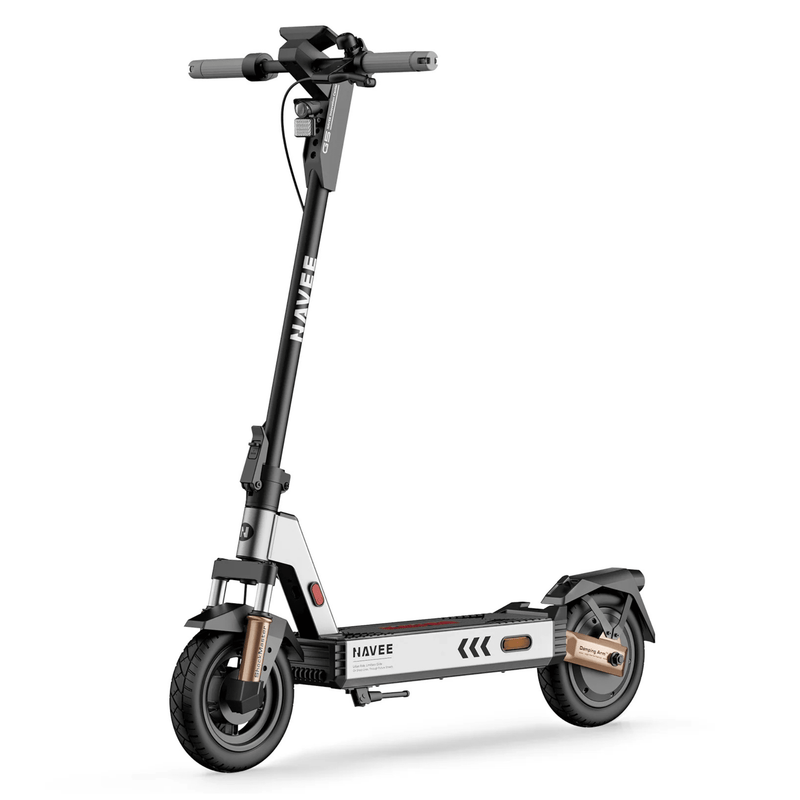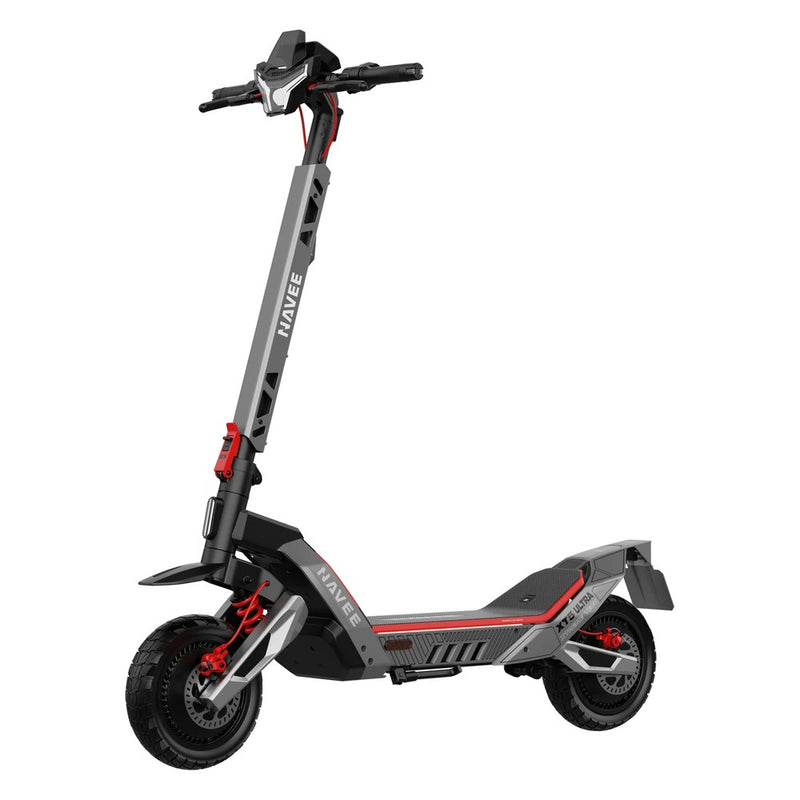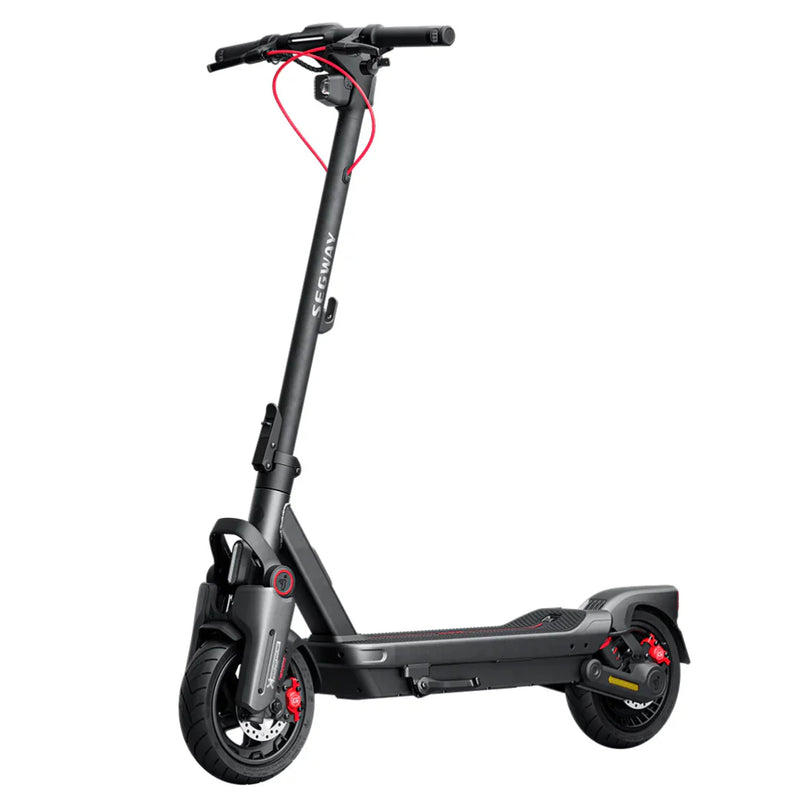

Front-wheel or rear-wheel drive electric scooter: it is a question most people never think about until the wheel spins on a wet uphill stretch. The motor sits in the hub of one of the wheels, or in both, and its position decides how the scooter finds grip, how it behaves in bends and how much it weighs. Here we go through the three drive types, what separates them in practice and which one suits the way you ride.
Front-wheel or rear-wheel drive? The short answer
Choose rear-wheel drive if you ride on hills, in the rain or on gravel: your weight rests on the rear wheel, so the driven wheel gets the best grip. Front-wheel drive is enough for short trips on dry, flat tarmac and mostly comes on light, cheaper models. Dual motors drive both wheels and suit steep hills and rough ground, but weigh and cost more.
How the drive works on an electric scooter
An electric scooter has no chain and no gearbox. The motor is a hub motor built into the wheel itself, and when you open the throttle it turns the wheel directly. That keeps the design simple and almost maintenance-free, but it also means that all the drive force has to reach the ground through one small tyre.
How much force that tyre can transfer depends on two things: how well it bites into the surface and how much weight is pressing it down. This is where the position of the motor comes in. On an electric scooter you stand with most of your weight over the rear wheel, and when you accelerate or ride uphill even more weight shifts backwards. The rear wheel is pressed into the ground just as the motor pulls hardest, while the front wheel gets lighter.
Front-wheel drive electric scooter: light and simple
Front-wheel drive means the motor sits in the front wheel and pulls the scooter forward. In a sample of one hundred electric scooters from our range, this drive type is found almost only on light entry-level models: they weigh from 10.5 kg, have motors of 250–500 W and usually come without suspension.
Advantages of front-wheel drive
- Low weight and low price. Motor, controller and cables are grouped at the front, which keeps the build simple.
- Easy to push and carry. The weight sits close to the stem, so the scooter is easy to wheel alongside you and to lift by the handlebar.
- Simple rear wheel. The rear wheel only carries a brake, so changing a tyre at the back is quicker.
Drawbacks of front-wheel drive
- Less grip when it is slippery. The Italian consumer organisation Altroconsumo writes that a front-wheel drive scooter can be less stable than a rear-wheel drive one, especially when grip is poor, because the rider's weight rests mainly on the rear wheel.
- Weaker on hills. Riding uphill unloads the front wheel even further, and a lightly loaded drive wheel spins more easily.
- More sensitive steering. If the front wheel spins in a bend, it affects the steering straight away.
Rear-wheel drive electric scooter: better grip
On a rear-wheel drive electric scooter the motor sits in the rear wheel and pushes the scooter forward. It is the most common layout in our range and the one you find on most commuter models and upwards. In the same sample, the rear-wheel drive models weigh 17–42 kg and have motors of 350–2 000 W, a much wider span than the front-wheel drive ones.
Advantages of rear-wheel drive
- Grip when you need it. Your weight presses the drive wheel down when you set off and on climbs, so the power reaches the ground.
- Calmer steering. The front wheel only has to steer and roll, which feels more stable at higher speeds.
- Copes with more power. That is why the stronger motors almost always sit at the back.
Drawbacks of rear-wheel drive
- Heavier rear end. The scooter is tail-heavy when you push it and when you lift it by the handlebar.
- Fiddlier rear tyre change. The motor cable has to be disconnected before the rear wheel can come off.
- Sliding under hard throttle. With a strong motor, the rear wheel can let go in a wet bend if you accelerate too early.
All rear-wheel drive models are gathered under rear-wheel drive electric scooters.
Dual motors: drive on both wheels
With dual motors there is a hub motor in each wheel. The power is shared between two tyres, so each tyre has less to transfer and the risk of wheelspin drops. You notice it most on steep hills, on gravel and with a heavy load. Writing about one dual motor model, the reviewer at ERideHero puts it this way: a commute with serious hills is where two motors prove their worth.
The price is weight and consumption. In our sample, the dual motor models weigh from 26 kg, and often closer to 40 kg, and all of them have suspension front and rear. The same ERideHero review notes that the range is modest for the size of the battery, because two motors use more power. On many models you can switch one motor off with a button and ride on a single motor when you want to save battery. You will find the selection under dual motor electric scooters.
Comparison: three drive types side by side
| Drive type | Weight | Motor power | Grip on hills and in the wet | Suits |
|---|---|---|---|---|
| Front-wheel drive | 10.5–33 kg, mostly around 15 kg | 250–500 W | Weakest of the three | Short trips on flat tarmac, carried often |
| Rear-wheel drive | 17–42 kg, mostly around 24 kg | 350–2 000 W | Good | Commuting, hills, mixed surfaces |
| Dual motor | 26–83 kg, mostly around 39 kg | 700 W and up, split between two motors | Best of the three | Steep hills, gravel, heavy rider |
Source: Wheelyshop product data, November 2026, for a sample of one hundred electric scooters. Weight and motor power are the figures stated for the models; the grip assessment is our own. What motor power and speed you may use on public roads is covered in our overview of electric scooter laws in Europe.
Grip in rain, on gravel and on hills
The difference between the drive types is small on dry tarmac and grows as grip gets worse. Electric scooters have small wheels, and small wheels are sensitive: a scattering of gravel that merely crunches under a shoe or a bicycle tyre can be enough to unsettle a scooter.
On surfaces like that you want the drive on the wheel that carries the most weight, which is the rear wheel. Three situations where it shows:
- Setting off uphill. The front wheel is unloaded, and a front-wheel drive scooter can spin before it gets going. Lean forward and go easy on the throttle.
- Wet leaves, manhole covers and painted lines. A drive wheel that loses grip at the front pulls the handlebar sideways. If the rear wheel loses grip, you can usually recover by easing off the throttle.
- Gravel and forest tracks. This is where dual motors make the biggest difference, because two tyres share the work. Models built for it are among our off-road electric scooters.
Do you ride all year round? Then tyres and speed matter more than the drive type. We cover that in the guide to riding an electric scooter in winter and in the guide to electric scooters in the rain.
Tyres, suspension and brakes matter just as much
The drive type is only one part of how a scooter handles. TechRadar writes in its guide to the best electric scooters that pneumatic tyres offer better stability, cushioning, climbing and traction than solid ones, while solid tyres need less maintenance and cannot puncture. Suspension works towards the same end: on anything but perfectly smooth ground, a model sprung at both the front and the rear keeps its wheels in contact with the surface.
A front-wheel drive model with wide pneumatic tyres can therefore have better grip than a rear-wheel drive one with hard, narrow tyres. So always compare three things besides the drive type:
- Tyres: pneumatic tyres of at least 10 inches give the largest contact patch. We explain the differences in the guide to solid vs pneumatic tyres.
- Suspension: keeps the wheels on the ground over bumps, which is a precondition for grip.
- Brakes: ideally a mechanical brake on each wheel. The electronic motor brake only acts on the wheel where the motor sits.

Weight, price and range: what does the drive cost?
Front-wheel drive is the cheapest to build, which is why the front-wheel drive models in our sample start in the lowest price class, under 500 € (November 2026). Rear-wheel drive starts at roughly the same level but stretches to over 2 000 €. Dual motors start in the 750–1 100 € class.
Weight follows the same ladder. If you carry the scooter up stairs or take it on the train, a light front-wheel or rear-wheel drive model under 20 kg is realistic. A dual motor model of 35–40 kg is not something you carry; you roll it into a ground-floor storeroom.
Range depends more on the size of the battery, your weight and your speed than on where the motor sits. Two motors do draw more at every start, though, and the round-up at Tom's Guide points out that hills drain the battery faster than the stated range suggests. In a separate piece of buying advice from Tom's Guide, the tester reckons 250–300 W is enough on flat ground, but that you want at least 500 W if your route has plenty of hills. We work out how much power you actually need in the guide to how many watts an electric scooter needs.
How to tell which drive a model has
On our product pages the drive type has its own line in the specification: front-wheel drive, rear-wheel drive or dual motor. Independent reviews help too: the Tom's Guide round-up states for each scooter it has tested whether it has front-wheel or rear-wheel drive. If you have the scooter in front of you, there are three quick signs:
- The hub. The wheel with the motor has a thick, enclosed hub. The wheel without a motor has a slim hub or a visible brake disc.
- The cable. A thick cable enters at the axle of the motor wheel.
- The motor power. If the specification says 1000 W x2, for example, there are two motors.
Common mistakes
- Looking only at watts. 500 W at the front does not give the same pull on a wet hill as 500 W at the back.
- Buying dual motors for a flat city commute. You pay in weight and range for power you never use.
- Full throttle from a standstill. Whatever the drive type, the wheel spins most easily at the start. Kick off first and open the throttle gently.
- Forgetting tyre pressure. An over-inflated tyre has a smaller contact patch and less grip; an under-inflated one rolls heavily.
- Standing too far back on a front-wheel drive model. Move your weight forward on hills, so the drive wheel has more to bite with.
How to choose: three questions
1. What does your route look like? A flat cycle path in town suits every drive type. If you have a long hill, a gravel road or cobbles on the way, you should choose rear-wheel drive.
2. Will you carry the scooter? If you carry it every day, weight matters most, and that puts you among the light single-motor models. If it lives in a garage, you can choose freely.
3. How much do you weigh with luggage? If you are over 100 kg or ride with a heavy rucksack in hilly country, a powerful rear motor or dual motors are worth the money.
A worked example: you commute 6 km each way with a 300-metre hill and weigh 85 kg. A rear-wheel drive model with 500 W or more and pneumatic tyres handles that with room to spare. You do not need dual motors, and a light front-wheel drive model of 250–350 W will lose speed on the hill and may spin when it rains.
Warranty and service
Every electric scooter at Wheelyshop comes with a 2-year warranty, regardless of drive type. Keep the original box: if the scooter needs to be sent in for repair it must be packed in its original box, and we do not send out new boxes. If you are unsure which drive a particular model has, or need a spare part for a motor wheel, contact our customer service with the exact model name.
If you want to see how the drive type plays out on properly rough ground, we have compared six models in the guide to the best off-road electric scooter. The full range is among our electric scooters.