
In much of Europe, winter means more rain, slush and the odd frosty morning than deep snow – and it's that first icy commute that catches people out. You can keep riding an e-scooter or e-bike right through it, but winter punishes what summer forgives: too much speed, a hard grab of the front brake and a battery left out in the cold. Here's what actually helps – and when it's smarter to leave it parked.
Can you ride an electric scooter in winter?
Usually, yes. On cleared and gritted cycle lanes, in packed snow and in slush you'll be fine if you slow down, brake early and gently, and have tyres, lights and clothes for the weather. Check your manual first, though: some manufacturers advise against riding in snow or on wet or icy roads – Segway-Ninebot does for its ES series, for example. Ride anyway in weather your model isn't made for, and water damage may not be covered by the warranty. The e-bike has an easier time than the e-scooter thanks to bigger wheels and studded tyres in most sizes. The line is black ice, freezing rain and deep, loose snow. Then the e-scooter stays at home, and so does the e-bike unless it has studded tyres.
E-scooter or e-bike – the difference on snow and ice
Same road, different vehicles. This is how they compare in practice:
| What | E-scooter | E-bike |
|---|---|---|
| Wheels | 8.5–10 inches, sometimes 11–12 – thrown by ice ruts, frozen tyre tracks and grit | Big wheels that roll over ruts and bumps more easily |
| Studded tyres | Available for some models, mostly in 8.5 and 10 inches | Available in most sizes, including reinforced e-bike versions |
| Staying warm | You stand still in the wind – hands and feet get cold first | You pedal a little, but with the motor helping you don't really warm up |
| Braking | Short wheelbase and a lot of weight over the front when you brake | Heavy bike that needs more distance to stop |
Small wheels are the e-scooter's weak spot even without snow. Loose grit that a bike rolls straight over can make them twitchy, and winter adds the grit left behind after a thaw, ice ruts and frozen tyre tracks. The e-bike has different problems. A weight of 25 kg or more isn't unusual, so it slides away more easily in a corner – and, as BikeRadar's winter commuting guide points out, its extra mass takes more force and more distance to stop; some e-bike systems now add anti-lock brakes for extra safety. For year-round riding, that's a point in the e-bike's favour – we weigh up the rest in electric scooter vs e-bike.
How to ride in snow, slush and ice
Most of it comes down to not surprising your tyres. A tyre asked to do one thing at a time – roll, brake or turn – keeps its grip far longer than one asked to do all three at once.
- Slow down and leave more space. Stopping distances get much longer on snow and ice, and you want time to roll off rather than slam on the brakes. Cycling UK's icy-road advice boils it down to smooth, controlled braking and no sudden steering.
- Brake early, gently and in a straight line. Brake before the corner, not in it. BikeRadar's snow-riding tips say to lean on the rear brake more than the front, because a rear-wheel slide is easier to catch. On an e-scooter with one brake per lever, use both gently and let the rear do most of the work. Some models have one lever for both wheels or electronic ABS – then it's simply smooth and even. Lock the front wheel on ice and you're down in a second.
- Get to know the motor brake. On many e-scooters the motor brakes one wheel when you pull the lever or let go of the throttle. Feel how hard it bites as you roll off. On some models you can set its strength in the app, and a softer setting is easier to handle when it's slippery.
- Go easy on the throttle and pick a calm mode. A spinning drive wheel loses grip. Ride the e-scooter in eco mode and the e-bike on a low assist level, especially when you pull away.
- Stay upright through corners. Slow down before the turn, lean as little as you can, and neither brake nor accelerate halfway round.
- Avoid anything slipperier than the rest: painted lines and zebra crossings, drain and manhole covers, metal plates, tram tracks and cobbles. Stay in the cleared part of the lane or cycle path, away from the edge where slush collects and freezes. Grit on ice gives grip, but loose grit on bare tarmac is slippery for small wheels, especially in a thaw.
- Expect ice where the sun doesn't reach – in the shade and on bridges – and take hills extra carefully. The bottom of a hill is often colder than the top.
- If you hit black ice: steer and brake as little as possible and let the vehicle roll through. On the e-bike, dropping the saddle a little for winter makes it easier to get a foot down.
- Stand loose on the e-scooter. Knees slightly bent, one foot a little behind the other and both hands on the handlebar. That way your legs soak up the ruts, not your arms.
When to leave the e-scooter at home
Cycling UK puts it plainly: if you don't feel comfortable riding on icy roads, you never have to. Skip the ride when
- there's black ice or freezing rain – the e-scooter whatever its tyres, the e-bike unless it has studded tyres
- there's more than a few centimetres of loose snow or deep slush – small wheels plough instead of rolling
- your model's manual advises against snow or wet, slippery roads, as Segway-Ninebot's does for the ES series
- it's colder than the lowest riding temperature in your manual – for many models around −10 °C. The battery can cut out mid-ride, and the Xiaomi 6 Max even has its own error codes for a battery that's too cold – see what the Xiaomi error codes mean
- you don't feel safe. Then the bus or a walk is the right call that day.
An e-bike on studded tyres copes with more, but the same goes for it: ride for the conditions in front of you, not for how it usually goes.
Studded tyres and tyre pressure – what to know
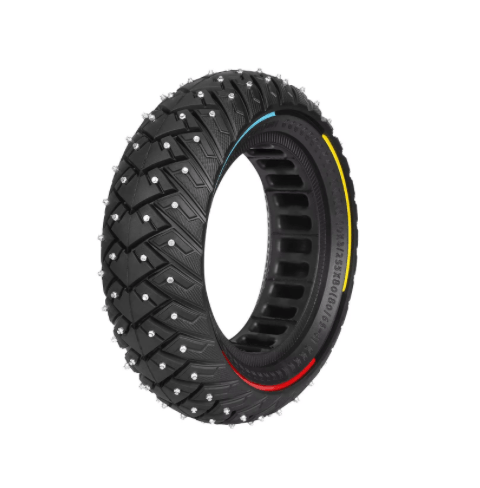
What really grips on ice is studs: the steel pins bite into the surface where plain rubber just slides. If you only fit one studded tyre, put it on the front.
- Fit them before the ice arrives and run the studs in on bare tarmac for a few dozen kilometres before they have to work on ice. Check at the same time that the new tyre doesn't rub on the mudguard – the studs make it wider.
- Take it easy on clear roads. On dry or wet tarmac, studded tyres grip less when you corner or brake, and the studs wear quickly.
- Pneumatic tyres: don't pump them up hard for extra grip. It works the other way round. Cold lowers the pressure, so check it more often. On ice, slightly lower pressure puts more studs on the surface, and on days without ice you can add a little air again – that's what Cycling UK's winter tyre advice recommends. Stay between the minimum and maximum marked on the sidewall, because too little pressure in a tubed tyre soon means a pinch flat. Solid and honeycomb tyres have no air to adjust.
- E-scooter: check our winter accessories to see whether there are studded tyres for your model – usually 8.5 or 10 inches. Compare the full size on the sidewall before you order. Home-made cable ties round the tyre – a classic forum tip – snap easily and only work on wheels without rim brakes. Ready-made anti-slip straps – studded bands that go round the tyre and rim – give some grip, but check that they suit your wheel and brakes. Studded tyres still grip best on ice.
Which tyre type suits you the rest of the year – tubed, tubeless or puncture-proof – we compare in solid vs pneumatic e-scooter tyres. Solid and honeycomb tyres grip less in the wet. If the motor sits in the wheel that's getting the studded tyre, our walk-through on changing an electric scooter tyre shows you how to deal with the motor cable.
The battery in the cold – three habits that go a long way
A cold battery isn't broken; it simply hands over less energy until it warms up again. Segway-Ninebot's ES manual says range and performance can drop below 0 °C and recover once the temperature rises. There's a catch, though: the London Fire Brigade warns that repeatedly exposing a battery to freezing temperatures can lead to permanent capacity loss. So the recovery only holds if the battery isn't left out in hard frost for long. In everyday use:
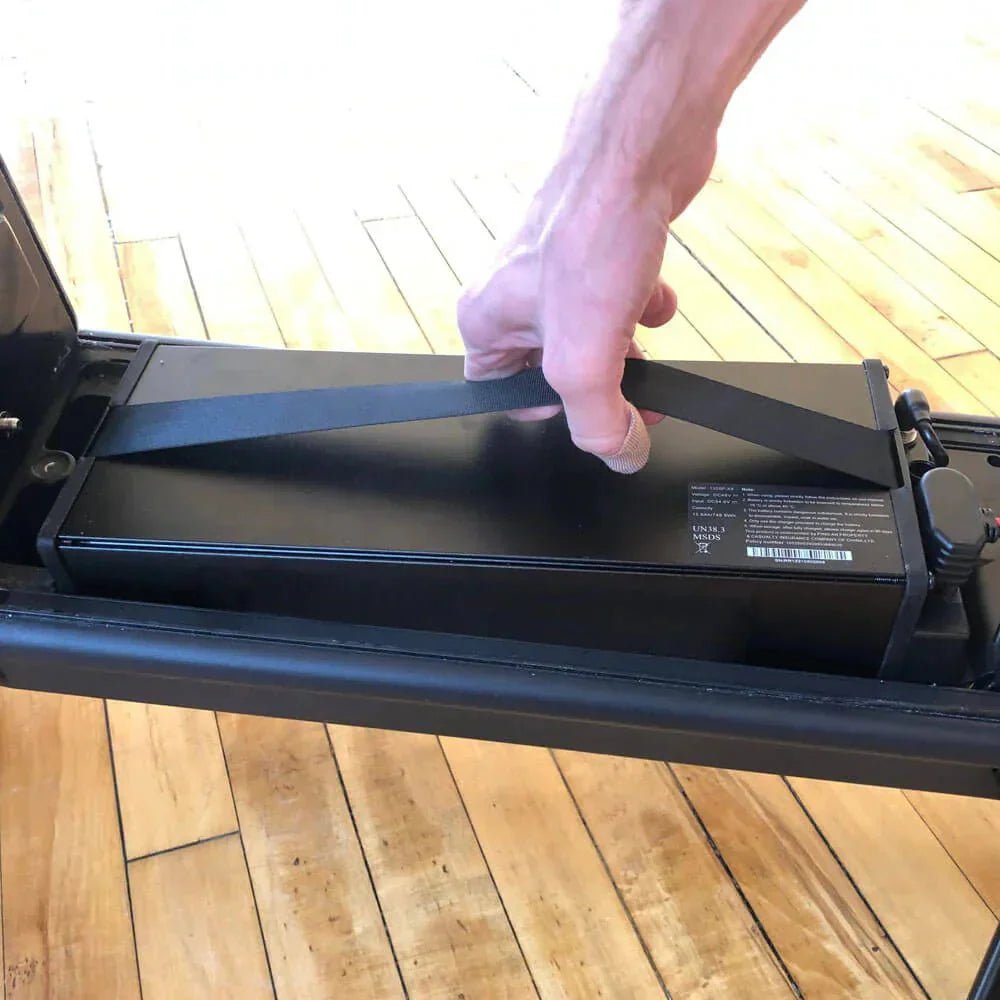
- Keep the battery indoors and carry it in after the ride – if it isn't removable, bring the whole e-scooter inside. A battery that starts the ride at room temperature stays warmer while you ride. An insulating battery cover helps an e-bike battery hold its heat.
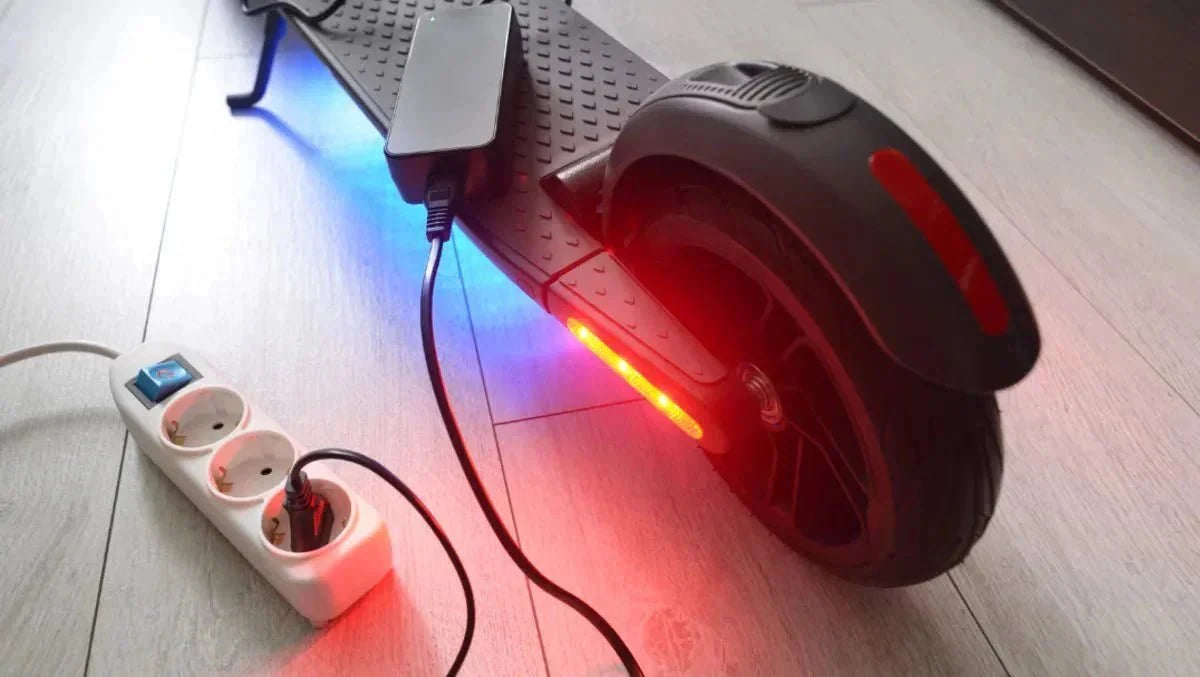
- Let the battery warm up to room temperature before charging, and give snow and moisture on the charging port time to dry off first.
- Plan for winter range, not summer range. In the cold the battery gauge can drop fast on a climb and bounce back when you stop – that's the voltage dipping for a moment, not the battery giving up.
Charging routines and winter storage have their own guide: charging an electric scooter battery. And for what to expect from range in the cold, see getting more range from an e-scooter or e-bike.
Salt and slush – keeping rust at bay
Road salt is winter's hidden cost. It creeps into electrical connectors, bolts, brakes and the e-bike's chain. You don't need to wash after every ride, but do this:
- Wipe down after salty rides with a damp cloth – frame, deck, tyre edges and brakes – as Cycling UK's winter bike care also suggests. Dry connectors and the charging port with a dry cloth.
- Give it a proper clean now and then with warm water, mild soap and a sponge – never a pressure washer. Cycling Weekly explains how pressure washers strip the grease that keeps water and grime out of bearings. The e-bike can take a gentle stream from a garden hose, but take the battery out first. On the e-scooter, leave the hose alone: wipe rather than rinse.
- Oil the e-bike's chain more often and wipe off the excess, or the oil turns road grit into a grinding paste.
- Check the folding mechanism and bolts on the e-scooter. Salt and grit settle in the joint, and a little play soon becomes more.
- Fit mudguards. A front guard that reaches well down keeps slush off both you and the scooter – see our electric scooter mudguards.
Rain is a topic of its own: how much water your model tolerates, and what its IP rating actually tests, we cover in electric scooters in the rain.
Lights and reflectors in the winter dark
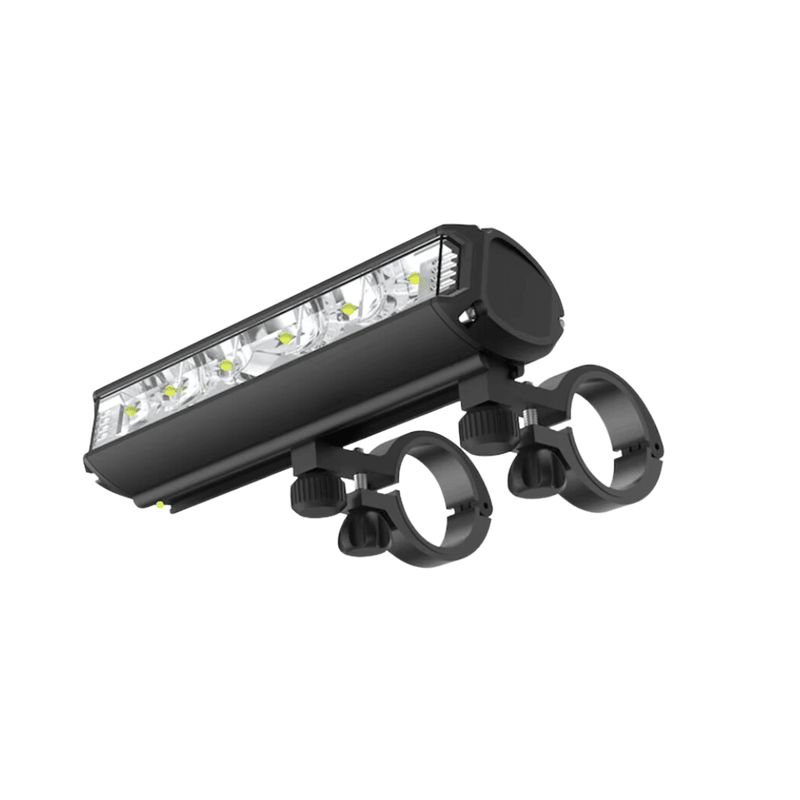
In winter, most commuting happens in the dark or half-light. Switch your lights on as soon as it starts to get dark – in the far north they may need to stay on all day – and use them in low winter sun too, when drivers are squinting into the glare.
- Charge your lights more often and carry a spare rear light.
- Wipe snow and slush off lights and reflectors before you set off.
- Angle the front light down so you don't dazzle people coming the other way.
- Be visible from the side: reflective bits on what moves – hands and feet – and reflective stickers on the vehicle make a difference at junctions.
You'll find electric scooter lights and reflectors in our shop. Which lights and reflectors you need after dark depends on the country – the details are in electric scooter laws in Europe and electric bike laws in Europe.
Clothing: you're standing still in a headwind
The most common mistake is dressing for a bike ride. On an e-scooter you hardly move, and on an e-bike the motor does much of the work, so you don't warm up the way you do when you pedal hard. Dress more as you would for a walk on a windy day:
- Hands first. They sit still in the wind and get cold first, and stiff fingers brake worse. Windproof winter gloves go a long way. The riders in Cycling UK's guide to warm fingers and toes wear two pairs – a thin liner under a windproof outer glove – and switch to heated gloves when it gets properly cold. Bar mitts that stay on the handlebar are another option. Whatever you choose, make sure you can still feel the throttle and the brake lever – there are several types among our electric scooter gloves.
- Thin under the helmet. A thin hat or balaclava keeps the wind out without spoiling the fit. A thick bobble hat turns the helmet into a loose hat. For a thin face cover, see our WindGuard balaclavas.
- Protect your eyes with a visor or glasses against snow and icy wind.
- A windproof outer layer with layers underneath. A merino or synthetic base layer stays warm even when it gets damp; cotton turns cold and clammy.
- Warm feet and shoes with grip. Your feet stand still on the deck, and when you put a foot down on ice you don't want slippery soles. Cycling UK tells of a commuter who made it to work on studded tyres – then fell over getting off, because his shoes had nothing like the same grip.
Where to keep it between rides
If you ride all year, everyday storage decides how the scooter looks by March. Ideally it lives indoors or in a frost-free shed – but wipe off salt and moisture first, or rust can actually speed up in the warmth. If it has to stay outside, use a cover and bring the battery in if it's removable. When you bring a cold e-scooter inside, condensation forms, so let it dry and warm up before you charge it. Keep the hallway and stairs clear, though – you may need that route to get out fast. If it's going to stand unused all winter, the winter storage advice in the battery guide applies.
Winter check – a checklist for the whole season
- Tyres: tread depth, pressure once a week on pneumatic tyres, and studded tyres on before the first ice.
- Brakes: test them in the first few metres of every ride and keep the discs free of oil and salt.
- Lights and reflectors: charged, clean and correctly angled.
- Battery and charging port: battery indoors overnight, port dry and rubber cap on.
- Bolts, stem and folding mechanism: tighten them and feel for play.
- Chain (e-bike): oiled and wiped.
- Mudguards: intact, firmly fixed and clear of the studded tyre.
- After salty rides: wipe down.
If something needs replacing, you'll find tyres, brake parts and other spares in our spare parts finder.
Common winter mistakes
- Pumping the tyres up hard for more grip. That puts less rubber on the road, not more.
- Riding at summer speed and braking in the corner.
- Grabbing the front brake hard on ice.
- Charging the battery straight away when it comes in from the cold.
- Blasting the salt off with a pressure washer – or, on the e-scooter, a garden hose.
- Dressing for pedalling when you're really standing still.
- Waiting to fit studded tyres until the first ice is already here.
Not sure which studded tyre fits your model? Send the model name and the tyre size from the sidewall to our customer service – we'll help you pick one.