
“What PSI should I run?” Ask that in any e-scooter forum and you get three kinds of answer: pump it by feel, pump it to the number on the tyre, or follow a chart based on rider weight. Those are three different things, and they don’t lead to the same pressure. Here’s what actually counts – and how to keep your tyres right without turning it into a project.
What tyre pressure should an electric scooter have?
Whatever the manufacturer specifies for your exact model, usually in the user manual under maintenance or specifications. That value should sit within the range printed on the tyre sidewall, and you never pump above the tyre’s maximum. There’s no single number that suits every e-scooter, and values vary even within one brand: Segway specifies 32–37 PSI (about 2.2–2.6 bar) for the Ninebot Max G30 but 42–48 PSI (about 2.9–3.3 bar) for the Max G2, and some other models run higher still.
How to find the right pressure for your model
- The manual. Look under care, maintenance or specifications. Lost it? Most manufacturers post the manual as a PDF on their support site – search for the exact model name, because closely related models can have different values.
- The tyre sidewall. Moulded into the side of the tyre you’ll find its size and usually a pressure, either as a range or a maximum in PSI, bar or kPa. That tells you what the tyre can take, not what the scooter maker recommends. If the manual’s value sits inside the sidewall range, everything is as it should be.
- Fitted a different tyre? Then the new tyre’s range is the limit. Stay within it and as close to the manual’s value as you can.
- Two different values in the manual? Sometimes the specifications and the maintenance schedule disagree. Go with the value under specifications, stay below the maximum on the sidewall and ask customer service if you’re unsure.
- Can’t find anything? Send the model name to our customer service and we’ll try to track down the value.
Put three manuals side by side and you can see how far apart the values are:
| Model | Pressure in the manufacturer’s manual | In bar |
|---|---|---|
| Segway Ninebot Max G30 | 32–37 PSI, same front and rear | about 2.2–2.6 bar |
| Segway Ninebot Max G2 | 42–48 PSI | about 2.9–3.3 bar |
| NAVEE V25i Pro (first generation) | 45–50 PSI | about 3.1–3.4 bar |
This isn’t a list to pump by. It shows why your own manual beats any general chart: two models from the same maker sit well apart. If you have a newer version of a model, such as the V25i Pro II, go by the manual for that version.
PSI, bar and kPa – how to convert
Manuals often give PSI, the pump gauge shows bar and some compressors show kPa. The maths is simple: 1 bar is about 14.5 PSI and exactly 100 kPa. Divide PSI by 14.5 and you have bar.
| PSI | bar | kPa |
|---|---|---|
| 30 | 2.1 | 207 |
| 35 | 2.4 | 241 |
| 40 | 2.8 | 276 |
| 45 | 3.1 | 310 |
| 50 | 3.4 | 345 |
| 55 | 3.8 | 379 |
The bar values are rounded. If the manual’s value is close to the maximum on the sidewall, don’t round up.
Heavy rider, luggage or gravel – can you adjust?
Yes, but within the manufacturer’s range. More weight squashes the tyre more, so if you’re on the heavy side or ride with a loaded backpack, aim for the upper part of the manual’s range. Charts that add a few PSI for every 10 kg look precise, but they don’t know your model – a chart that climbs to 60–65 PSI for heavy riders can end up above both the manual’s value and what the tyre can take.
Check the maximum load as well. According to the manuals it’s 100 kg for the Max G30 and the first-generation V25i Pro, and 120 kg for the Max G2. If you and your luggage weigh more than that, no tyre pressure will solve it.
- Gravel and broken tarmac: the lower part of the range gives a little more comfort and grip. Don’t go below it – with an inner tube, the risk of pinch flats against kerbs and stones goes up.
- Winter: cold lowers the pressure on its own (more on that below), so check more often when temperatures drop, and stay within the range even if you let out a little air for grip. Studded tyres and icy roads are covered in our guide to the electric scooter in winter.
- Front and rear: if the manual gives one value for both tyres, pump them equally. Segway says explicitly that both tyres on the Max G30 should be inflated equally.
Too low or too high – how to tell
Too low often shows up first in your range: a soft tyre has more rolling resistance, so the battery empties faster. More ways to get further on a charge are in our guide on how to increase electric scooter range. Other signs:
- The steering feels sluggish or wobbly in corners.
- The tyre bulges a lot when you stand on the deck.
- You get a puncture with two small holes side by side – a pinch flat, or “snakebite”, where the tube has been trapped against the rim. BikeRadar links it to running a tubed tyre at too low a pressure; the advice is written for bikes, but a scooter’s inner tube behaves the same way. How to patch or replace the tube is in our guide on how to change an electric scooter tyre.
Too high feels like a harsh, bouncy ride. The tyre doesn’t soak up joints and cracks, and grip gets worse in the wet and on gravel. It rolls easily – but there’s no reason to go above the manual’s range to squeeze out a little more range.
How to pump up e-scooter tyres, step by step
- Measure with cold tyres – before you ride, not straight after.
- Unscrew the valve cap. Most e-scooters with pneumatic tyres have a Schrader valve, the same type as on a car (ERideHero’s guide to scooter pumps explains the valve types), and on some models it sits awkwardly close to the hub. A valve extender makes it much easier to get the pump on – Segway even puts one in the box with the Max G30.
- Push the pump head straight onto the valve and lock it. If it hisses, it’s on at an angle.
- Pump to the manual’s value and read it off the gauge. A floor pump with a pressure gauge is the easiest to read and control.
- Take the pump head off quickly, check that the valve points straight out of the rim and screw the cap back on – it keeps dirt and moisture out of the valve.
- Do the same on the other wheel.
Most portable compressors stop when they reach the pressure you’ve set, which is handy. Many of them can go far higher than a scooter tyre can take, though, so set the right value before you start. A petrol station works too, but its compressor fills a small tyre very quickly – add air in short bursts and check with your own gauge. Pumps, portable compressors and valve adapters are among our electric scooter tools.
How often should you check the pressure?
Air seeps out even from a tyre with no puncture – as Cycling UK puts it in its winter bike-care advice, there’s no such thing as a perfect seal – and small tyres don’t have much air to spare. If the manual for your model tells you to check more often, do what it says: NAVEE’s manual for the first-generation V25i Pro, for example, says “Check the tire pressure before riding.” Otherwise a quick check once a week is a good habit if you ride often, as well as before longer trips and when the weather turns.
Cold lowers the pressure by itself: going by the gas laws, a tyre pumped to 50 PSI at 20 °C loses roughly 4 PSI if it’s left outside at 0 °C. If a tyre drops noticeably over a few days, it isn’t the weather – it’s most likely a slow puncture or a leaking valve.
Tubeless, self-sealing and solid tyres
- Tubeless pneumatic tyres need pumping just like tyres with a tube – they lose air too, and the manual’s value applies all the same.
- Self-sealing tyres contain a gel that plugs small holes, but it doesn’t replace the air. Segway specifies 42–48 PSI for the Max G2, which has self-sealing tubeless tyres.
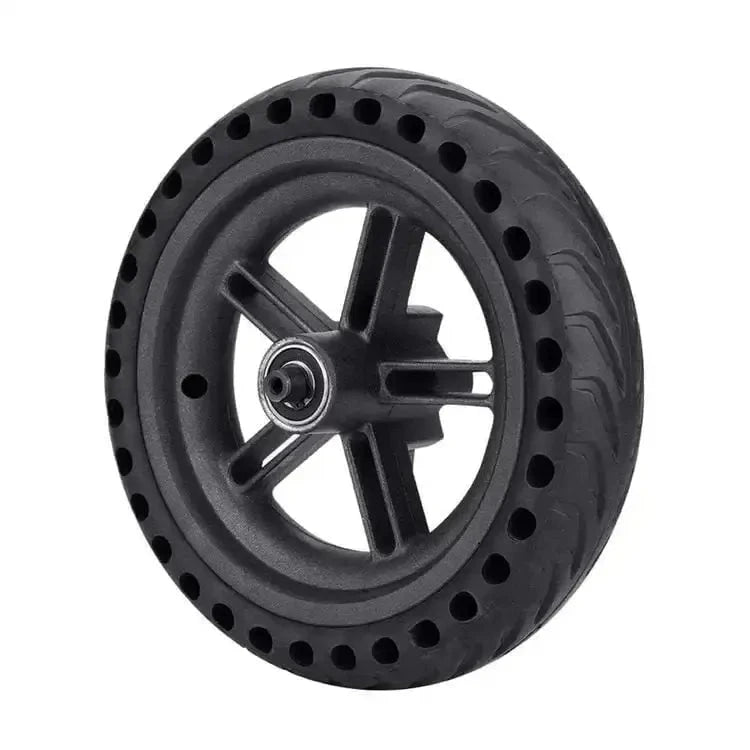
- Solid and honeycomb tyres have no air and never need pumping – but the ride is harsher. What you gain and lose by ditching the pump is covered in our guide to solid vs pneumatic tyres.
Common tyre pressure mistakes
- Pumping to the maximum on the sidewall and thinking that’s the recommendation.
- Following a chart or forum thread that’s about a different model.
- Measuring straight after a ride, when the tyre is warm.
- Squeezing the tyre instead of measuring.
- Filling up at a petrol station without checking afterwards.
- Forgetting the valve cap.
- Going above the manual’s range for a little extra range.
Need a new inner tube – ideally with a bent valve if space is tight – or a new tyre? Search for your model in the spare parts finder or browse our tyres and wheels for electric scooters.