
























Buying guide
Electric scooter with NFC – keyless unlocking with a card or tag
You unlock or start an electric scooter with NFC by holding an NFC card or tag against the reader in the display or handlebar, instead of turning a key. The idea is that only someone with an authorised card can start the scooter. Here you'll find around forty models from Teverun, Kaabo, Wheely, BOYUEDA, OOTD, iScooter and more – from 20 kg commuter scooters to heavy performance machines. Every electric scooter comes with free delivery, a 2-year warranty and 14-day returns.
In short
- The range: around forty e-scooters with NFC from 14 brands, including Teverun, Kaabo, Wheely and BOYUEDA – 40–220 km stated range and 20–83 kg.
- NFC cards: for 20 models, NFC cards or NFC tags are listed in the box contents. According to the product data, only a few can also be unlocked with a phone.
- On an electric scooter with NFC the NFC lock is an immobiliser, not theft protection – always lock the scooter with a proper lock when you park.
- Rules: practically every model here exceeds the limits for public roads in the EU and is intended for private or enclosed land.
- Wheelyshop: free delivery on electric scooters, a 2-year warranty and 14-day returns.
How to choose an electric scooter with NFC in 2026
NFC is a convenience and security feature, but it rarely decides which model suits you. Choose on range, weight and how you ride first, then check how unlocking works on that particular model.
How does an electric scooter with NFC work?
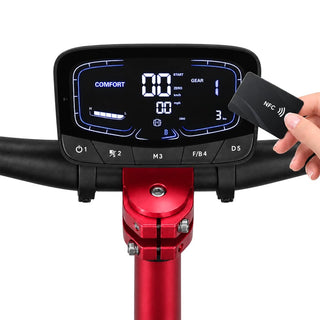
NFC (Near Field Communication) is the same contactless technology used in payment cards. A reader sits in the display or handlebar, and when you hold an authorised NFC card or tag close to it the scooter is activated. That gives you keyless unlocking: no key to turn and, on most models, no code to type in. The product descriptions present the feature as protection against unauthorised use – without the card the scooter should not start.
NFC card, tag or phone?
On most models you unlock with an NFC card or tag. For 20 of the models, NFC cards or NFC tags are explicitly listed in the box contents – for example VIPCOO VS6 and VS6 Pro (three cards), YUME Raptor 2 (two cards) and BOYUEDA S5-11 (two NFC tags). For the other models, check what's included on the product page. Only a few product descriptions mention a phone: TEVERUN BLADE GT II can be unlocked with an Android device, TEVERUN BLADE Q PRO with an NFC-compatible card or smartphone and YUME Raptor 2 with compatible mobile devices. ENGWE Y700 unlocks with an NFC card or via Bluetooth from your phone. If the phone isn't mentioned, assume you need the card.
NFC lock combined with code, key and app
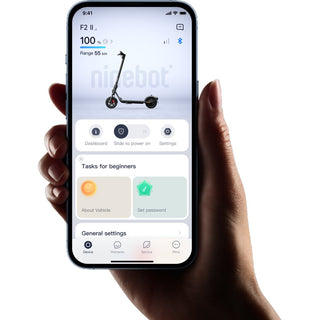
Several models offer more than one way to start. BOYUEDA S5-11 and OOTD T30 have both NFC and a password lock, and BOYUEDA M2 can be unlocked with an NFC card or a password. Wheely N3L Max comes with NFC cards and remote keys, YUME Raptor 2 with two mechanical keys and a remote, and TEVERUN FIGHTER SUPREME ULTRA V4 has an ignition key as well as the NFC lock. 17 of the models also have an app, mostly from Teverun and BOYUEDA but also from KOOLUX, YUME, Apefox, iScooter and ENGWE. What the app controls differs between models, so read the product page.
Is an electric scooter with NFC theft-proof?
Not on its own. The NFC lock is an electronic immobiliser: it stops someone from starting the motor, but not from carrying or lifting the scooter away. Even the product description for the TEVERUN FIGHTER ELEVEN+ V4 recommends an extra lock. So always lock the scooter to a fixed object when you park – see our range of electric scooter locks. iScooter GX3 Pro and DriveTron DT10 have an integrated combination lock, BOYUEDA S5-11 and Q7 PRO MAX come with a combination lock, and BOYUEDA G2, G6 and M2 with a chain lock.
If you lose the NFC card
The product descriptions don't say how a lost card is replaced or how new cards are paired with the reader. If several cards are included, keep one at home as a spare rather than on the scooter. If you have lost every card, contact customer service with the model name and order number and we'll tell you what applies to your model.
Electric scooter rules in the EU
NFC does not change which vehicle class an electric scooter falls into. In most EU countries e-scooters on public roads are limited to 20–25 km/h and a power limit, often with a minimum age and insurance. Practically every model in this collection exceeds those limits and is intended for private or enclosed land. Always check your national rules – read more at Your Europe.
Checklist – electric scooter with NFC
Note the same details for the models you're comparing:
- How you unlock: card or tag only, or also phone, code or key
- How many NFC cards are included
- Whether the model has an app and what it controls
- Which lock you'll use when you park
- Range, weight and brakes – 40–220 km and 20–83 kg in this collection
Our best-selling models are in the top list, spare parts in the spare parts portal and the full range under electric scooter.
Frequently asked questions
How do you unlock an electric scooter with NFC?
Hold the NFC card or tag close to the reader in the display or handlebar and the scooter is activated. Some models also offer other options such as a password, key, remote or phone – the product page says which.
Can I use my phone as an NFC key?
Only on some models. According to the product data, TEVERUN BLADE GT II can be unlocked with an Android device, TEVERUN BLADE Q PRO with a smartphone and YUME Raptor 2 with compatible mobile devices. The other models unlock with an NFC card or tag.
Is the NFC lock enough to protect an electric scooter with NFC from theft?
No. The NFC lock stops the motor from being started but not the scooter from being carried away. Always lock it with a sturdy lock when you park.
What should I do if I lose the NFC card?
Use a spare card if several were included. If you have none left, contact customer service with the model name and order number and we'll tell you what applies to your model.
Can I ride an electric scooter with NFC on public roads?
NFC doesn't affect the vehicle class. Practically every model in this collection exceeds the speed and power limits for public roads in the EU and is intended for private or enclosed land. Check your national rules.