
























Buying guide
Long range electric scooter – 70 to 220 km on a single charge
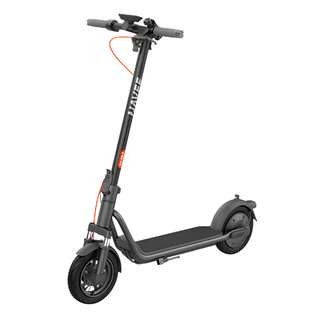
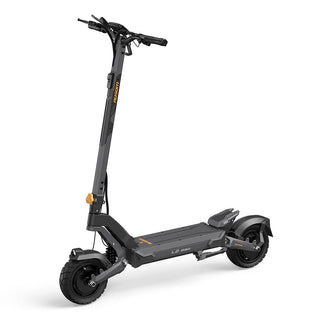
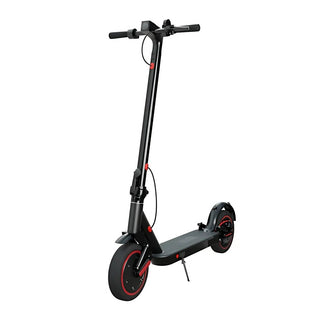
Here Wheelyshop brings together electric scooters that, according to the manufacturer, cover at least 70 km on one charge – from nimble commuter models such as the Ninebot Max G3 and NAVEE ST5 Max to dual-motor long range electric scooters from Kaabo, Dualtron and Teverun with a claimed range of up to 220 km. Compare range, weight, battery and tyres directly in the filter and find the model that covers your journey with margin to spare. Every electric scooter comes with free delivery, a 2-year warranty (in addition to your statutory rights) and the option to pay in instalments.
In short
- The claimed range of a long range electric scooter is the manufacturer's test figure – expect a shorter real-world distance in cold weather, on hills and at high speed, and choose a model with a margin for your longest regular trip.
- The collection spans roughly 19 to 83 kg. More range almost always means a heavier vehicle, so decide first how often you will need to carry or lift it.
- Compare battery capacity in Wh, charging time and whether the battery is removable – not just the kilometre figure.
- Tyres, suspension and seat vary widely within the same range class; choose according to the surface you ride on.
- In most EU countries e-scooters are limited to 20–25 km/h and 250–500 W on public roads, and many require a minimum age, insurance or a plate – check the version and ride mode, and your national rules, before you order.
How to choose the best long range electric scooter 2026
Long range is about never having to think about charging – not about chasing the highest number in the catalogue. Start from your longest regular trip, add a margin and then pick the lightest model that covers it. That way you get a vehicle that works every day rather than one that only impresses on paper.
1. Electric scooter with 70, 100 or 200 km range – choose a range class
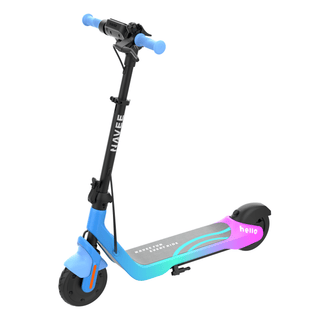
- 70–99 km: the widest choice and the lightest models, often 19–27 kg. Ideal for commuting where the e-scooter is sometimes carried up stairs or taken on the train.
- 100–149 km: more margin for longer commutes or several days between charges. Many models weigh 30–47 kg and are rolled rather than carried.
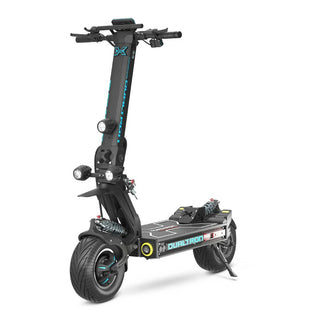
- 150–220 km: the highest capacity, with dual motors and large batteries. Expect 50 kg or more and plan storage, charging space and servicing before you buy.
If several models in the lowest class cover your needs, it is usually right to compare those first. Stepping up a class gives you more reserve, but also more weight and longer charging times.
2. Real-world range of an electric scooter – not the catalogue figure
The manufacturer's range is measured under favourable conditions: smooth surface, light rider, low speed and mild temperatures. Temperature, hills, headwind, rider weight, load, tyre pressure and how often you accelerate all affect the outcome, and on a cold winter day the distance can drop considerably. Calculate your round trip between charges and add a clear margin. Our guide on how to maximise the range of your e-scooter walks you through getting the most out of the battery.
3. Long range electric scooter for adults – weigh range against weight
The collection ranges from roughly 19 to 83 kg. A model under 25 kg can be lifted when needed, a model of 30–45 kg is rolled into lifts and storage rooms, and the heaviest long range models should be treated as vehicles that are stored and charged at ground level. Measure stairs, lifts, doors, thresholds and boot space before you choose, and check the folded dimensions on the product page. A vehicle that does not fit your everyday logistics is not the right choice just because the battery is big.
4. Battery and charging – how to compare e-scooters with a big battery
- Capacity in Wh (volts × amp hours) says more about range than Ah alone.
- Charging time and charger: large batteries can need 8–12 hours with the standard charger; check whether a fast charger is available. How much electricity a charge uses, and what it costs, is shown in our article on the cost of charging an electric scooter.
- A removable battery lets you charge indoors while the vehicle stays in a storage room or garage.
- Battery care: store at room temperature, charge before the battery is completely empty and keep it at around half charge during longer storage.
5. Choose tyres, suspension and seat for your surface
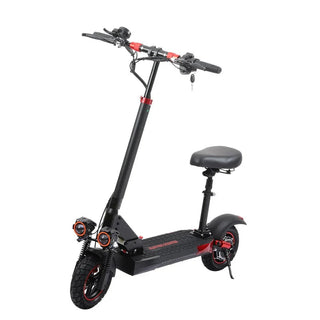
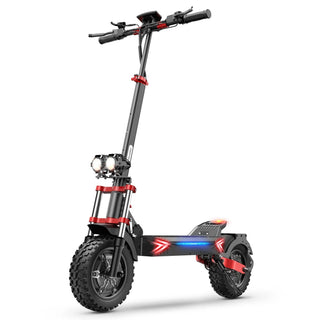
The same range class covers everything from city models with hard-wearing pneumatic tyres to off-road models with knobbly tyres and dual suspension. Pneumatic tyres give comfort but need the right pressure; too little pressure reduces range and increases the risk of tyre damage. If you mostly ride on gravel and rough roads you will find the right fit among our off-road electric scooters, if you would rather never pump a tyre there are puncture-proof models, and for long seated rides there are electric scooters with seat. Always check on the product page whether the seat is fixed, adjustable or removable.
6. Rules for a long range electric scooter in the EU
In most EU countries e-scooters are limited to 20–25 km/h and 250–500 W on public roads; many countries require a minimum age (often 14), third-party insurance and/or a plate, and some require a helmet. Always check your national rules before riding. Many powerful long range models are built for higher speed and power and may then only be ridden on private land or in enclosed areas. Read more about road rules across the EU at Your Europe and check the exact version, ride mode and documentation on the product page – a restricted mode in the app is not proof of vehicle classification.
Best long range electric scooter – final comparison
When you are down to two models, write down the same details for both:
- Claimed range and battery capacity in Wh
- Charging time, charger and whether the battery is removable
- Weight, folded dimensions and maximum load
- Tyre type, tyre size and suspension
- Motor power, design top speed and vehicle class
Mark any missing data rather than assuming a value. The model with the highest number is not automatically the right one – choose the one whose overall package works for your journey, storage and servicing. Spare parts for every model are in our spare parts portal, and the current best-selling models are in our electric scooter top list. If you want a wider selection, browse all electric scooters.
Frequently asked questions
How far does a long range electric scooter really go?
The claimed range is the manufacturer's test figure at low speed, on a smooth surface and in mild temperatures. In real-world riding with hills, cold weather and higher speeds you should expect a noticeably shorter distance. So choose a model whose claimed range exceeds your longest regular trip by a comfortable margin.
Which electric scooter has the longest range?
In our range the Teverun Fighter Supreme Ultra has the highest claimed range at 220 km, followed by models from Kaabo and Dualtron at 150–200 km. Range is determined by battery size, but weight is also affected by the frame, motors and suspension – two electric scooters with almost the same range can differ by 20–30 kg. Always compare weight and dimensions against how you will store the vehicle.
How long does it take to charge an electric scooter with a big battery?
With the standard charger, a full charge often takes 6–12 hours for batteries of 1,000 Wh or more. Some models support fast chargers or dual chargers that halve the time. Charging time and charger output are listed on the product page.
Can you ride a long range electric scooter in the cycle lane?
Only if it is built for your country's limits for public roads – in most EU countries that means 20–25 km/h and 250–500 W, and many countries also require a minimum age, insurance or a plate. Models with higher power or speed may only be ridden on private land or in enclosed areas. Check the version and your national rules before buying.
How do I store the battery if the e-scooter sits unused over winter?
Store the battery at room temperature at around 40–60 percent charge and top it up every one to two months. Never charge a cold battery straight after riding in sub-zero temperatures – let it reach room temperature first. Follow the manufacturer's instructions for your specific model.