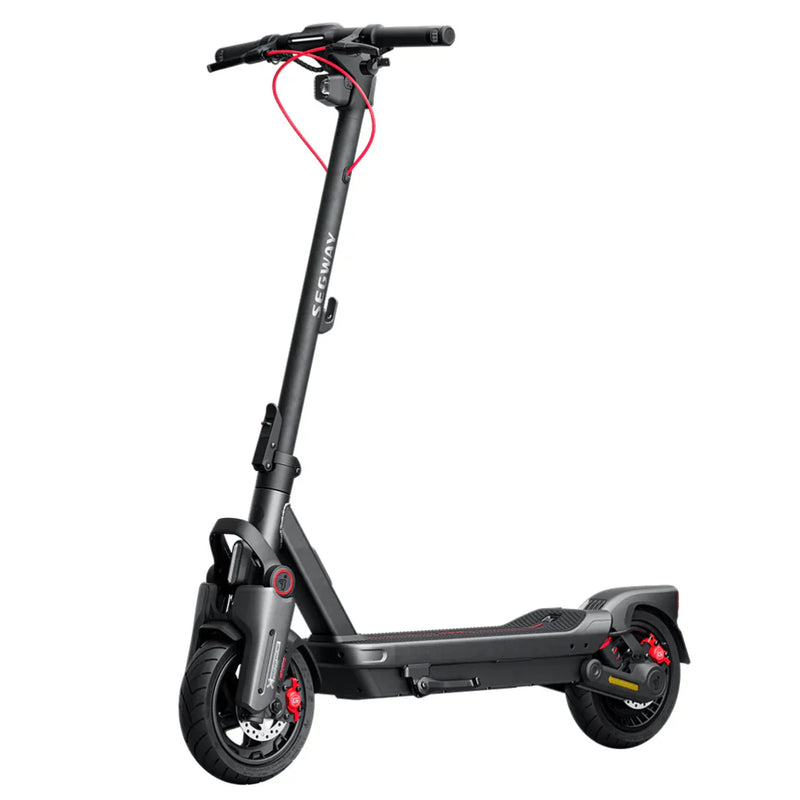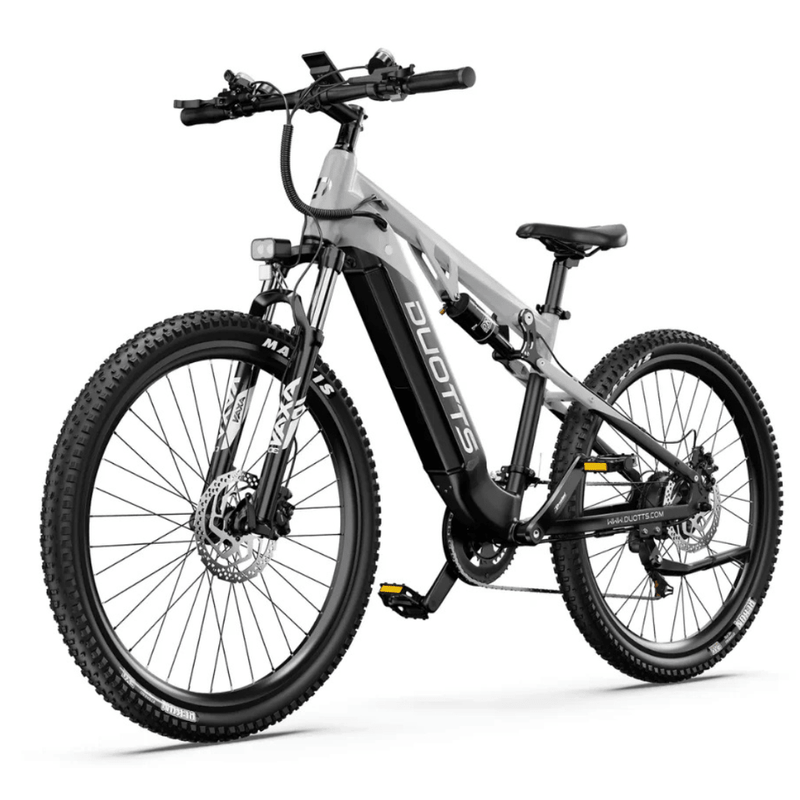

Both get you around with the help of an electric motor, but they solve different problems. The e-scooter is small, folds quickly and can come inside with you. The e-bike is a real bicycle with extra power in the pedals. The rules in this guide come from EU law and national authorities, and the weights and prices from our own range.
Electric scooter vs e-bike: what decides the choice?
Your distance, the road surface and what you need to carry decide it. The e-bike is the more versatile choice, and the e-scooter is the handiest for short trips.
- Choose an electric scooter if your trip is short and mostly on smooth tarmac, or if you want to fold it and carry it indoors. If you combine the trip with trains or buses, check the operator's rules first: some cities ban e-scooters on public transport but allow e-bikes, and a folding e-bike can then be the easier option.
- Choose an e-bike if you ride more than a few kilometres, have hills or gravel on the way, need to carry luggage or a child, or want some exercise as well.
E-scooter vs e-bike: the key differences
| Comparison | Electric scooter | E-bike |
|---|---|---|
| Road-legal limit: Germany, Italy | 20 km/h, 500 W | Assist to 25 km/h, 250 W |
| Road-legal limit: Austria | 25 km/h, 600 W | Assist to 25 km/h, 250 W |
| Road-legal limit: France, Spain | 25 km/h, no watt limit | Assist to 25 km/h, 250 W |
| Weight | Usually 18–23 kg (light models) | Usually 20–30 kg |
| Wheels | 8–11 inches | 20–29 in, folding 14–20 |
| Folding | Almost always | Only folding models |
| Passengers and luggage | One rider, no passenger | Rack, basket, child seat |
| Electricity per 100 km | About €0.48 | About €0.32 |
| Motor insurance | Often required* | Not required |
| Our prices, September 2026 | €530–800 (light models) | €975–1,330 |
| Exercise | Little – you stand | Yes – you pedal |
*EU law requires motor insurance for vehicles without pedals that are designed for more than 25 km/h, or for more than 14 km/h and weigh over 25 kg. Many countries go further: Germany, France, Spain and Italy require liability insurance for every e-scooter.
The first three rows show the limits a vehicle must stay within to be ridden on public roads – as an e-scooter, or as a bicycle in the case of the e-bike – not what it can do. So check the top speed and rated power in the product specifications before you buy. A model built for more than the limit where you ride may not be used on public roads there as an e-scooter.
Weights, wheel sizes and prices are typical ranges for the models we sell in September 2026. By light e-scooters we mean models for adults that weigh up to 25 kg. The e-bike figures refer to e-bikes that count as bicycles. Prices are in euros; if you shop in another currency, you will see the converted price. The electricity cost assumes about 15 Wh/km for an e-scooter and 10 Wh/km for an e-bike, the EU average household price of €0.29/kWh and 10 per cent charging losses.
How far will you ride? Distance and range
The range in the specifications is measured in good conditions. Our rule of thumb: expect 50–70 per cent of the stated range in real traffic in summer, and less when it is cold. Plan for the whole return trip and add a margin.
- Short trips and the last mile to the bus or train suit the e-scooter. You stand, and the small wheels pass on more of the bumps in the road, so long rides become tiring.
- Longer commutes suit the e-bike. You sit, the large wheels roll more easily over bumps, and because you pedal along it uses less electricity per kilometre and goes further on the same battery.
As a guide, both work well for trips under about 5 km each way. For longer trips, the e-bike is more comfortable. You get more kilometres per charge with our tips on how to increase e-scooter and e-bike range.
Hills, gravel and rough roads
The e-bike has a clear advantage here. The motor adds to your own pedalling power, and with gears you can keep a steady pace uphill. An e-scooter relies on its motor alone and has no gears, so a road-legal model can lose speed on steep climbs, especially with a heavy rider.
The small wheels also make the e-scooter more sensitive to the road surface. Sweden's national road and transport research institute (VTI) reports that single-vehicle crashes are the most common e-scooter accidents, and its investigators point out that a little gravel can make e-scooters with their small wheels very unstable. If your route has gravel, cobbles or poor cycle paths, the e-bike's larger wheels are safer.
Luggage, children and public transport
An e-scooter is built for one rider. In Austria, France and Italy, for example, you may not carry a passenger, and there is rarely room for more than a backpack. An e-bike can take a rear rack, a basket and a child seat. National rules decide from what age you may carry a child and how, so check them where you live.
If the vehicle needs to come with you on public transport, the rules vary from operator to operator, so check them before you travel. Two examples from Germany show how different they can be. Deutsche Bahn lets you take a small electric vehicle such as an e-scooter on its long-distance trains free of charge as hand luggage, as long as it is folded and stowed safely, for instance in the luggage rack. The battery may not be removed, charged or used as a power bank during the journey.
In Berlin, by contrast, the city operator BVG has banned e-scooters from all its vehicles and stations since 1 May 2024, because fire-safety reports found the standards for their lithium-ion batteries insufficient. E-bikes are exempt. A folding e-bike takes up less space than a full-size one, but the operator's rules apply to it too.
Rules and insurance in the EU
Whether an e-bike counts as a bicycle is decided at EU level. E-scooters are regulated by each country.
- E-bike: an e-bike whose motor only assists while you pedal, with no more than 250 W continuous rated power and cutting out at 25 km/h, is a bicycle under EU law in every member state. You need no licence, registration or insurance.
- Faster e-bikes: stronger or faster e-bikes, and e-bikes with a throttle for riding without pedalling, fall outside that definition, and national law decides how they may be used. A speed pedelec with assistance up to 45 km/h counts as a moped, with type approval, number plate, insurance and a moped licence. Read more in our guide to electric bike laws in Europe.
- E-scooter: e-scooters have no seat and fall outside the EU vehicle rules, so each country sets its own. Speed limits are usually 20 or 25 km/h, most countries set a minimum age of 14–16, and helmet, insurance and registration rules differ. Don't assume a speed limiter makes a more powerful model road-legal. The rules in all 27 EU countries are in our guide to electric scooter laws in Europe.
- For example: Germany only allows e-scooters with a national type approval or an individual approval, while a helmet is compulsory for every e-scooter rider in Italy and for under-16s in Austria.
Insurance: under the EU motor insurance directive, vehicles without pedals that are designed for more than 25 km/h, or for more than 14 km/h and weigh over 25 kg, need motor insurance. So even a heavy e-scooter with a 20 km/h limiter can need it. Many countries go further, and Germany, France, Spain and Italy require liability insurance for every e-scooter.
Insurance does not make a model road-legal if it is built for more than the national limit. An e-bike that counts as a bicycle needs no compulsory insurance. For theft and damage, it is usually insured like a bicycle through home or bike insurance, so check the terms. More in our guide to electric scooter insurance in Europe.
What do they cost to buy and to run?
The e-scooter is cheaper to buy. In September 2026, light e-scooters (up to 25 kg) in our range usually cost €530–800, while e-bikes that count as bicycles usually cost €975–1,330. The most powerful e-scooters cost more than most e-bikes, though. The price says nothing about how a model is classified, so check the top speed and rated power in the product specifications if the e-scooter is to be ridden on public roads.
Running costs differ little. At the EU average household electricity price of €0.29/kWh, electricity costs about €0.48 per 100 km on an e-scooter and about €0.32 on an e-bike, because you pedal along. The full calculation is in our article on how much it costs to charge an electric scooter.
The bigger costs over time are wear parts: tyres and brakes on both, the chain and gears on the e-bike, and eventually a new battery. The e-scooter has simpler mechanics, with no chain or gears.
Theft, rain and storage
- Theft: an e-bike usually has to be locked up outside, while a folded e-scooter can come with you into the office or your flat. Here is how to protect your electric scooter and e-bike from theft.
- Rain: both have electronics that must be kept away from water. The IP rating shows how well the electronics coped with a water test, and the manual tells you whether you may ride in the rain. Read more about riding an electric scooter in the rain.
- Storage: an e-scooter fits in a hallway or under a desk. An e-bike needs a bike room, shed or garage. If the battery is removable, you can charge it indoors.
Five questions that decide it
- How long is the trip one way? Under about 5 km, both work. If it is longer, choose an e-bike.
- Are there hills, gravel or poor cycle paths? Then the e-bike is better.
- Does the vehicle need to come on a train, a bus or up the stairs? Then an e-scooter or a folding e-bike. Check the operator's rules, as some ban e-scooters but allow e-bikes.
- Do you need to carry luggage or a child? Then you need an e-bike.
- Do you want exercise? Choose an e-bike. In a small Norwegian study, commuters on e-bikes rode at moderate to high intensity for almost the whole trip. If you want to arrive without any effort, choose an e-scooter.
Compare the models among our electric scooters and electric bikes. If the e-scooter is for getting to work, you will find light models among our commuter electric scooters. If it is to be ridden on public roads, check the top speed and rated power in the product specifications. Any questions? Contact our customer service.