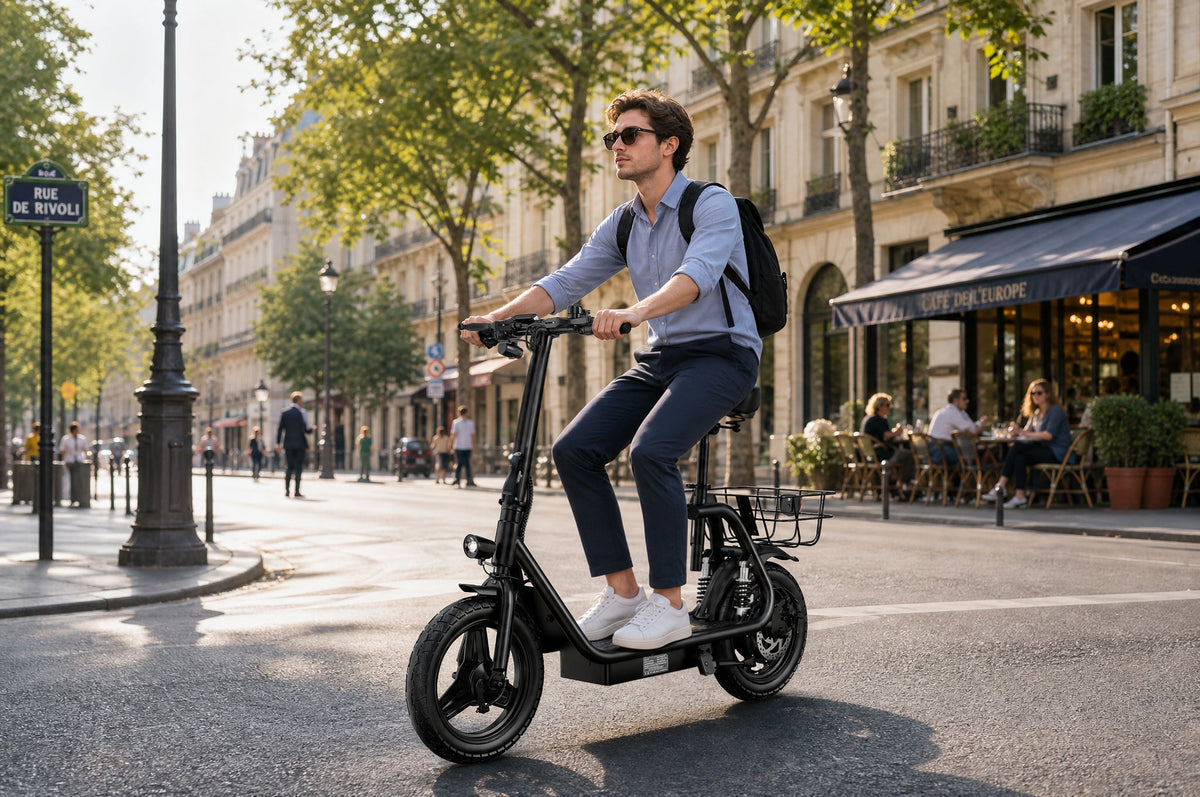

“Can I take my e-scooter on the bus, or will I be turned away at the door?” Our answer is almost always the same: fold it before you board, keep it out of the way and charge it at home. Where e-scooters are allowed, that is usually all it takes. The catch is knowing where they are allowed, because taking an electric scooter on public transport works very differently from one city and operator to the next.
Are e-scooters allowed on trains and buses?
Often, yes – if the scooter is folded. Deutsche Bahn’s long-distance trains and Trenitalia’s regional trains take a folded e-scooter free of charge. City networks differ: Berlin, Munich, Madrid, Barcelona, Rome and all NTA-contracted services in Ireland keep e-scooters off board, and Vienna no longer allows them on buses and trams. Charge at home, not on board.
Long-distance trains: usually yes, folded
Trains, especially long-distance ones, are generally the easiest place to bring an e-scooter, as long as you fold it. This is how three of Europe’s big operators handle it in September 2026:
| Operator | Folded e-scooter | Good to know |
|---|---|---|
| Deutsche Bahn (ICE, ECE, IC/EC, RJX, TGV) | Free as hand luggage, stowed safely | Unfolded, it counts as a bulky item. Never take the battery out, charge it or use it as a power bank |
| Trenitalia (regional trains) | Free, up to 120 × 80 × 45 cm | Switch it off and fold it before boarding, then put it under the seat or between facing seats |
| Renfe (Cercanías, Media and Larga Distancia) | Allowed again since 7 September 2026, folded and switched off | Only for scooters registered under Spain’s new rules. Not on Rodalies or Cercanías Euskadi. No charging on board |
Deutsche Bahn’s rule covers its long-distance trains; regional and S-Bahn networks can have rules of their own. Crossing a border? Since 14 December 2025, European rail operators have applied a common definition of a bicycle on international trains, according to the European Cyclists’ Federation – but it covers bicycles and e-bikes up to 25 km/h only, not e-scooters. For a scooter, each operator’s own luggage rules apply, so check every operator on your route.
Our tip: pick a seat at the end of the carriage, close to the luggage space, and avoid the busiest departures – on a packed train there may simply be nowhere safe to put it.
City buses and metros: where e-scooters are banned
Local transport is where most people get caught out. Because of the fire risk from lithium batteries, a number of operators no longer carry e-scooters at all – often not even folded ones. Some examples, as of September 2026:
| City (operator) | Not allowed | Good to know |
|---|---|---|
| Berlin (BVG) | E-scooters in all vehicles and stations | Since 1 May 2024. E-bikes are still allowed |
| Munich (MVG) | E-scooters on the U-Bahn, trams and buses and in U-Bahn stations | Since 2 April 2024 |
| Madrid (Metro, EMT and regional buses) | E-scooters on the network and in the main interchanges | The ban has been extended to 2027 |
| Barcelona (TMB and the metropolitan network) | E-scooters on the metro, buses and trains | Since February 2023. A return was debated in September 2026, but no date has been set |
| Rome (ATAC) | All motorised micromobility | Applies to e-bikes too |
| Ireland (all NTA-contracted services) | E-scooters, even folded, on Dublin Bus, Bus Éireann, Go-Ahead Ireland, Irish Rail, Luas and TFI Local Link | Since October 2024. E-bikes are still allowed |
| Vienna (Wiener Linien) | E-scooters on buses and trams, even folded | Since 1 September 2026. On the U-Bahn only outside rush hours |
Several other German cities, including Hamburg, Cologne, Leipzig and Frankfurt, have similar bans (ADAC, as of November 2025). It isn’t a ban everywhere, though: in Milan, ATM carries e-scooters free on the metro throughout the day. The rules also change – Ireland’s restriction is reviewed periodically, and Barcelona’s transport authority reopened the question in September 2026 – so check the operator’s own page before you travel.
If the metro in your city is off limits, the usual workaround is to lock the scooter at the station and continue without it. Our guide on protecting your electric scooter from theft shows how to lock it so it is still there when you get back.
Choose a scooter that is easy to carry
If you take your e-scooter on the bus, you also carry it – up stairs, onto the platform and into the carriage. Three things decide how easy that is:
- Weight. In our commuter electric scooters category, the lightest adult models weigh around 10.5–13 kg (September 2026). You will feel the difference from a heavier model on the very first staircase.
- Folded size. Folding rarely makes a scooter much shorter, because the stem folds down along the deck. Check the folded dimensions in the specifications – Trenitalia’s regional trains, for example, accept items up to 120 × 80 × 45 cm.
- Folding mechanism. It should fold with one hand in a few seconds, and the stem should lock to the rear so you can carry the scooter by it without it unfolding.
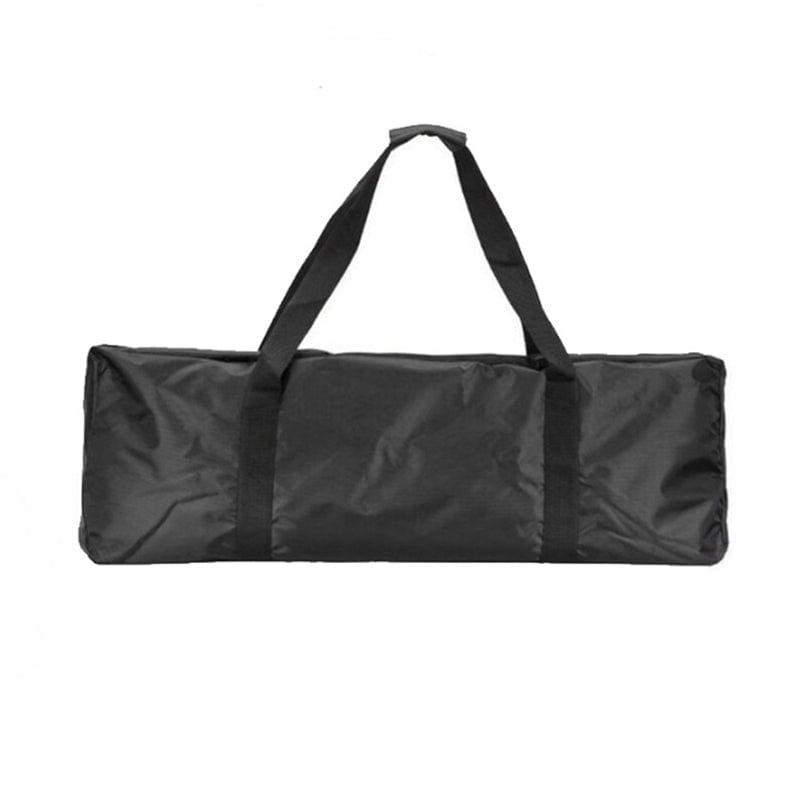
Two more things make everyday trips easier. A carry bag keeps dirt and water off seats and clothes, and Deutsche Bahn even suggests stowing the scooter in a bag on its trains. Puncture-free tyres reduce the risk of getting stuck on the way to the station, but they give a harsher ride. Which suits your route is explained in our guide to solid vs pneumatic tyres.
What different types weigh and how much you can comfortably carry is covered in how much does an electric scooter weigh.
At the station and on board
- Switch off and fold before you board. Do it at the stop or before you enter the station, not in the doorway. Don’t ride on platforms or through stations – Wiener Linien in Vienna, for example, only allows bikes and e-scooters to be pushed through its stations.
- Take the lift, not the escalator. With 15–20 kg in one hand and a backpack on, an escalator is an easy place to lose your grip. Wiener Linien bans bikes and e-scooters on its escalators for safety reasons.
- Stow it properly. Under the seat, between seats or in the luggage area – never in the aisle, in front of the doors or in the spaces reserved for wheelchairs. If you use an overhead rack where it is allowed, as on Deutsche Bahn’s long-distance trains, wedge it in so it can’t slide.
- Keep an eye on it. It shouldn’t be able to roll away when the train brakes or dirty anyone else’s clothes.
- Make room. Wheelchairs and prams go first. If the driver or conductor says no, wait for the next departure.
- Charge at home. Deutsche Bahn and Renfe forbid charging on board, and Deutsche Bahn doesn’t let you take the battery out or use it as a power bank either. How to charge so the battery lasts is covered in our guide on charging an electric scooter battery.
Public transport is also a good backup when the weather turns. If it is pouring, fold the scooter and take the bus part of the way instead of riding through standing water – where the operator allows it. Why that is a good idea is explained in our guide to riding an electric scooter in the rain.
E-bikes on trains and buses – what changes
E-bikes are often treated differently from e-scooters – sometimes better. Several of the city bans above, such as BVG’s in Berlin and the one on Ireland’s NTA services, apply to e-scooters but not to e-bikes, because e-bike batteries have to meet stricter safety standards. In Rome, on the other hand, ATAC doesn’t carry e-bikes either, and in Vienna e-bikes follow the same rules as e-scooters. On international trains, the common definition works in your favour: e-bikes up to 25 km/h count as regular bicycles, although you may only charge them on board if the socket clearly says so. On national and regional trains, a full-size e-bike follows each operator’s bike rules – Trenitalia’s regional trains, for example, take one only on trains marked with a bike symbol and usually with a bike supplement (€3.50 in many regions, free in some).
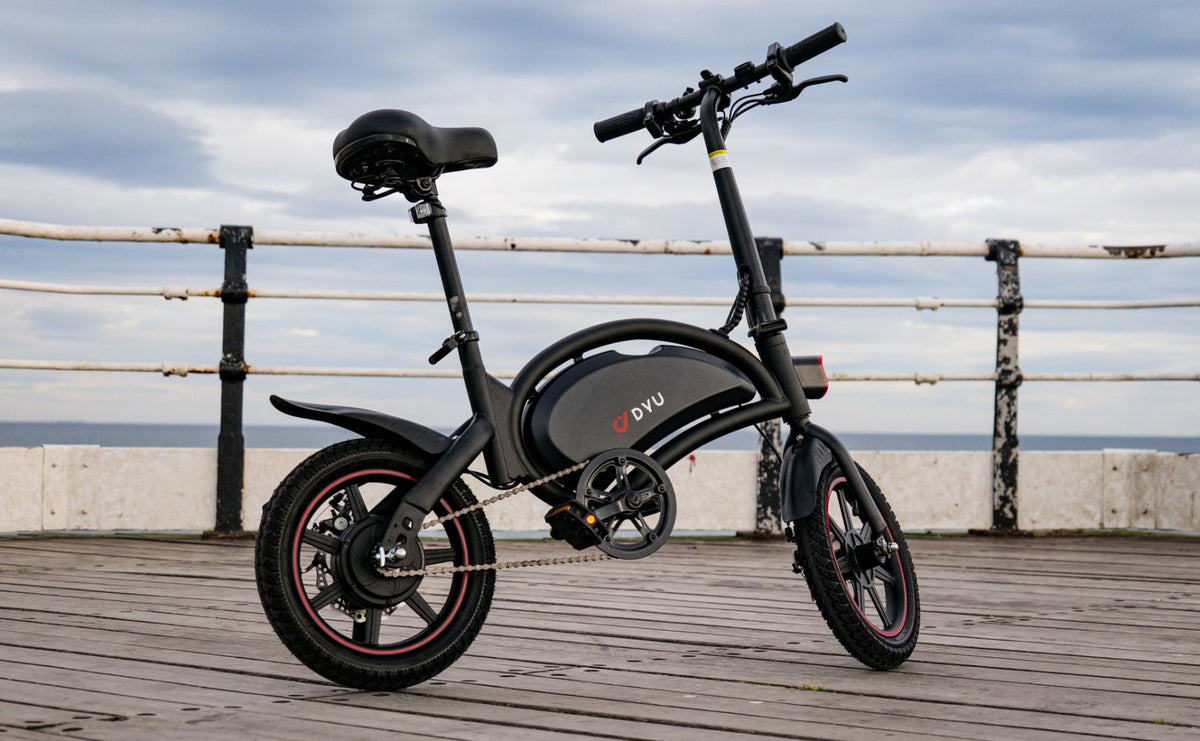
A folding e-bike is closer to an e-scooter. On international trains it travels free as hand luggage, and Trenitalia’s regional trains take a folded bike free as well. It is still bigger and heavier than a scooter: the lightest models we sell weigh 14–17 kg, but many weigh 20–35 kg (September 2026). If you are torn between the two, our comparison electric scooter vs e-bike is a good place to start.
Common mistakes
- Assuming folded is always enough. In Ireland and on Vienna’s buses and trams, the ban explicitly covers folded scooters too.
- Folding at the door. That is where the queue and the annoyed looks start. Do it before the bus arrives.
- Plugging the charger into the socket on board. Deutsche Bahn and Renfe forbid it, even if there is a socket right next to your seat.
- Buying the heaviest model for a commute with stairs. A heavy scooter with a big battery is comfortable on the road but hard to carry – weigh range against weight.
- Expecting the same rules on holiday. They differ from city to city and they change: Vienna tightened its rules on 1 September 2026, and Renfe let e-scooters back on board on 7 September 2026. Check the operator at your destination before you pack.
Thinking about swapping the car for a scooter and the train? We have done the maths in our comparison electric scooter vs car. Not sure an e-scooter suits you at all? Read the pros and cons of an electric scooter before you decide.