
The battery is often the most expensive part of an e-scooter or e-bike, and it’s also the part that’s most affected by what you do every day. Most of the needless wear comes from small habits: plugging in the moment you come in from the cold, leaving the battery full all summer or flat all winter, or grabbing whatever charger happens to fit the socket. Here’s what actually makes a difference – and how to tell when your battery is getting tired.
How do you charge an electric scooter battery properly?
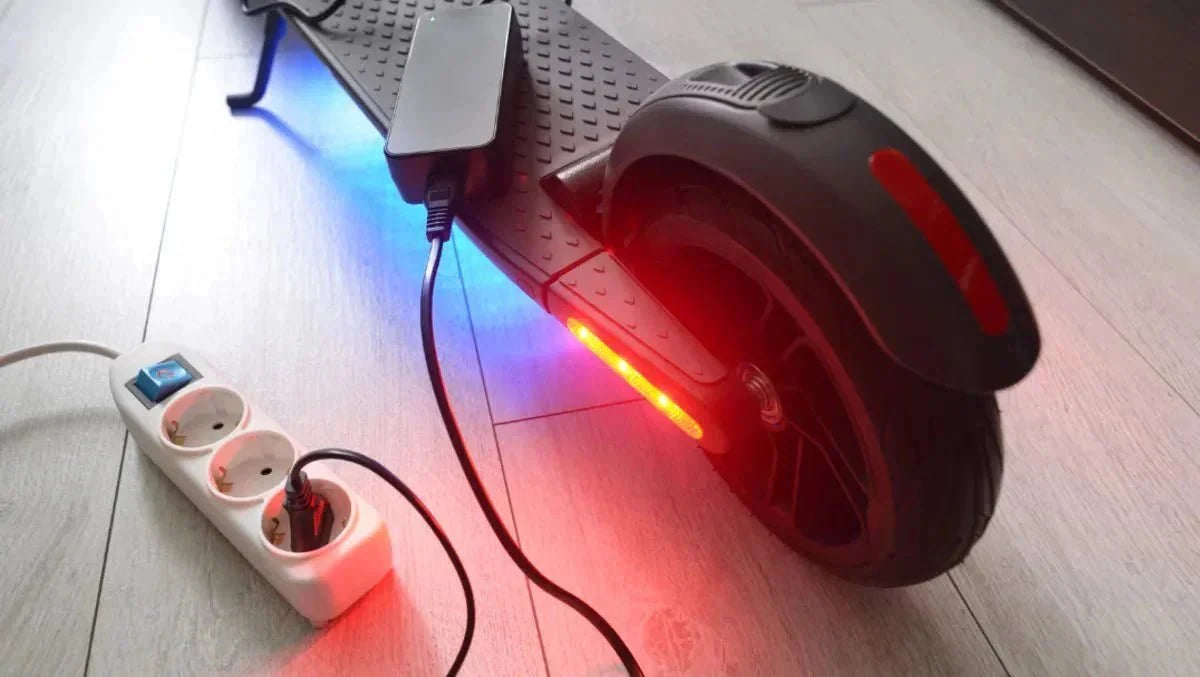
Use the charger made for your model, charge at room temperature while you’re home and awake, and unplug when the light changes. Day to day, charging to around 80% is plenty – top up to full only before a long ride. Don’t run the battery completely flat, and never charge one that’s ice-cold, wet or damaged.
Everyday charging: why 80% is enough
A lithium-ion battery wears fastest when it sits completely full or almost empty for a long time, and when it gets hot. Everything in between is much gentler on it. In practice, that means:
- Charge when it suits you. Lithium-ion batteries have no memory effect, so topping up after a short ride or stopping a charge halfway does no harm. You don’t need to run the battery flat first – just don’t leave it sitting near empty for long.
- Around 80% for everyday riding. In Battery University’s figures, a cell that stops at roughly 80% instead of 100% lasts about twice as many charge cycles – 600–1,000 instead of 300–500. If your scooter’s app or charger has a charge limit, use it. If not, a timer plug on the socket does the job.
- Full before long rides – then go. Charge to 100% the evening before, not a week ahead. Using the battery soon after a full charge is exactly what Specialized’s battery expert recommends in BikeRadar’s five battery tips.
- Let it cool after the ride. If you’ve ridden hard or in the heat, wait half an hour before you plug in. Coming in from the cold? Wait until the battery is at room temperature.
- Unplug when it’s done. The charger and the battery’s management system stop at full, but there’s no reason to leave it plugged in overnight or all weekend.
How long a charge takes depends on the size of the battery and the charger’s current. As a rough rule, the battery’s amp-hours divided by the charger’s amps gives you the hours – a 10 Ah pack on a 2 A charger needs about five – and the last stretch up to 100% is slower. That’s because the battery management system turns the current down as the battery gets close to full; Specialized’s expert compares it to pouring a pint, fast at first and slowly near the top. Bigger batteries can take eight hours or more, so check your manual. What a charge actually costs is worked out in our guide to how much it costs to charge an electric scooter, and you’ll get more kilometres out of every charge with the tips on how to increase e-scooter and e-bike range.
Where to charge at home – and where not to
E-scooter and e-bike fires are rare, but once a lithium battery catches fire it spreads fast and is hard to put out. Most of these fires start while the battery is charging, so this is mostly about where and when you charge:
- Outside your home, if you can. A dry storeroom or garage is even better than your flat, as long as it stays at around +10°C or warmer – if it’s colder, charge indoors. Check what your building or landlord allows in bike rooms and storerooms.
- A hard floor and clear space around it. A surface that won’t burn – not the bed, the sofa or a rug – and no coats, paper or boxes on top of it or next to it.
- Not in the hallway or stairwell. That’s your way out if something happens. London Fire Brigade’s advice on charging e-bikes and e-scooters safely is to charge away from exits and never block your escape route.
- A smoke alarm in the same room – and test that it works.
- When you’re home and awake. Never leave it charging while you’re out or asleep. Plug in when you get home and unplug before you go to bed.
- Dry. If you’ve ridden in the rain, wipe the scooter down and let the charging port dry before you plug in. How much water your model can take is covered in our guide to riding an electric scooter in the rain.
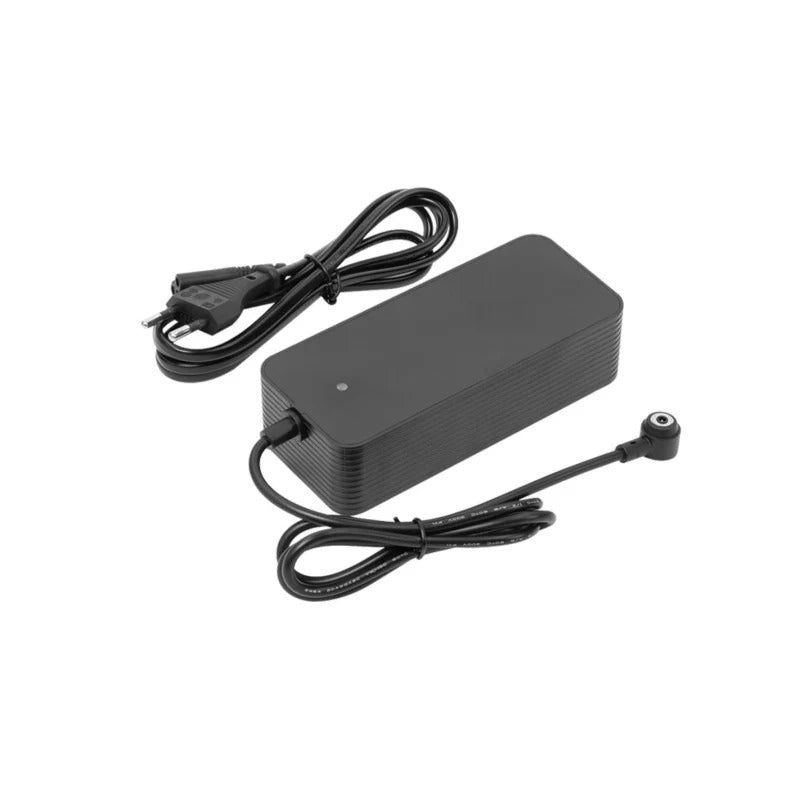
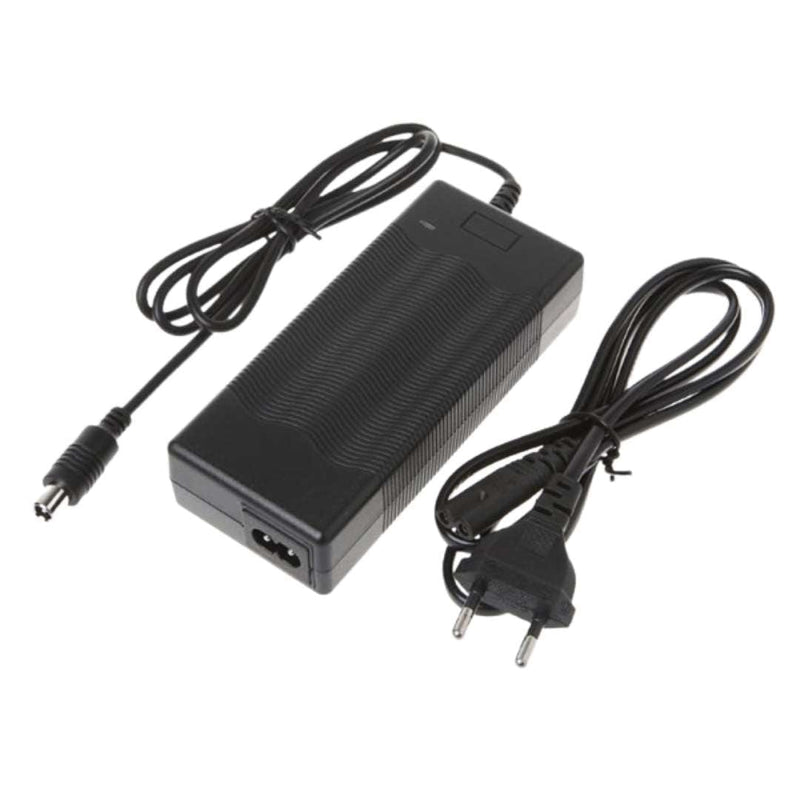
- The original charger or an exact replacement. Same voltage, connector and charging current as the manufacturer specifies – a charger that happens to fit the socket isn’t enough. A 36 V battery, for example, is charged with a charger labelled 42 V. Lost the original? Search for your model among our chargers for e-scooters and e-bikes.
If the scooter has fallen over or the battery has taken a hard knock, check for cracks and dents before you charge it. If the battery gets unusually hot, gives off a strong chemical smell, hisses or crackles, or the casing starts to bulge, unplug it and don’t charge it again – these are the warning signs London Fire Brigade lists. A swollen battery is failing, so stop using it and contact the manufacturer or the shop you bought it from. If it smokes or catches fire: get out, close the door behind you and call 112. Don’t try to put out a battery fire yourself, and don’t breathe in the smoke.
Cold, heat and winter storage
Cold doesn’t permanently harm the battery as long as it isn’t left out in severe cold for long, but it gives out less energy while it’s cold. A BikeRadar tester with more than 200 e-bikes behind him puts the loss at as much as 20% of the range in winter – and the capacity comes back once the battery warms up. What does real damage is charging a cold battery. Bring it in and wait until it has reached room temperature before you plug in – a battery that sits in the deck takes longer than you’d think – and never warm it up next to a radiator. London Fire Brigade’s page on heat, cold and rain says the same: let a cold battery warm up to room temperature, and never charge a frozen one. Some scooters simply refuse: Xiaomi’s Electric Scooter 6 won’t charge while its battery is below 3°C.
Heat is the quiet battery killer. According to Battery University, a battery left fully charged for a year at 25°C keeps about 80% of its capacity, against 96% if it’s stored at 40% – and in real heat it goes even faster. Don’t leave the scooter in direct sun or in a hot car, and don’t park it next to a radiator.
If the scooter is going to stand unused over the winter:
- Charge to about 60%. Neither full nor empty – follow the manual if it gives a different level.
- Store it dry and frost-free, ideally at 10–20°C. Take a removable battery indoors; a scooter with a built-in battery goes in a frost-free storeroom, or indoors in a room with a smoke alarm – not in the hallway or among clothes.
- Unplug the charger and switch the scooter off completely.
- Check the charge level every month and top it up to about 60% if it has dropped. The battery slowly loses charge even when the scooter is standing still, and a battery left flat for a long time can be deep-discharged and stop taking a charge – Xiaomi’s FAQ warns about exactly that.
- In spring: charge to full, pump up the tyres and take a short test ride before your first commute.
Riding all year round? Bring the battery – or the whole scooter – in overnight, but not into the hallway, so you start the day with a warm battery. An insulating cover around an e-bike battery holds on to the warmth on longer rides, and you’ll find them among our e-bike battery covers and scooter battery guards. Wipe off road salt with a damp cloth, never with a pressure washer. More cold-weather tips in our winter checklist for e-bikes and e-scooters.
Signs your battery is wearing out
Every lithium battery loses capacity over time. That’s normal, and at first you just notice that you charge a bit more often. Shimano, for example, guarantees at least 60% of the capacity after 1,000 full charge cycles, and Bosch 60% after 500 cycles or two years – and a good battery is often still usable below that. These are the signs that things are heading the wrong way:
- The range shrinks in the same conditions. Compare summer with summer – cold weather and winter tyres cut the range even on a healthy battery. And measure on a route you know rather than trusting the display: when Tom’s Guide tested the Segway Max G3, the display promised about 40 km in Sport mode, but the ride worked out at roughly 18 km.
- The scooter cuts out under load. It’s normal for the percentage to dip on a steep hill and creep back up. If the scooter switches off on the hill, or the percentage drops more than it used to on the same hill, a cell may be weak.
- The battery drains while it’s standing. If it loses noticeable charge without being ridden, something is wrong.
- The charger turns green quickly, but the charge doesn’t last.
- Battery error codes. Many models show a code when the battery, or the communication with it, plays up – see for example the Xiaomi scooter error codes.
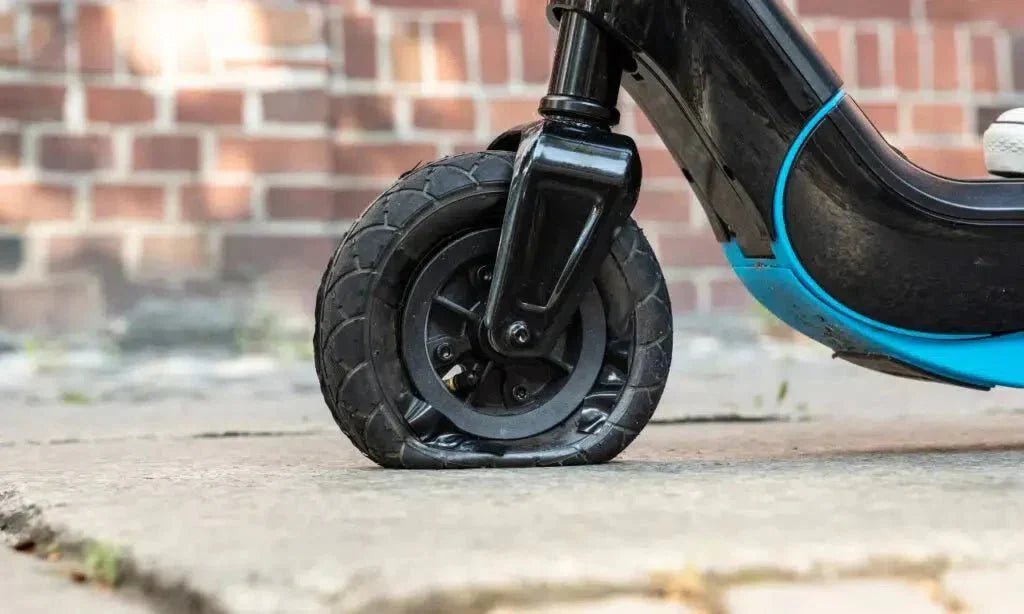
Before you blame the battery: check the tyre pressure and that the brakes aren’t dragging, and test with an identical charger (same voltage and connector) if you can borrow one. Soft tyres and a dragging brake eat more range than you’d think. And a swollen battery isn’t worn out – it’s damaged, and it shouldn’t be charged or used again.
Replacing the battery – and recycling the old one
A battery isn’t finished just because it has lost 20% of its capacity. It’s finished when it no longer covers your rides with a bit of margin, or when the scooter starts cutting out. Then you have three options:
- A new battery. It has to be built for your model: same voltage, connector, shape and management electronics. Never switch to a different voltage from the one the scooter is designed for. Search for your model among our electric scooter batteries or in the spare parts finder. A new original battery rarely comes cheap, so it pays to look after the one you have.
- Recelling. Some specialists replace the cells in a worn pack, and that can cost less than a new battery. Cycling UK’s guide to e-cycle batteries lays out the trade-off: it can be an option, but the official industry advice is against it, and non-expert recelling is a real fire risk. A rebuilt pack won’t carry the original maker’s warranty either – so if you go this way, pick a specialist with a good reputation, and never open the battery yourself.
- Fix what’s actually broken. Sometimes it’s the charger, the charging port or a cable that’s playing up, not the battery. More on repairing instead of replacing.
All our products come with a 2-year warranty. It covers manufacturing and material defects, including in the battery and the charger supplied with it – but not the battery’s normal ageing, when the capacity drops gradually. Read more on our warranty page or contact customer service if you’re unsure.
Hand the old battery to the staff at your local recycling centre, or to a shop that sells batteries for e-scooters or e-bikes – never put it in household waste or a recycling bin. Tape over the terminals if they’re exposed, and call the recycling centre first if the battery is swollen. If the battery is built in, the whole scooter goes to the recycling centre as electrical waste. BikeRadar’s guide to e-bike batteries has a section on end-of-life and recycling too.