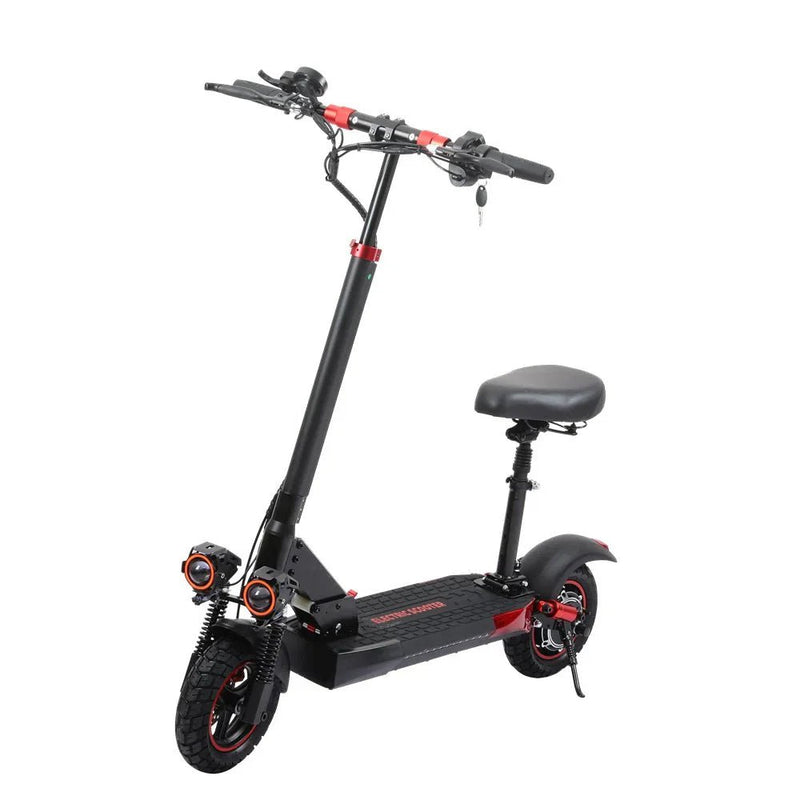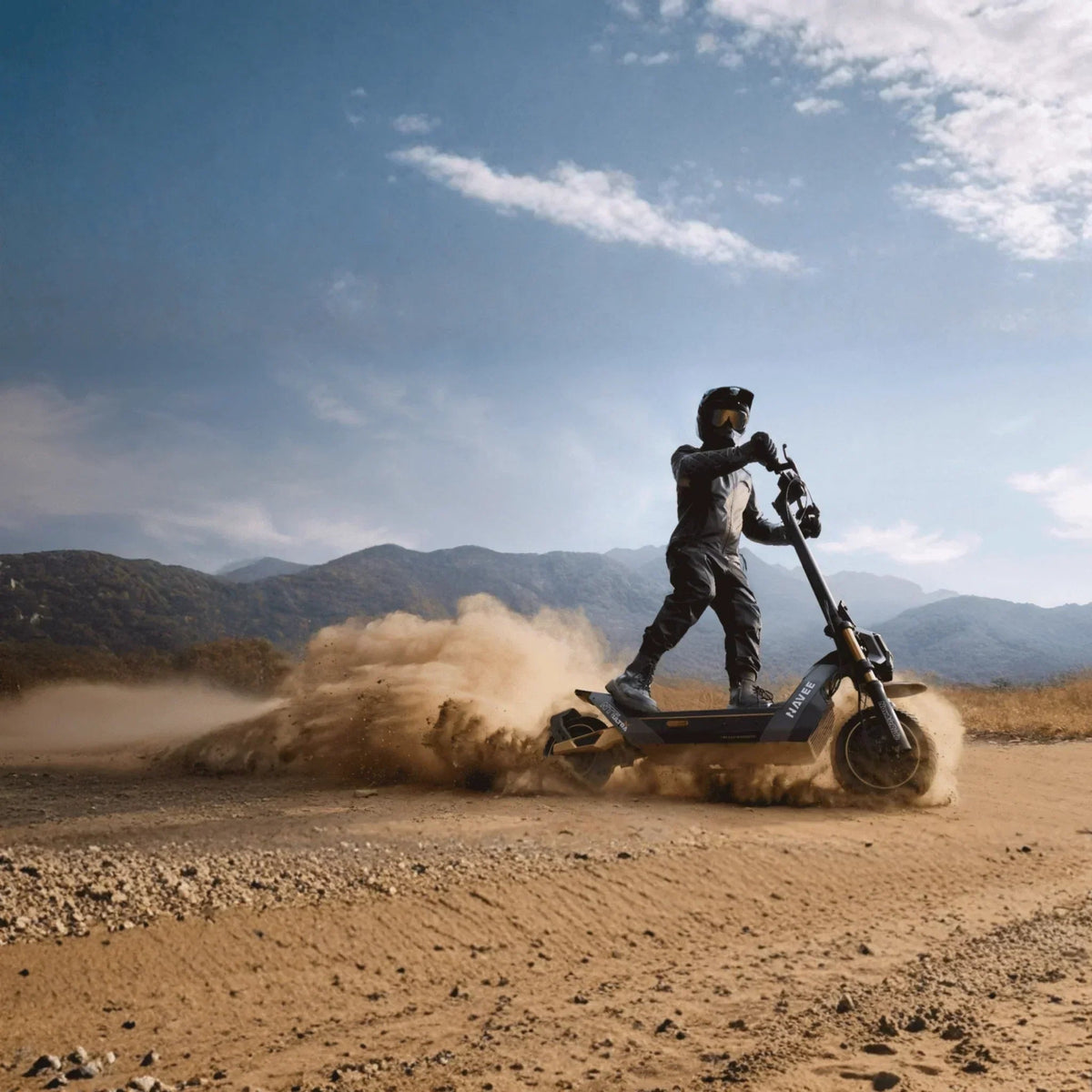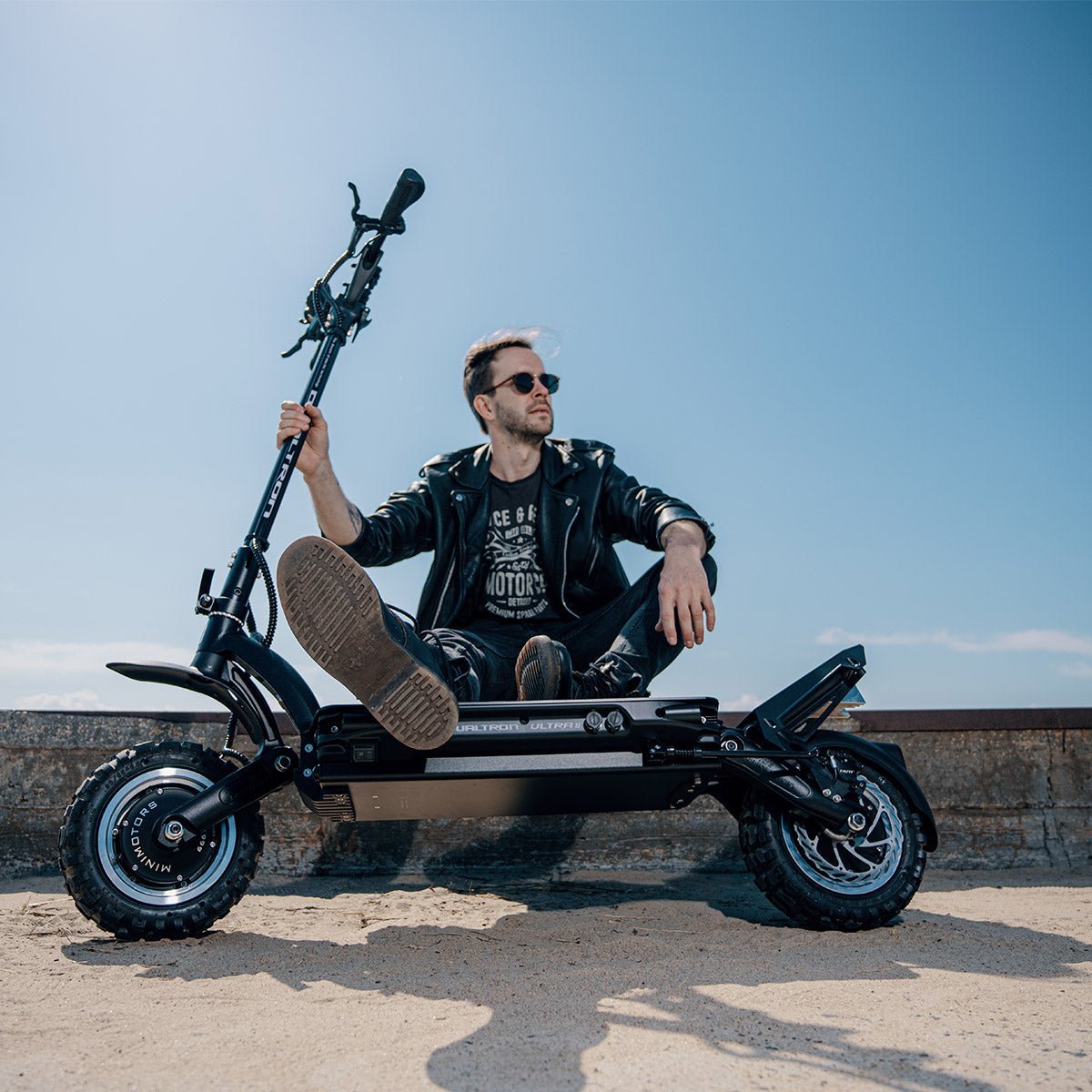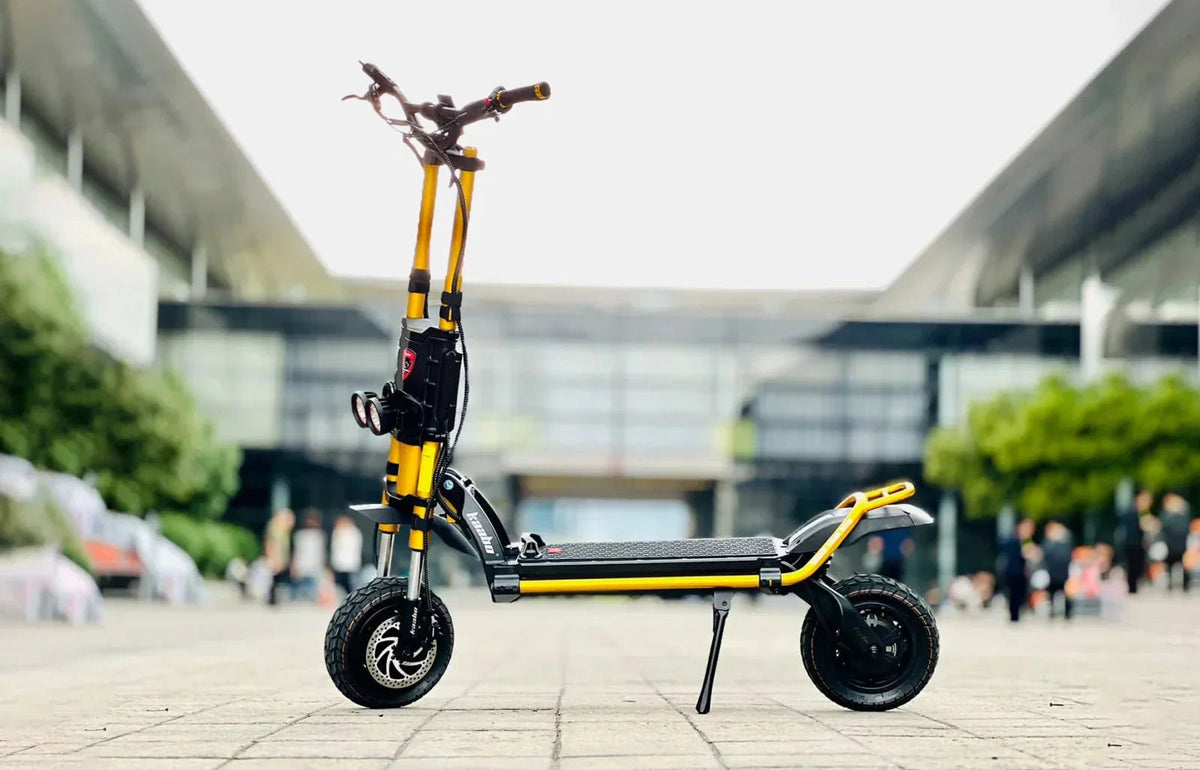

Which iScooter should I buy – the i9 Max or the i10? The iX3 or the iX4? The model names don’t tell you much. The series overlap, and what really separates the models in everyday life is weight, tyres, brakes and battery. Here we go through what decides the choice, using the figures from our product pages.
Which iScooter suits you? The short answer
If the scooter has to be carried up stairs or lifted into the car, start with the i9M or i9 Max, which weigh 13–15 kg. If you mostly ride short distances on tarmac and want air-filled tyres and suspension, look at the i10 or W8 at around 20 kg. For gravel, hills or a rider over 100 kg: the iX4 or W10, which take 150 kg and weigh around 25 kg. If you want to sit: the F2 or F3 on smooth surfaces (no suspension), the F7 or Y16 if you want suspension and bigger wheels. The DX5 series and the Y18 are e-cross bikes – a different kind of vehicle. Decide how the scooter will be carried and stored before you compare range.
How the models group in everyday use
The figures in the table are the manufacturer’s, taken from our product pages (September 2026). Every model and its full specification is in the iScooter collection – here we look at what the differences mean when you live with the scooter.
| Type | Models | Weight | Suits you if you | What you live with |
|---|---|---|---|---|
| Easy to carry | i9M, i9 Max, W6, W7 | 13–16 kg | carry the scooter up stairs, into a lift or into the car | 25–40 km quoted range, one disc brake; the i9M and W6 have no suspension |
| Everyday on tarmac | i10, W8, i10 Pro | 20–25 kg | mostly ride on tarmac and want air-filled tyres and suspension | heavy to carry far, one disc brake plus E-ABS |
| Gravel and hills | iX3, iX4, iX5S, W9, W9 Air, W10, iF1, GX3 Pro | 22–28 kg | ride on gravel, up hills or weigh more than 100 kg | two disc brakes and chunky tyres – but a lot to lift |
| Dual motor | iX7 Pro, iX8, W12 | 30–38 kg | want the most power and range on a stand-up scooter | wheeled rather than carried, 7.5–10 hours to charge |
| With a seat | F2, F3, i12, F7, Y16 | 17.5–34.5 kg | want to sit down while you ride | the F2, F3 and Y16 have drum brakes, the Y16 doesn’t fold |
| E-cross | DX5, DX5 Pro, DX5 Max, Y18 | 46–56 kg | want a heavier-built vehicle with a seat and big wheels | don’t fold, need a ground-level space |
Foldable doesn’t mean portable. All the stand-up models fold – even the W12 at 37.8 kg – but one flight of stairs a day feels very different with 15 or 25 kg in your arms. Walk through the route home, the lift and the car boot before you decide.
What applies where you ride is covered in our overview of electric scooter laws in Europe.
i9M, i9 Max, i10 or W8 – the lighter everyday models
- i9M or i9 Max. Almost the same weight (13.1 and 14.7 kg) but a different set-up. The i9M has air-filled tyres but no suspension and a quoted range of 25 km. The i9 Max has front and rear suspension, a quoted 40 km and puncture-proof honeycomb tyres. Honeycomb tyres can’t puncture, but they ride harder than air – Tom’s Guide’s scooter tester advises choosing air-filled tyres if you can, because they have far more give over potholes and bumps. The suspension on the i9 Max takes some of the edge off.
- i10. 20 kg with 10-inch air-filled tyres, front and rear suspension and indicators. The difference from the i9 Max lies less in the range (45 vs 40 km quoted) and more in the air-filled tyres and the stronger motor (650 vs 500 W). The downside is just over 5 kg more to carry.
- W8. 21 kg with 9.3-inch air-filled tyres with an off-road tread, front and rear suspension and indicators. Choose it over the i10 if your route has gravel and kerbs; the i10 has a slightly longer quoted range.
- i10 Pro. 25 kg, chunky 10-inch tyres and 800 W – a step towards the heavier-built models, but still one disc brake plus E-ABS.
- W6 and W7. The W6 (15 kg) has puncture-resistant tyres but no suspension. The W7 (16.1 kg) has suspension and 8.5-inch wheels but a maximum load of 100 kg – the lowest in our iScooter range.

If you’re torn between air and puncture-proof, we go through the pros and cons in solid vs pneumatic tyres.
iX3 or iX4 – and when the iX5S or W10 is worth it
The iX3 and iX4 share the same motor (800 W), 10-inch chunky air-filled tyres, two disc brakes with E-ABS and front and rear suspension. The difference: the iX4 has a bigger battery (48 V 15 Ah vs 10 Ah, 50 vs 40 km quoted), takes 150 instead of 120 kg and is rated for steeper climbs (25° vs 14°). The downside is 3 kg more – 25 vs 22 kg. If you weigh over 100 kg or live somewhere hilly, the iX4 is the more sensible choice.
- W9 and W9 Air sit in the same weight class as the iX3 (21.75 and 22.7 kg). The W9 has 1,000 W, the W9 Air 800 W.
- W10 (24.8 kg, 1,200 W, 60 km quoted) is rated IPX6, the highest water rating in our iScooter range, and the iF1 is rated IPX5.
- iX5S (28 kg) and GX3 Pro (27 kg) have 11-inch wheels. The GX3 Pro starts with an NFC card; the iX5S has no app.
- Dual motor: iX7 Pro (30 kg, 2 × 1,000 W, 80 km quoted), iX8 (35 kg, 12-inch wheels, hydraulic disc brakes and two charging ports) and W12 (37.8 kg, 2 × 1,500 W, 100 km quoted). These are scooters you wheel rather than carry.
The heavier-built models above are also among our off-road electric scooters, where you can compare them with other brands. Torn between iScooter and KuKirin? We go through the differences between the KuKirin G2 and G2 Pro in a separate guide.
Seat or e-cross – the F, Y and DX5 series
F2 and F3 are light seated scooters (17.5 and 19.5 kg) that fold, with drum brakes and no suspension. The F3 has the stronger motor (1,000 vs 500 W) and a quoted 60 km against the F2’s 30 km. The i12 has a seat, 12-inch air-filled tyres, front and rear suspension and two disc brakes, but weighs 25 kg.
The F7 has 16-inch off-road tyres, hydraulic disc brakes, front suspension and a removable battery (30.25 kg). The Y16 has 14-inch wheels, a quoted 100 km, drum brakes and an NFC card instead of an app, but it doesn’t fold (34.5 kg). The seated models F2, F3, i12, F7 and Y16 are also among our electric scooters with seats.
DX5, DX5 Pro, DX5 Max and Y18 are e-cross bikes: 46–56 kg, 15–17-inch wheels and not foldable. They’re closer to a light motorbike than to an electric scooter and need a ground-level space – a garage or a storage room without stairs. Of these, the DX5 Max has a removable battery. You can compare them with other brands among our e-cross bikes.
Tyres, brakes and suspension – what you feel daily
The brakes follow the size of the scooter, and they differ more than you’d expect within one brand:
- One disc brake plus E-ABS (i9M, i9 Max, W6, W7, W8, i10, i10 Pro). E-ABS is the electronic motor brake – it helps, but it doesn’t replace the mechanical brake.
- Two disc brakes (iX3, iX4, iX5S, iX7 Pro, W9, W9 Air, W10, W12, iF1, GX3 Pro and i12). More stopping power, but two sets of pads to keep an eye on. Weak braking, a loud howl when braking in the dry or a lever that travels further than it used to are typical signs of worn or contaminated pads, as BikeRadar explains for bikes.
- Hydraulic disc brakes (iX8, F7, DX5, DX5 Pro, DX5 Max). The most stopping power for the least hand force. Get used to them in a closed-off area where you have permission to ride first – grabbing a hydraulic front brake hard can lock the front wheel.
- Drum brakes (F2, F3 and Y16; the Y18 has one disc brake and one drum brake). Enclosed and low-maintenance, but the cable needs tightening now and then.
The i9M, W6, F2 and F3 have no suspension, the F7 has it at the front only and the other models have it front and rear. Without suspension you feel kerbs and joints more, especially with puncture-proof tyres.
Most of the models have air-filled tyres – a softer ride, but a puncture can happen. How to repair or replace one is in our guide to changing an electric scooter tyre. Most models are rated IP54 or IPX4, the iF1 IPX5 and the W10 IPX6. That covers splashes and rain, not riding through deep puddles – we explain what the numbers mean in electric scooter in the rain, and if you ride all year round there are more tips in electric scooter in winter.
Charging, app and spare parts once you own one
Of the models we sell, the F7 and DX5 Max have a removable battery. All the others are charged where they’re parked, so the scooter needs a spot near a socket. Quoted charging times range from 4–6 hours for the i9 Max to 9–10 hours for the Y16, Y18, DX5 Pro and DX5 Max. Charge when you’re at home and awake: according to the London Fire Brigade, most e-bike and e-scooter fires happen while the battery is charging, so never leave it charging unattended or while you sleep, keep it away from your exit route and use the charger that came with it. More charging habits are in our guide to charging an electric scooter battery.
Quoted range is the manufacturer’s figure in good conditions. The same Tom’s Guide tester, who weighs close to 90 kg and lives somewhere hilly, says he typically gets about 50–60 per cent of the advertised range. Plan with a margin, and read how to increase your range.

The app differs between models. According to our product pages, the iX3, i10 Pro, iF1 and GX3 Pro among others use the iScooter Club app, the W6 uses Voltix and the iX7 Pro uses Minirobot. The iX5S, iX8, F2, F3, i12, Y16, Y18, DX5 Pro and DX5 Max have no app, and the Y16, Y18, GX3 Pro and DX5 models use an NFC card. Check the manual before you download anything.
The spare parts finder has parts for the iX3, iX4 and i9 Max among others – for the iX3 and iX4, for example, brake pads, a brake disc, thumb throttle, controls and kickstand, and for the i9 Max brake pads and a kickstand. Always search by the exact model name: the i9, i9M and i9 Max are different scooters, as are the iX5 and iX5S. If you can’t find the part, ask customer service. All iScooter models come with a 2-year warranty from us.

If the scooter will be parked outside or in a shared bike store, read how to protect your electric scooter from theft. And buy the helmet at the same time – you’ll find one among our helmets.
Common mistakes when choosing an iScooter
- Choosing by quoted range. It applies in good conditions. Plan with a margin, especially in the cold and on hills.
- Thinking foldable means portable. The W12 folds, but it weighs 37.8 kg.
- Assuming disc brakes front and rear. The F2, F3 and Y16 have drum brakes, and several light models have one disc brake plus E-ABS.
- Forgetting the maximum load. The W7 takes 100 kg, the other models 120 or 150 kg. If you’re close to the limit, choose a model with a margin.
- Buying parts on an approximate model name. The i9, i9M and i9 Max – and the iX5 and iX5S – are different scooters.
- Counting on a test ride and sending it back. An electric vehicle that has been ridden or registered in the manufacturer’s app can’t be returned as unused. You can unpack it and check that it powers on – read the returns information before you order.