
If you’re weighing up the KuKirin G2 Pro vs G2, you’ve probably noticed that almost everything in the range is called G2 something: G2, G2 Pro, G2 Max, G2 Master, G2 Ultra – plus ABE and VMP versions. The names sound like a ladder where each step beats the one before, but it isn’t quite that simple. Below we go through what actually separates the models in everyday use: weight, seat, motor, climbing ability, battery, brakes and charging. The figures are the manufacturer’s, taken from manuals and product sheets, and we say plainly where the trade-offs are.
G2, Pro, Max and Master – what the names mean
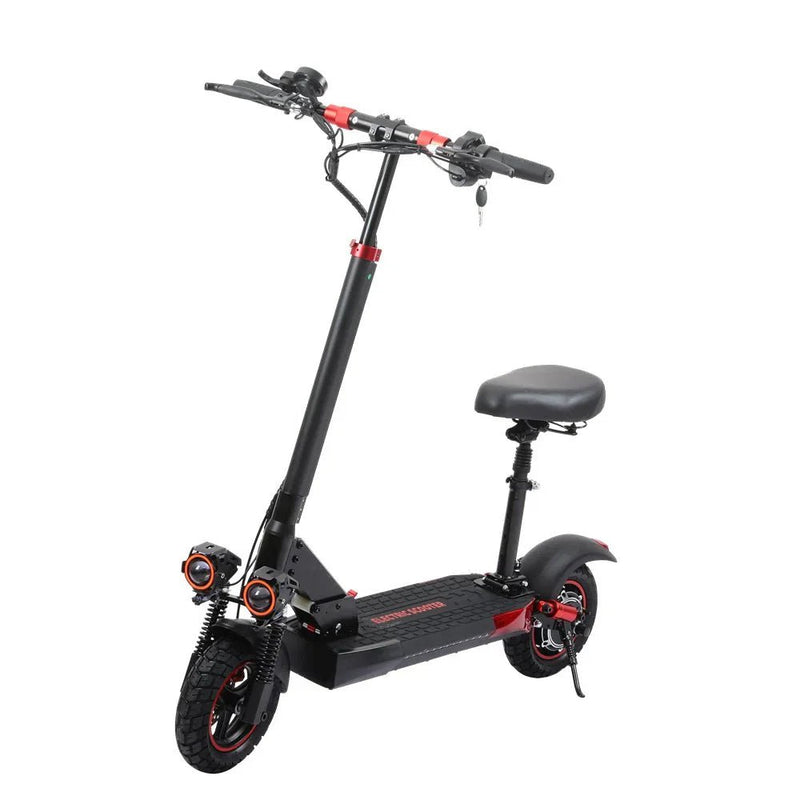
The most common misconception is that Pro means more powerful. The G2 has an 800 W motor, while the G2 Pro has 600 W – but the regular G2 Pro comes with a seat and smaller 9-inch tyres. The G2 Max has a 1,000 W motor, a seat and a bigger battery. The G2 Master and G2 Ultra have two motors but no seat, and the G2 Master is the heaviest in the family.
The ABE and VMP labels mark separate 500 W versions limited to 20 and 25 km/h respectively – they are models in their own right, not a mode you switch on. The G2 Pro (ABE) and G2 Pro (VMP) also have no seat mounts, so a seat can’t be fitted to them.
| Model | Motor | Battery | Weight | Climb | Tyres | Seat |
|---|---|---|---|---|---|---|
| G2 | 800 W | 720 Wh | 26 kg | 20° | 10-inch | No |
| G2 Pro | 600 W | 720 Wh | 26.7 kg | 20° | 9-inch | Yes |
| G2 Max | 1,000 W | 960 Wh | 31 kg | 30° | 10-inch | Yes |
| G2 Ultra | 2 × 800 W | 864 Wh | 30.4 kg | 26° | 10-inch | No |
| G2 Master | 2 × 1,000 W | 1,082 Wh | 41.5 kg | 20° | 10-inch | No |
Motor output is nominal, and the climb figure is the manufacturer’s stated maximum. Battery capacity in watt-hours (volts × amp-hours) is the most honest number to compare when you’re thinking about range. KuKirin was previously called Kugoo Kirin, so the old name still turns up in listings and older reviews – Electrek’s test of the Kugoo Kirin G3 from 2022, for example.

Which KuKirin should I buy?
Start from how you’ll use the scooter, not from the top speed or the number of motors.
- Easy to carry: S1 Max. 16 kg, 8-inch puncture-free honeycomb tyres and rear suspension only. It’s the easiest one to take with you, but also the weakest on hills and the one you’ll feel most on rough tarmac.
- City and gravel: G2, T3 and M4 Max. 800 W, front and rear suspension and 10-inch pneumatic tyres, at around 24–27 kg. These are the all-rounders in the range.
- Want to sit down now and then: G2 Pro and G2 Max. Both come with a seat – that applies to the regular G2 Pro, not the ABE and VMP versions. The G2 Max has more motor and a bigger battery, but weighs just over four kilos more. You’ll find more models among our electric scooters with seats.
- Steep hills: G3 Pro, G4 Ultra, G2 Max and G2 Ultra. The manufacturer quotes 35 degrees for the G3 Pro, 30 for the G4 Ultra and G2 Max and 26 for the G2 Ultra, against 20 for most of the others. The price you pay is weight: 30–40 kg.
- Gravel and long rides: G2 Master and G4. Big batteries of 1,082 and 1,200 Wh, but heavy with it: 41.5 and 37 kg respectively. Despite its two motors, the G2 Master is rated for only 20 degrees of climb, the same as the G2, so it suits gravel and uneven ground better than really steep hills. The G4 has 11-inch tyres. Both work best if the scooter mostly lives in a garage and rarely needs lifting.
The G2 Pro (ABE) is the version sold for Germany, and the G2 (VMP) and G2 Pro (VMP) are the versions sold for Spain. What applies where you ride is covered in our overview of electric scooter laws in Europe. KuKirin also makes the X1 electric cross bike, which you’ll find in our electric cross range, and you can see the whole brand in the KuKirin collection. Torn between KuKirin and iScooter? Read which iScooter suits you as well.
Weight matters more than top speed
Weight is easy to underestimate. Many KuKirin models weigh 22–27 kg, while the G2 Max, the dual-motor models and the G4 models come in at 30–42 kg. They all fold, but above 25 kg most people only carry them short distances – up a few steps or into the car – not all the way up to a fourth-floor flat.
A simple test: lift a fully packed suitcase and carry it up a flight of stairs. If that feels heavy, a model over 30 kg is the wrong choice for you, however good it is on gravel. If you plan to combine the scooter with the train or bus, Tom’s Guide’s scooter tester suggests staying under roughly 14 kg so you can carry it up and down station stairs. No KuKirin is that light – the S1 Max at 16 kg comes closest.
Range and charging – plan conservatively
KuKirin quotes anything from 39 km for the S1 Max to 70–80 km for the largest models. Figures like these are measured in favourable conditions, and real-world range is lower: the same Tom’s Guide tester, who rides in a hilly area and weighs close to 90 kg, typically gets 50–60% of the advertised range. Rider weight, hills, cold weather and how much you ride at full throttle all play a part. So compare the batteries in watt-hours: from 374 Wh in the S1 Max, through 720–1,082 Wh in the G2 family, to 1,200 Wh in the G4 and G4 Ultra and 1,206 Wh in the G3 Pro. How to get more out of the battery is covered in our guide on how to increase your range.
Charging times are given as 7–8 hours for the S1 Max, T3, G2 Pro and the ABE and VMP versions of the G2 Pro, 8–10 hours for the G2, G2 Ultra and M4 Max, and 10–12 hours for the G2 Max, G2 Master and G4. The G4 Ultra is rated at about 5–6 hours with a 5A charger, and the G3 Pro at 4–11 hours depending on the charger. Of these models, only the G3 Pro has a removable battery, and it also has two charging ports – the others are charged where they stand, so think about where you have a socket before you buy. How to charge so the battery lasts is explained in our guide on how to charge an electric scooter battery.
Comfort: tyres, suspension and weather
Every model except the S1 Max has front and rear suspension. Tyre size still makes a big difference: the G2 Pro and the ABE and VMP versions of the G2 Pro have 9-inch tyres, most others 10-inch and the G4 models 11-inch. Larger pneumatic tyres take cobbles and roots more softly, and small wheels cancel out some of what the suspension gives you.
The S1 Max has puncture-free honeycomb tyres. You avoid punctures, but the ride feels different – solid tyres simply have less give than air-filled ones over potholes and bumps. Which type suits you is covered in our guide to solid vs pneumatic tyres, and if you do get a puncture, we show you how to change an electric scooter tyre.
Water protection is IP54 on most models and IPX4 on the G2 Master, G2 Ultra, G2 (VMP) and G4 Ultra. What that means when it rains is explained in our guide to riding an electric scooter in the rain.

Brakes and motor – more power asks more of you
Most KuKirin models have front and rear disc brakes, several of them backed up by an electric motor brake. The G3 Pro has hydraulic brakes, which bite harder with less force at the lever. That’s good when you need to stop quickly, but a strong front brake can lock the wheel if you grab it too hard. So practise hard braking in a closed-off area where you have permission to ride before you head out on longer trips. The S1 Max has an electric brake and a foot brake instead.
The single 800 W motors are rated for 20-degree climbs, the G2 Ultra for 26, the G2 Max and G4 Ultra for 30 and the G3 Pro for 35 degrees. Despite its two motors, the G2 Master is rated for 20 degrees, the same as the G2. All models except the S1 Max are built for riders up to 120 kg. If you’re close to that limit or live at the top of a steep hill, look at the climb rating rather than the number of motors. If you mostly ride flat city streets, you’re paying for power you’ll rarely use – in weight and often in longer charging times.
Spare parts and service
You’ll find KuKirin parts in our KuKirin spare parts collection, and in the spare parts finder you can search by model. Always search with the full model name. Some parts are shared between models – the brake disc and the display, for example, are the same on the G2 Pro and G2 Max – while others, such as the controller, are unique to each model. The G2 Pro, G2 Pro (ABE) and G2 Pro (VMP) are different scooters, so don’t assume everything fits across them. The range also covers parts for the older G3.
All our electric vehicles come with a 2-year warranty. If you’re unsure which part fits your model, ask our customer service before you order.

Common mistakes when choosing a KuKirin
- Assuming Pro means most powerful. The G2 Pro has a weaker motor than the G2 – what the regular G2 Pro gives you is the seat.
- Taking claimed range at face value. Compare watt-hours and expect less in real life.
- Forgetting the weight. A model over 30 kg isn’t something you’ll want to carry up the stairs every day.
- Mixing up the versions. The regular G2 Pro and its ABE and VMP versions have different motors, speeds and parts – and the ABE and VMP versions of the G2 Pro can’t take a seat.
- Choosing by the number of motors. Two motors add weight and don’t always climb best – the G2 Master is rated for 20 degrees, the single-motor G2 Max for 30.
- Not thinking about where you’ll charge. Of the KuKirin models here, only the G3 Pro has a battery you can take out.