
X8 or X9 Plus? X9B or X9 Pro Max? The names sit close together, but the models don’t. What separates them in everyday life is how much they weigh, how big the battery is and whether they have suspension. Here we go through what decides the choice, using the figures from our product pages.
Which HX suits you? The short answer
Carried up stairs or on the bus: the X7 (12 kg) or X8 (15 kg) – the X8 has almost twice the quoted range. Longer commutes: the X9 Plus, or the X9B with front and rear suspension. Hilly area: the X9 Pro Max. Want to sit: the S20. The X10, at 38 kg with two motors, is for long rides.
How the HX models differ in everyday use
The figures in the table are the manufacturer’s, taken from our product pages (October 2026). Every model with its full specification is among our HX electric scooters – here we look at what the differences mean when you live with the scooter.
| Type | Models | Weight | Quoted range | What you live with |
|---|---|---|---|---|
| Easy to carry | X6, X7, X8 | 10.5–15 kg | 20–45 km | no suspension; the X6 has small solid tyres and only a foot brake |
| Commuting with a bigger battery | X11, D01 | 17.5–19 kg | 50–55 km | the X11 has front suspension, the D01 an app but no suspension |
| The X9 family | X9 Plus, X9B, X9 Pro Max | 19–22 kg | 70–75 km | two disc brakes; only the X9B has suspension |
| With a seat | S20 | 19 kg | 40 km | fixed battery, charged where the scooter is parked |
| Dual motor | X10 | 38 kg | 100 km | wheeled rather than carried, 8–10 hours to charge |
Quoted range is the manufacturer’s figure in good conditions. The Tom’s Guide scooter tester, who weighs close to 90 kg and lives somewhere hilly, says he typically gets about 50–60 per cent of the advertised range. Plan with a margin, especially in the cold and on hills, and read how to increase your range.
What applies where you ride is covered in our overview of electric scooter laws in Europe.
X6, X7 or X8 – the light models
- X6. 10.5 kg and the lightest HX of all. It has 5.5-inch solid tyres, no suspension, only a foot brake and a quoted range of 20 km. It suits short trips on smooth tarmac – on cobbles and joints you feel every bump. The maximum load is 100 kg.
- X7. 12 kg with 10-inch air-filled tyres, a disc brake, E-ABS and a foot brake. A quoted 25 km and 3 hours to charge – the lightest HX with air-filled tyres.
- X8. It has the same dimensions as the X7 and shares many spare parts with it, but the battery is twice as big (36 V 10.4 Ah vs 5 Ah) and the quoted range is 45 km. It weighs 15 kg and also charges in 3 hours. Mind the maximum load: 100 kg against the X7’s 120 kg.
Neither the X7 nor the X8 has suspension. If you want a softer ride, we sell the Monorim front suspension kit, which according to the product page is made for the HX X7 and X8 among others – ask customer service if you’re unsure whether it fits your version.
X9 Plus, X9B or X9 Pro Max
The three X9 models sit in the same range class but are set up differently:
- X9 Plus (19 kg): 36 V 15.6 Ah, a quoted 70 km, two disc brakes and 10-inch air-filled tyres. No suspension – the tyres take the bumps.
- X9B (21 kg): the same battery and quoted range as the X9 Plus, but with front and rear suspension. Two extra kilos for a softer ride – often the best X9 choice if your roads are rough. Charging is quoted at 7–8 hours against 5–6 for the X9 Plus.
- X9 Pro Max (22 kg): a 48 V battery, a quoted 75 km and a stronger motor rated for 30° climbs against 25° for the X9 Plus and X9B. No suspension.
The names are similar but the batteries aren’t: the X9 Pro Max runs at 48 V, the X9 Plus and X9B at 36 V. So always give the exact model when you order parts.
D01, X11, S20 and X10 – when they’re worth it
- D01 (17.5 kg): a 52 V battery, 11-inch air-filled tyres, a quoted 55 km and the only HX scooter with an app. One disc brake and no suspension.
- X11 (19 kg): front suspension, 10-inch air-filled tyres and a quoted 50 km. The only HX scooter without cruise control, which you notice on long straight stretches.
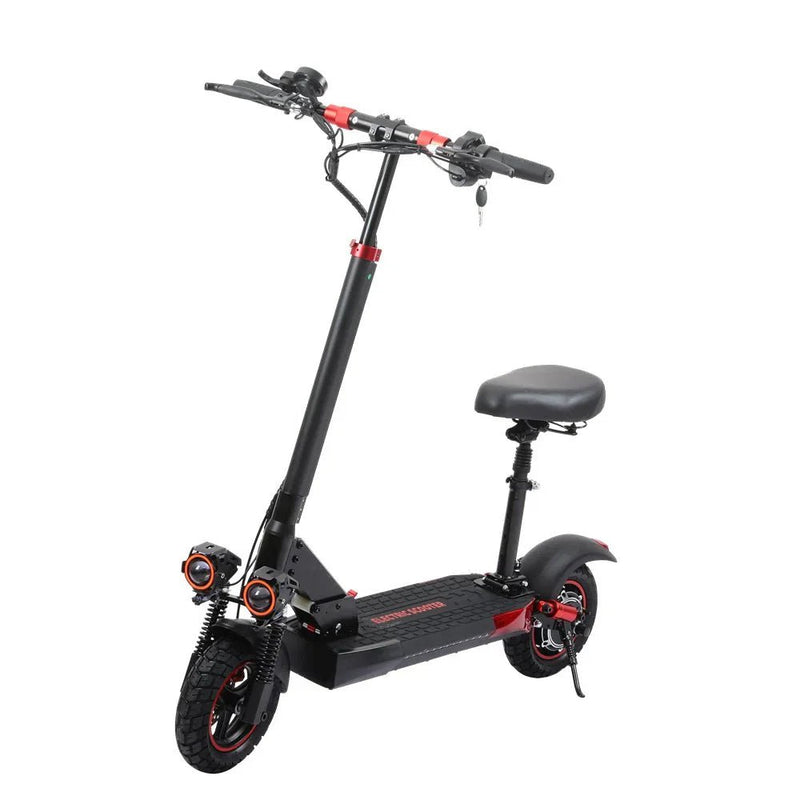
- S20 (19 kg): a seat, adjustable handlebars, front and rear suspension and two disc brakes. The battery is fixed, so it needs a spot near a socket. Compare it with other brands among our electric scooters with seats.
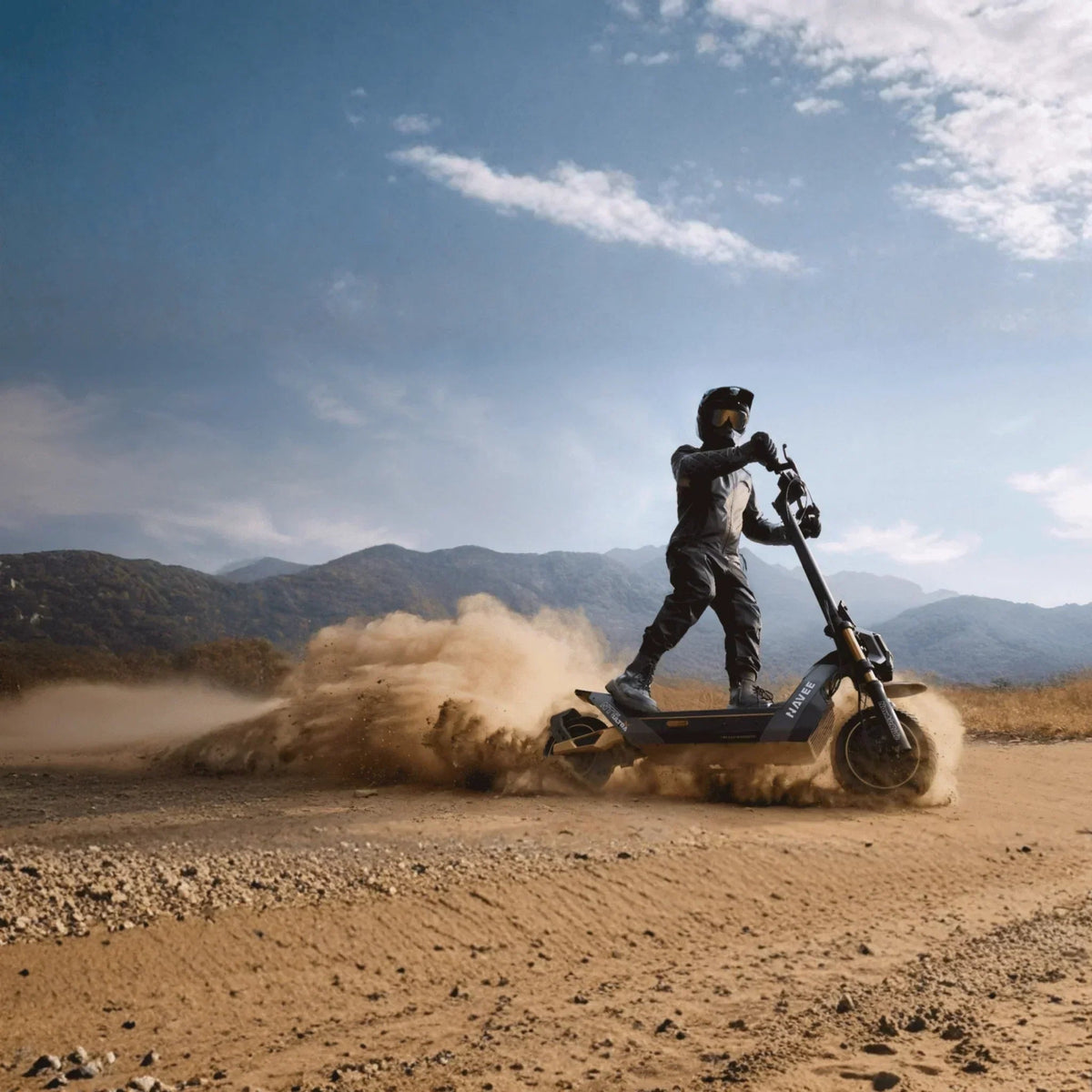
- X10 (38 kg): two motors, 11-inch off-road tread air-filled tyres, front and rear suspension and a quoted 100 km. Charging is quoted at 8–10 hours, and it has two charging ports. It folds, but at 38 kg you’ll wheel it rather than carry it.
Torn between HX and iScooter? We go through which iScooter to buy in a separate guide.
Tyres, suspension and brakes – what you feel daily
Every HX scooter except the X6 has 10- or 11-inch air-filled tyres. They ride more softly than solid tyres but can puncture – we go through the pros and cons in solid vs pneumatic tyres. For the X7 and X8 we also sell a puncture-proof 10-inch honeycomb tyre.
The X9B, S20 and X10 have front and rear suspension, and the X11 has it at the front. The other models rely on their tyres, so you feel kerbs and joints more.
The X9 Plus, X9B, X9 Pro Max and S20 have two disc brakes. The X7, X8 and X10 have a disc brake, E-ABS – the electronic motor brake – and a foot brake, the X11 a disc brake and E-ABS, and the D01 one disc brake. The X6 has only a foot brake, so adjust your speed to match.
Most HX models are rated IPX4 or IP54, and the X10 IP55. That covers splashes and rain, not deep puddles or a pressure washer – we explain what the numbers mean in electric scooter in the rain.
Charging, battery and spare parts
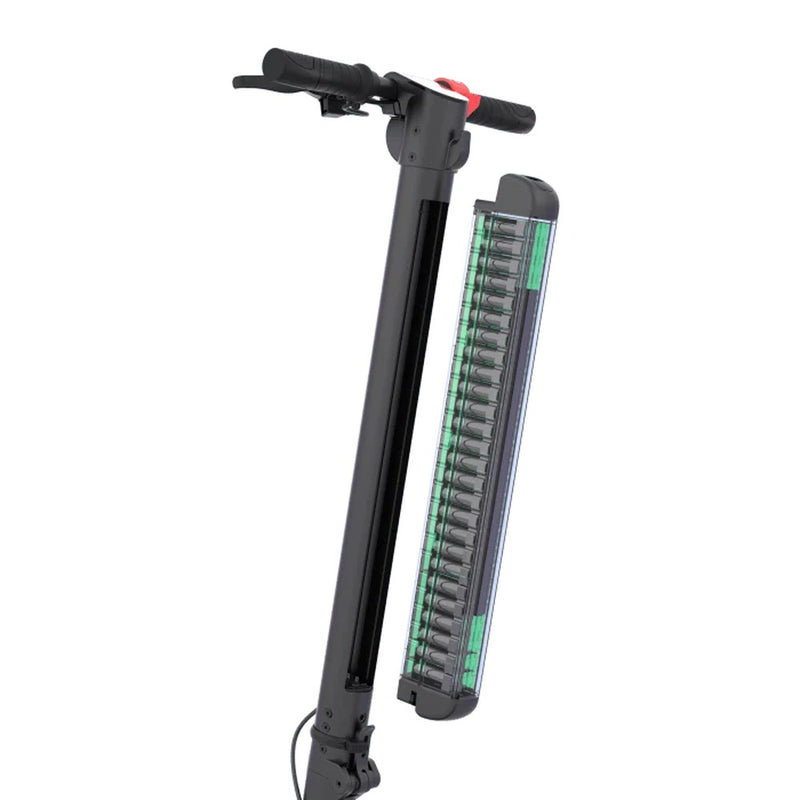
Every HX scooter except the S20 has a removable battery, so you can take the battery inside and charge it indoors even if the scooter lives in a shed or bike store. More models with that set-up are among our electric scooters with a removable battery. Quoted charging times range from 3 hours for the X7 and X8 to 8–10 hours for the X10. Charge when you’re at home and awake: according to the London Fire Brigade, most e-bike and e-scooter fires happen while the battery is charging, so never leave it charging unattended or while you sleep, and use the charger that came with it. More charging habits are in our guide to charging an electric scooter battery.
The spare parts finder has parts for the most common HX models – for the X7 and X8, for example, brake calipers, a brake disc, brake cables, a thumb throttle, mudguards, lights and a display, and for the X9 models a controller, display, brake levers and brake cables. Always search by the exact model name. If you can’t find the part, ask customer service. All HX models come with a 2-year warranty from us.
Common mistakes when choosing an HX
- Choosing by the model name. The X9 Plus and X9B share the same battery, but only the X9B has suspension. The X9 Pro Max has a bigger battery but no suspension.
- Thinking foldable means portable. Every HX scooter folds, but the X10 weighs 38 kg.
- Forgetting the maximum load. The X6 and X8 take 100 kg, the other HX scooters 120 kg. If you’re close to the limit, choose a model with a margin – rider weight also affects the range.
- Expecting the S20 to charge like the others. Its battery is fixed, so it needs a socket where it’s parked.
- Counting on a test ride and sending it back. An electric vehicle that has been ridden can’t be returned as unused. You can unpack it and check that it powers on – read the returns information before you order. Keep the original box: if the scooter ever needs to be sent in for repair, it has to be packed in its original box – we don’t send out new ones.
HX also makes the Q3 Plus and Q5S e-bikes, but this guide is about the electric scooters. More buying advice, comparisons and maintenance tips are in our guides.