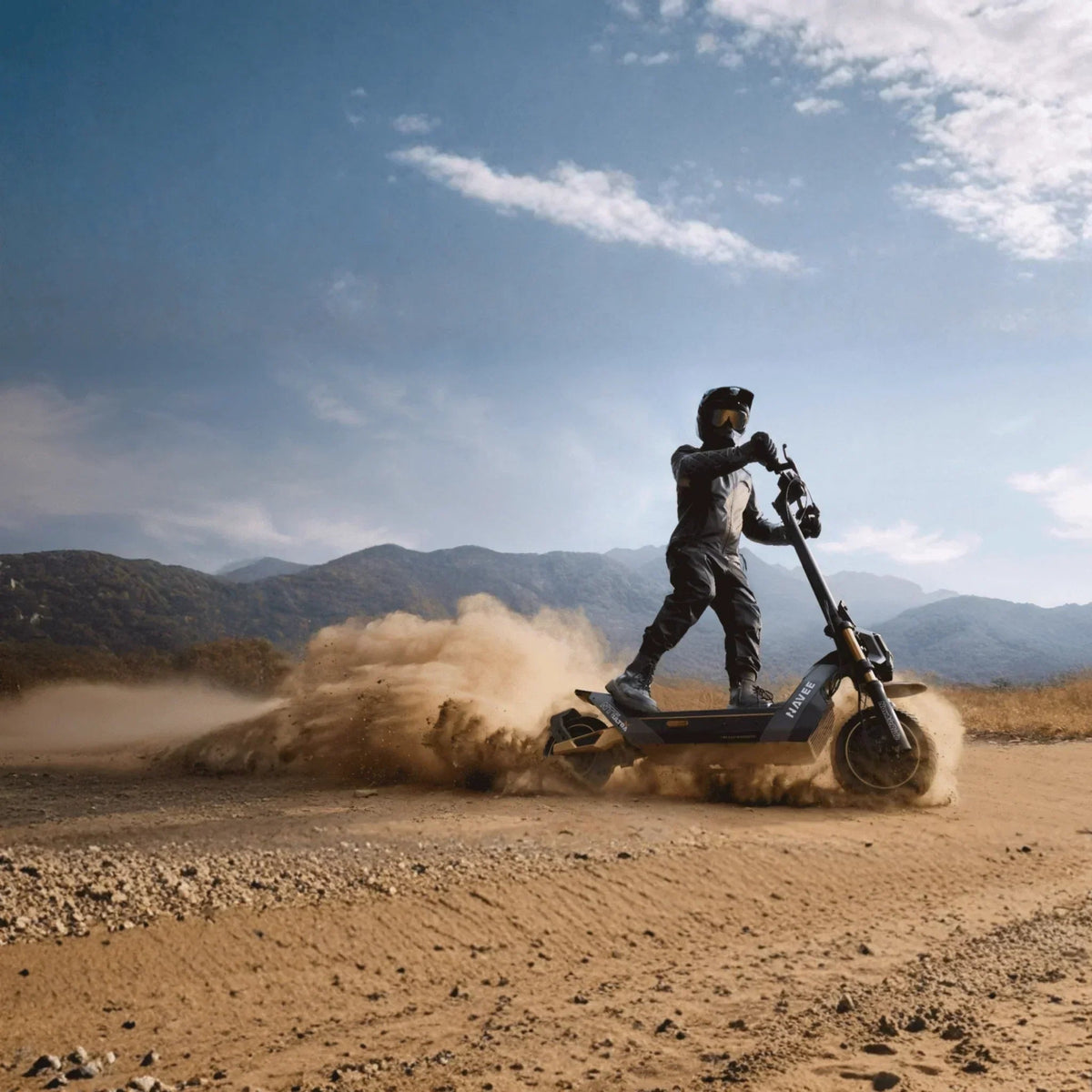

The fastest electric scooters in the world are faster than the cars on a country road – on paper. We compare the top models from Dualtron, Kaabo and Teverun, explain what makes them so fast and why 100 km/h on two small wheels takes more than a strong motor.
Short answer: how fast does the fastest electric scooter go?
The fastest electric scooters in our comparison reach 100–120 km/h according to our product data: the Teverun Fighter Supreme 7260R 120 km/h, the Dualtron X Limited 110 km/h and the Kaabo Wolf King GTR Max 105 km/h. Independent tests often land just under 100 km/h. The speed comes from high voltage, two motors and very large batteries.
The fastest electric scooters compared
| Model | Top speed | Battery | Motor power | Weight | Price band |
|---|---|---|---|---|---|
| Teverun Fighter Supreme 7260R | 120 km/h | 72 V, 60 Ah | 2 × 2,500 W | 64 kg | €4,000–4,500 |
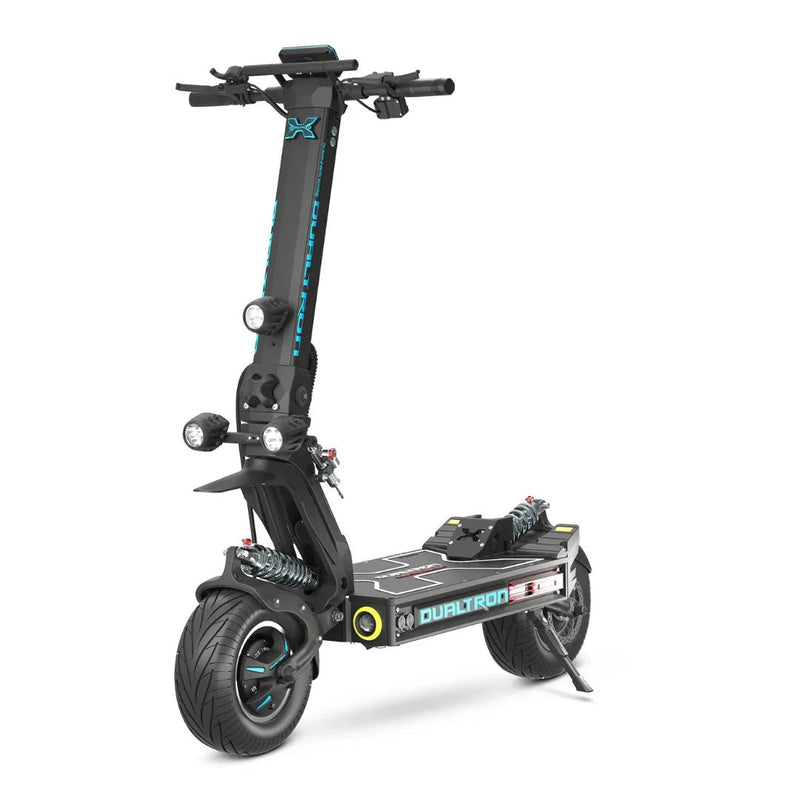
| Dualtron X Limited | 110 km/h | 84 V, 60 Ah | 2 × 2,000 W (max 2 × 6,000 W) | 82.9 kg | €5,000–6,000 |
| Kaabo Wolf King GTR Max | 105 km/h | 72 V, 40 Ah | 2 × 2,000 W (max 13,440 W) | 67 kg | €4,000–4,500 |
| Dualtron Thunder 3 | 100 km/h | 72 V, 40 Ah | 2 × 2,500 W | 51.2 kg | €4,000–4,500 |
| Teverun Fighter 11+ | 85 km/h | 60 V, 35 Ah | 2 × 1,600 W (max 5,000 W) | 36 kg | €3,000–3,500 |
| Kaabo Wolf Warrior 11 Max | 80 km/h | 60 V, 36 Ah | 2 × 1,500 W (max 6,720 W) | 52 kg | €2,500–3,000 |
Source: Wheelyshop product data, November 2026. Price bands as of November 2026. Top speed applies to private land – public roads have very different limits.
How fast are they in real life?
The top speed in the table is a best case with a full battery, a light rider and a flat road without wind. Independent tests often come in lower:
- Dualtron X Limited: Rider Guide measured 100.6 km/h, against 110 km/h in our product data.
- Teverun Fighter Supreme 7260R: Rider Guide recorded 61.5 mph, roughly 99 km/h, against 120 km/h in our product data – and still 58 mph with only 10 per cent battery left.
- Kaabo Wolf King GTR: on the sister model of the GTR Max, Rider Guide clocked 65.8 mph, roughly 106 km/h, in line with the 105 km/h for the GTR Max in our product data.
The gap depends on rider weight, wind, tyre pressure and state of charge. Voltage drops as the battery drains, and top speed drops with it.
How fast does a Dualtron Thunder 3 go?
According to our product data, the Thunder 3 reaches 100 km/h – about 62 mph. It has two 2,500 W hub motors and a 72 V 40 Ah battery of roughly 2,880 Wh. It weighs 51.2 kg, carries riders up to 120 kg and runs on 11-inch pneumatic tyres. Range is 170 km. An often-missed detail: a full charge takes 8–28 hours depending on the charger.

Acceleration and braking – the numbers you feel
Top speed gets the headlines, but acceleration is what you feel. Rider Guide timed the Dualtron X Limited from 0 to 15 mph in 1.8 seconds and from 0 to 40 mph in 6.4 seconds. The same test gave a braking distance of 3.3 metres from 15 mph, short thanks to hydraulic brakes and wide tyres. Braking distance grows quickly with speed, though, so at 80 or 100 km/h it is many times longer. Riders used to a commuter scooter are often surprised by how hard a dual-motor scooter pulls, which is why several models have reduced-power modes for beginners.
Why are they so fast?
High voltage
A typical commuter scooter has a 36 or 48 V battery. The fastest models use 60, 72 or 84 V. Higher voltage lets the motor spin faster and gives more power at the same current, so voltage is the first thing to check if you want to understand a scooter’s top speed.
Two motors and a strong controller
Every model in the table has a hub motor in each wheel. Two motors share the work, give traction on both wheels and more torque from a standstill. The controller decides how much current reaches the motors – which is why peak power can be several times the nominal rating.
Big batteries
Holding a high speed takes a lot of current for a long time. The four fastest models in the table have batteries of around 2,800–5,000 Wh, five to ten times the size of a typical commuter scooter’s. That is also a big part of why they are so heavy.
Why is 100 km/h so hard on an electric scooter?
Air is the main enemy. NASA explains that drag grows with the square of velocity. Because power is force times speed, overcoming air at 100 km/h takes roughly eight times the power needed at 50 km/h. On an e-scooter the rider stands upright and catches a lot of wind, so every extra km/h costs power and battery.
The same physics applies when you stop. Kinetic energy also grows with the square of speed, so at 100 km/h there is four times as much energy to brake away as at 50 km/h. That is why the fastest models use hydraulic disc brakes, wide tyres and steering dampers – and why braking distance grows so quickly with speed.
Why don’t they do 100 km/h straight out of the box?
Several of the fastest models have a speed limiter. According to our product data, the Dualtron X Limited, Kaabo Wolf King GTR Max and Kaabo Wolf Warrior 11 Max have a 25 km/h limiter, and top speed is meant for private land. Road-legal models are much slower: in the ADAC test (in German), scooters were measured at full speed between 20 and 22 km/h. Public roads in Europe typically cap e-scooters at 20 or 25 km/h – see our guide to e-scooter laws in Europe.
The brands behind the fastest electric scooters
Dualtron from Minimotors builds heavy, powerful dual-motor scooters, from the Thunder series to the X Limited with its 84 V battery. To see how the models differ, read which Dualtron to buy.
Kaabo is best known for the Wolf series with motorcycle-style front suspension and separable motors on the Wolf King. We explain the difference in Kaabo Mantis vs Wolf.
Teverun pairs high top speeds with big batteries – the Fighter Supreme 7260R has 200 km of range according to our product data. More in Teverun Blade vs Fighter.
Other brands belong at the top too. Cleanrider mentions (in French) the NAMI Burn-E at 105 km/h and notes that most fast models reach 80–85 km/h or more. It also points out that strong motors give more torque and range even when speed is limited.
What speed costs you
- Weight: 36–83 kg is too heavy to carry upstairs or lift into a car without a ramp.
- Charging time: big batteries take long to charge – 6–12 hours for the X Limited and 8–28 hours for the Thunder 3 according to our product data.
- Range at speed: air drag eats battery. Range at 50 km/h is far shorter than the figure quoted at 25 km/h.
- Wear: tyres and brake pads wear faster the harder you ride.
- Protective gear: Cleanrider recommends gearing up as for a motorbike – full-face helmet, gloves, back protector and knee and elbow pads.
Common misconceptions about top speed
- “More watts always means more speed”: voltage, controller and air drag matter just as much. Peak and nominal power are not the same.
- “Top speed always applies”: it applies in ideal conditions with a full battery and a light rider.
- “A fast scooter is better in town”: in city traffic you feel torque, brakes and suspension, not top speed.
- “A bike helmet is enough”: at high speed on private land you need motorbike-grade protection.
Curious how fast a normal e-scooter goes day to day? See how fast an electric scooter goes. The full range of powerful models is among our fast electric scooters, all with a 2-year warranty.