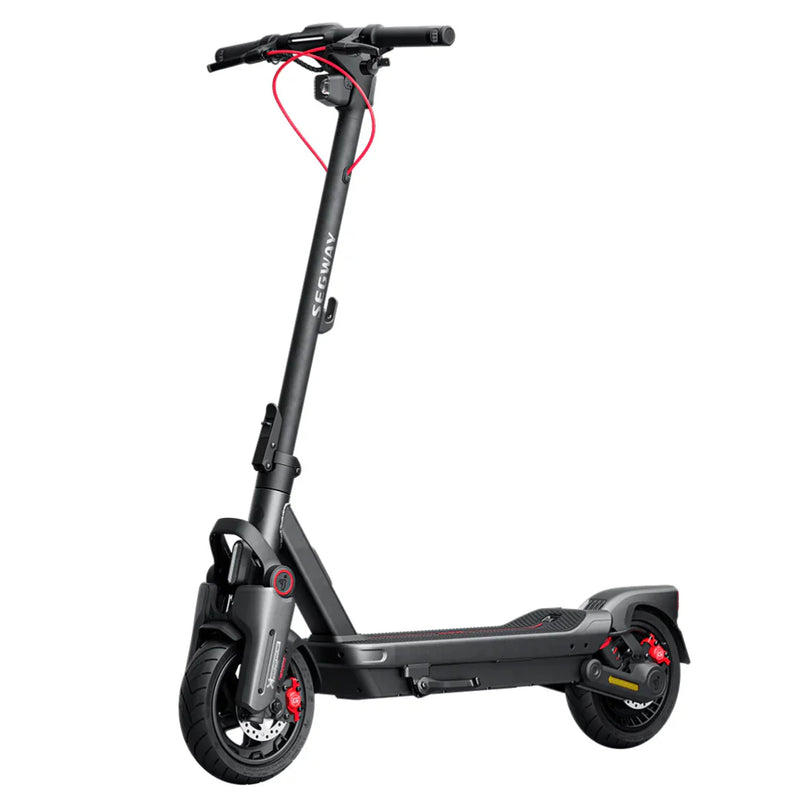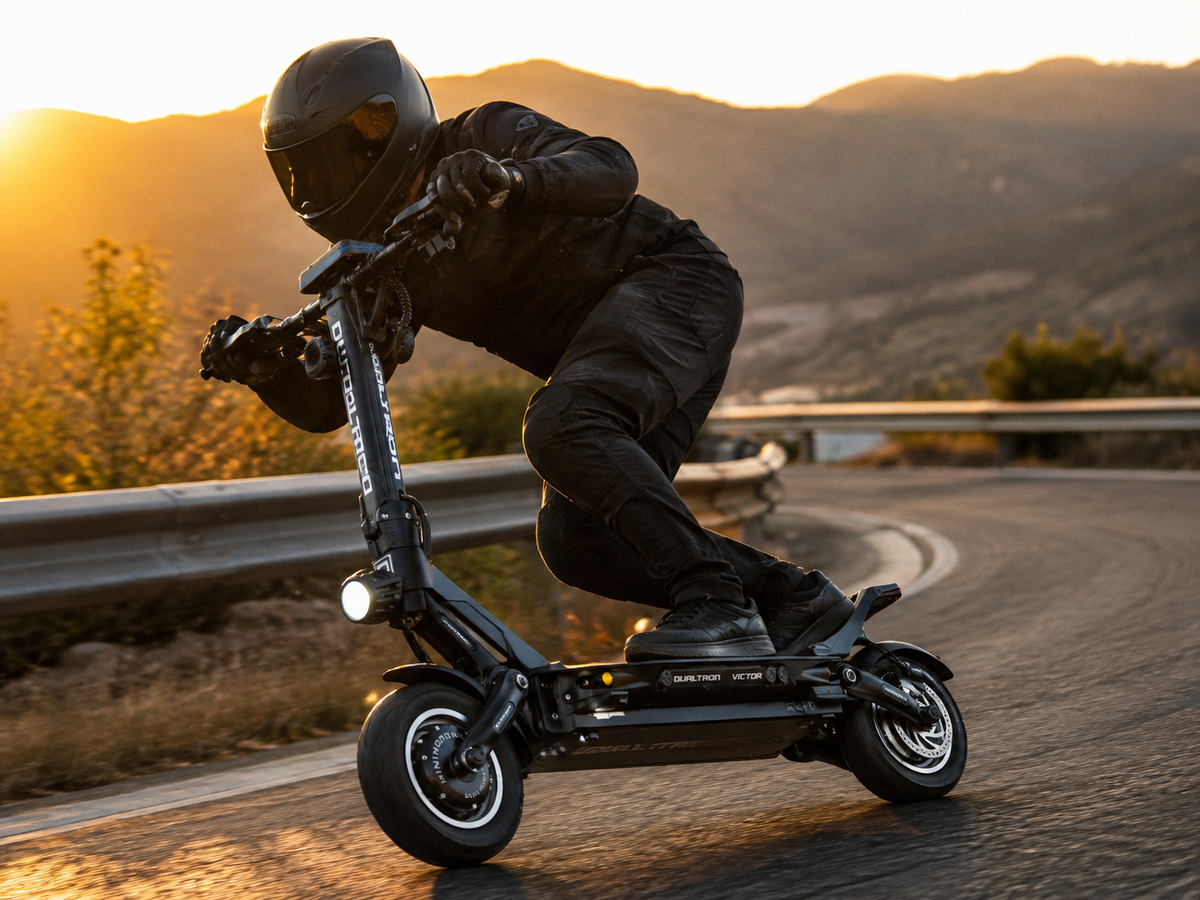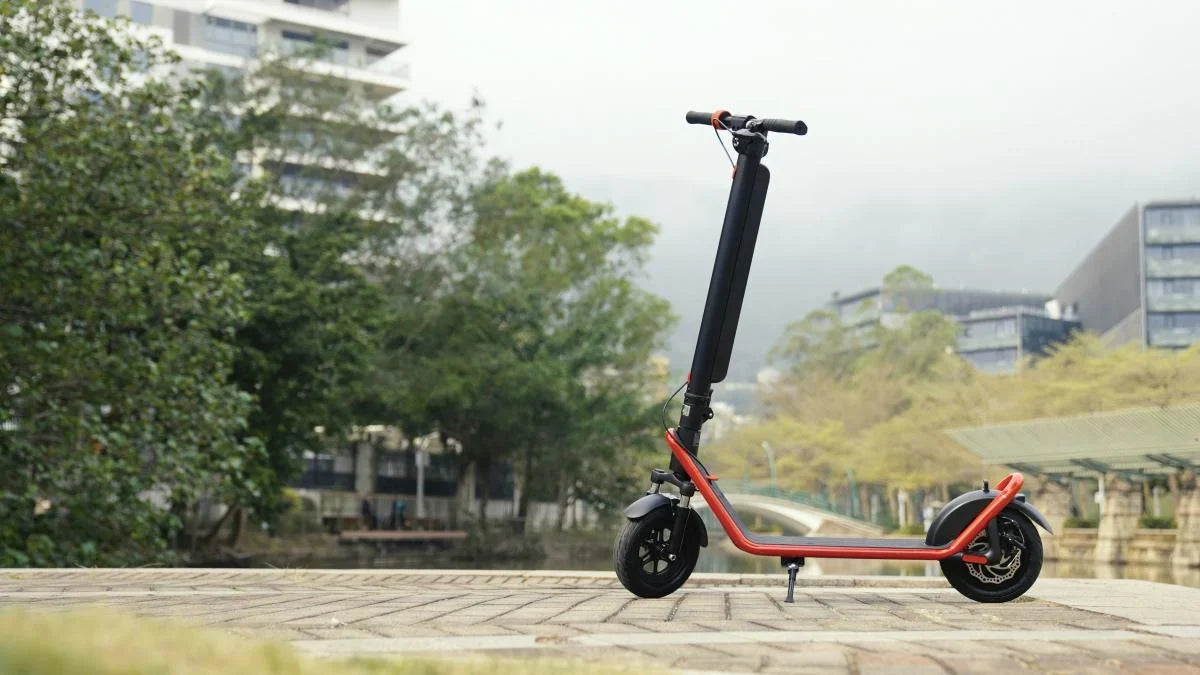

Which Boyueda should you choose? It is a common question from people who have decided on a powerful dual-motor electric scooter but get stuck on the model names. Boyueda has seven models in our range, from the G2 with a 52 V battery to the M2 with 72 V and 12-inch wheels. Here we compare them side by side using the figures from our own product data and go through who each model suits.
Which Boyueda suits you? The short answer
If you commute and want the lightest Boyueda, pick the G2 or Q7 Pro. To go further on a charge, the Q7 Pro Max and G6 are the next step. For gravel, forest tracks and heavier riders, choose the S3-11 or S5-11, with 11-inch off-road tyres and a 200 kg max load. The M2 is the flagship with 10,000 W and 12-inch wheels.
Boyueda at a glance
Boyueda builds electric scooters for riders who want more power and range than a typical commuter model offers. All seven models in our range share two hydraulic disc brakes with electronic ABS, front and rear shock absorbers, pneumatic tyres, indicators, a horn and front and rear lights. The Q7 series, the S series and the M2 fold, and every model except the G6 has adjustable handlebars.
What separates the models is mainly battery size, motor power, wheel size and whether a seat is included. The ranges break down like this: the G series (G2 and G6) are stand-up models with 10-inch wheels, the Q7 series has 10-inch wheels and a seat, the S series (S3-11 and S5-11) has 11-inch off-road tyres, and the M2 is the biggest, on 12-inch wheels. Every model except the G2 and G6 has a stated max load of 200 kg, which is more than most of the electric scooters we sell.
Every Boyueda model compared
The table shows the key figures from our product data. We have worked out the battery's energy in watt-hours ourselves by multiplying volts by amp-hours. The price band is relative within the Boyueda range, because prices change.
| Model | Range | Top speed | Weight | Max load | Motor | Battery | Wheels | Seat | Price band |
|---|---|---|---|---|---|---|---|---|---|
| G2 | 70 km | 50 km/h (limited to 25 km/h) | not stated | 150 kg | 1,600 W | 52 V 19 Ah (988 Wh) | 10 inch | No | Entry level |
| Q7 Pro | 70 km | 70 km/h | 30.2 kg | 200 kg | 3,200 W (2 × 1,600 W) | 52 V 19 Ah (988 Wh) | 10 inch | Yes | Entry level |
| Q7 Pro Max | 90 km | 70 km/h | 33.6 kg | 200 kg | 3,200 W (2 × 1,600 W) | 52 V 28 Ah (1,456 Wh) | 10 inch | Yes | Mid-range |
| G6 | 120 km | 70 km/h (limited to 25 km/h) | not stated | 150 kg | 3,200–3,600 W (two motors) | 52 V 28 Ah (1,456 Wh) | 10 inch | No | Upper mid-range |
| S3-11 | 120 km | 85 km/h | not stated | 200 kg | 6,000 W (2 × 3,000 W) | 60 V 38 Ah (2,280 Wh) | 11 inch off-road | Yes | Mid-range |
| S5-11 | 120 km | 85 km/h | 45 kg | 200 kg | 6,000 W (2 × 3,000 W) | 60 V 38 Ah (2,280 Wh) | 11 inch off-road | Yes | Mid-range |
| M2 | 120 km | 95 km/h | not stated | 200 kg | 10,000 W (2 × 5,000 W) | 72 V 40 Ah (2,880 Wh) | 12 inch | Yes | Top of the range |
Source: Wheelyshop product data, November 2026. Range and top speed are the manufacturer’s figures under good conditions. Watt-hours = volts × amp-hours, our calculation.
Model by model: who is it for?
Boyueda G2
The G2 is the simplest way into the Boyueda range: 52 V 19 Ah, 70 km of range, 10-inch pneumatic tyres and a 150 kg max load. It has an app, NFC and cruise control but no seat. In our product data it has a 25 km/h speed limiter. Suits: commuters who want hydraulic brakes and suspension without going up in weight and battery size.
Boyueda Q7 Pro
The Q7 Pro has the same battery as the G2 but two 1,600 W motors, a 200 kg max load and a seat in the box. It weighs 30.2 kg and is rated IP54. Suits: riders who want to sit down on longer stretches and have hills on their route, but do not need more than 70 km of range.
Boyueda Q7 Pro Max
The Q7 Pro Max is a Q7 Pro with a bigger battery, 52 V 28 Ah, which gives 90 km of range according to the manufacturer. It weighs 33.6 kg and has IPX5, cruise control and dual charging ports. Suits: riders who cover long distances every day and want to charge less often, and who have room for an electric scooter with a seat.
Boyueda G6
The G6 is a stand-up model with 52 V 28 Ah, 120 km of range and two motors. It has an app, NFC, cruise control and a USB port, and like the G2 it has a 25 km/h speed limiter in our product data. The max load is 150 kg and the handlebars are not adjustable. Suits: riders who want long range in a stand-up format without a seat.
Boyueda S3-11
The S3-11 has 6,000 W split across two motors, 60 V 38 Ah and 11-inch off-road tyres. It starts with an ignition key and comes with a seat, a front bag and two chargers in the box. Suits: gravel roads, forest tracks and heavier riders, with a 200 kg max load.
Boyueda S5-11
The S5-11 has the same motor, battery and tyres as the S3-11 but adds an app and NFC unlocking. It weighs 45 kg, is rated IP56 and climbs gradients of up to 45 degrees according to the manufacturer. Suits: the same riding as the S3-11, for those who want to control settings in the app and unlock without a key.
Boyueda M2
The M2 is the flagship: 10,000 W, 72 V 40 Ah and 12-inch pneumatic tyres. The box includes extra 12-inch off-road tyres, two chargers, a seat and a remote control for the RGB lighting. Suits: experienced riders who want maximum power and range and have somewhere to keep a large, heavy electric scooter.
Battery and range: count the watt-hours
The most useful measure when you compare batteries is watt-hours, which is volts multiplied by amp-hours. A 52 V 19 Ah battery holds 988 Wh, a 72 V 40 Ah one 2,880 Wh – nearly three times as much. Amp-hours on their own say little when the voltage differs between models. TNW explains that watt-hours are the most useful unit of energy capacity, and that many scooter makers only list volts and amp-hours, so you have to multiply them yourself. ERideHero’s range calculator puts it the same way: twice the battery gives roughly twice the range, all else being equal.
The range in the table is the manufacturer’s figure under good conditions. In real life it will be shorter. What Car? notes that manufacturers quote the best possible range, often tested with a 70 kg rider on a smooth, flat road with a full battery and optimal tyre pressure. When RiderGuide tested twelve electric scooters, they delivered on average 71 percent of their claimed range in real riding, with the best reaching 90 percent and the worst 53 percent. RiderGuide’s rules of thumb are to multiply the claimed range by 0.7, or to divide the battery’s watt-hours by 30 to get miles at a normal commuting pace. None of the tested scooters was a Boyueda, so treat this as a guide. The cold takes its share too: ERideHero says to expect 20 percent less range below freezing, and that riding above 80 percent of top speed can cut range by another 15 percent. Ridden hard, two motors on a powerful Boyueda draw a lot of current. So leave a good margin: if you need 50 km a day, a model with 70 km of claimed range is on the low side in winter.
Weight, size and seat
Power and range cost weight. The Q7 Pro weighs 30.2 kg and the S5-11 45 kg, and the models with 11- and 12-inch wheels are bulky even when folded. Our product data gives no weight for the G2, G6, S3-11 and M2, but expect the bigger models to be at the same level as the S5-11 or above. For comparison, What Car? puts typical electric scooters at 8 to 15 kg, with the battery accounting for much of the weight, and T3 points out that light models are light because they have smaller batteries and motors. Even stated weights are worth treating with care: ERideHero weighs every scooter it tests because manufacturers' measurements and weights are not always accurate. If you carry your scooter up stairs or need to fit it into a small car, weight often matters more than top speed. Read more about the weights of different types in our guide to how much an electric scooter weighs.
The seat is another big difference. The Q7 series, the S series and the M2 come with a seat, which makes long rides far more comfortable. The G2 and G6 are ridden standing and are therefore narrower and easier to handle in tight spaces. The rider height range is 160–210 cm on the models where it appears in our product data.
Brakes, suspension, tyres and IP rating
All Boyueda models have two hydraulic disc brakes with electronic ABS. T3 says brakes on both wheels are better than a single brake, and that among disc brakes hydraulic ones are the smoothest and best. On an electric scooter that weighs 30–45 kg and reaches 70 km/h or more, strong brakes are not an extra but a must. All models also have front and rear shock absorbers and pneumatic tyres. T3 adds that larger pneumatic tyres, nine inches or more, deal better with cracks, small potholes and gravel, and What Car? notes that anyone riding on rough surfaces or off-road will want some form of suspension. Cycling Weekly describes the main suspension types, from springs and rubber to hydraulic and air pistons, and rates a spring combined with a piston as the best.
Wheel size is the biggest difference. 10 inch (G2, G6, Q7 series) suits streets and cycle lanes, the 11-inch off-road tyres (S3-11 and S5-11) grip better on gravel and forest tracks, and 12 inch (M2) rolls most easily over bumps. If you plan to ride a lot off the tarmac, you will find more models in our comparison of off-road electric scooters.
The IP rating describes protection against dust and water. As ERideHero explains, the first digit covers solid objects and dust, the second water, and an X means no rating is given for that part, which is not necessarily the same as no protection. A first digit of 5 means dust-protected and 6 dust-tight. IP54 (Q7 Pro, M2) handles splashes, IPX5 (Q7 Pro Max) water jets and IP56 (S3-11, S5-11) stronger jets. ERideHero’s own advice is IPX4 or IP54 as a minimum for riding in rain, with IPX5 recommended. None of these ratings makes an electric scooter waterproof, and our product data gives no IP rating for the G2 and G6. We explain what it means in practice in our guide to electric scooters in the rain and IP ratings.
With two motors and speeds above 50 km/h, protective gear matters more than on a commuter model. What Car? calls a helmet a must-have whichever scooter you buy, and the Department for Transport’s guidance for e-scooter trial users says riders should wear a cycle helmet. Gloves and knee and elbow pads are a sensible addition on a scooter this powerful. See our guide to choosing the right helmet.
Boyueda vs KuKirin, Kaabo and Teverun
To show where Boyueda stands, we have compared two of its models with three powerful electric scooters from other brands in the same size class. What stands out is the max load: Boyueda’s seated models have a stated max load of 200 kg, while the KuKirin G4 and Kaabo Mantis King GT list 120 kg and the Teverun Fighter Eleven+ 150 kg. The batteries on the S3-11 and S5-11 are among the largest in the class.
The Kaabo Mantis King GT is lighter than the S5-11 with almost the same range and suits riders who want a dual-motor model they can still carry. The KuKirin G4 has a smaller battery but is a proven model in a lower price band. The Teverun Fighter Eleven+ matches the S series on top speed and weighs less, but sits at a higher price level. See the full ranges under KuKirin electric scooters, Kaabo electric scooters and Boyueda electric scooters.
| Model | Range | Top speed | Weight | Max load | Battery | Motor |
|---|---|---|---|---|---|---|
| Boyueda S5-11 | 120 km | 85 km/h | 45 kg | 200 kg | 60 V 38 Ah (2,280 Wh) | 6,000 W (2 × 3,000 W) |
| Boyueda Q7 Pro Max | 90 km | 70 km/h | 33.6 kg | 200 kg | 52 V 28 Ah (1,456 Wh) | 3,200 W (2 × 1,600 W) |
| KuKirin G4 | 75 km | 70 km/h | 41.5 kg | 120 kg | 60 V 20 Ah (1,200 Wh) | 2,000 W / 2,400 W |
| Kaabo Mantis King GT | 110 km | 70 km/h | 33 kg | 120 kg | 60 V 24 Ah (1,440 Wh) | 2,200 W (2 × 1,100 W) |
| Teverun Fighter Eleven+ V4 | 120 km | 85 km/h | 36 kg | 150 kg | 60 V 35 Ah (2,100 Wh) | 3,200 W / 5,000 W (2 × 1,600 W) |
Source: Wheelyshop product data, November 2026.
Where can you ride a fast electric scooter?
Every Boyueda in our range has a top speed of 50 km/h or more, so it is worth checking the rules where you live before you buy. In Great Britain, the Department for Transport classes e-scooters as motor vehicles, and privately owned ones can be ridden on private land with the landowner’s permission. Our guide to electric scooter laws in Europe covers other countries. Insurance is worth checking too: the Financial Ombudsman Service notes that specialist e-scooter insurance exists, and that anyone relying on home insurance should read the terms carefully. There is more on home, accident and motor insurance in our guide to electric scooter insurance.
Common mistakes when choosing a Boyueda
- Choosing on top speed. 85 or 95 km/h sounds tempting, but range, weight and a seat affect everyday riding more. Read more about why the fastest models go so fast in our article on the world’s fastest electric scooters.
- Comparing amp-hours instead of watt-hours. 38 Ah at 60 V is more energy than 40 Ah at 48 V. Multiply volts by Ah.
- Underestimating the weight. A 45 kg electric scooter is not something you carry up to the third floor every day.
- Forgetting about storage. The models with 11- and 12-inch wheels and a seat take up space even when folded. Measure the hallway or shed before you order.
- Skipping the protective gear. A helmet, gloves and ideally knee and elbow pads belong with a powerful electric scooter.
- Riding fast on cold tyres and a cold battery. In the cold both grip and range are worse; start gently.
What we do when someone asks
When someone asks us which Boyueda to choose, we start with where and how far they will ride, how much they weigh and where the scooter will be kept. If they mostly ride on tarmac and sometimes need to carry it, we point them to the G2 or Q7 Pro. If they ride long distances every day, it is the Q7 Pro Max or the G6, depending on whether the seat matters. For gravel, forest or a heavier rider we suggest the S3-11 or S5-11, and the choice between them comes down to key or app.
We only recommend the M2 to people who have already ridden a powerful electric scooter and know what 10,000 W means. We also remind people that the big models arrive in big boxes and that the original box is needed if the scooter ever has to be sent in for repair. If you have questions about a specific model, contact our customer service.