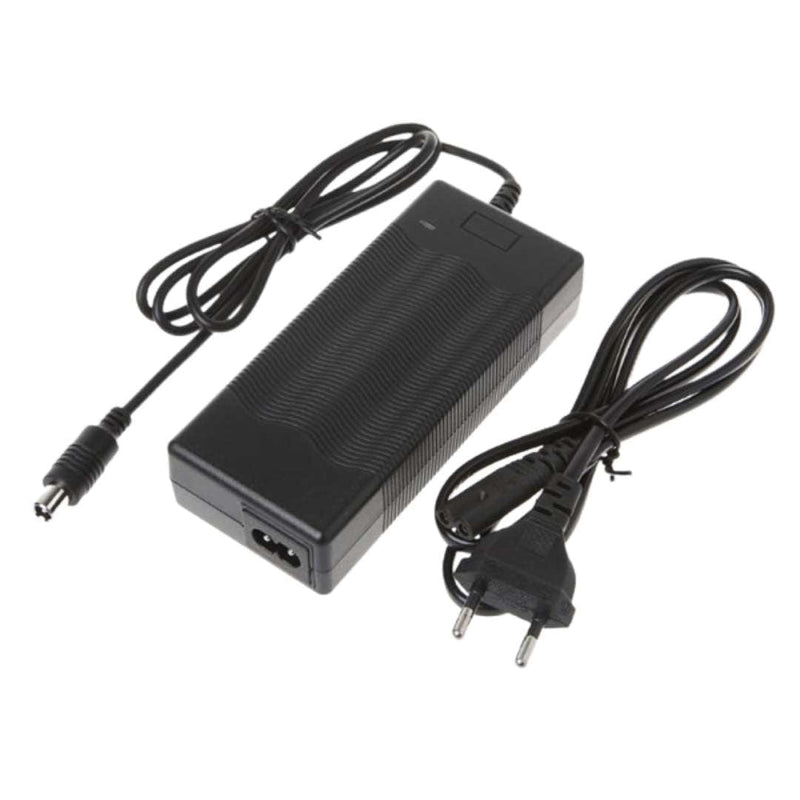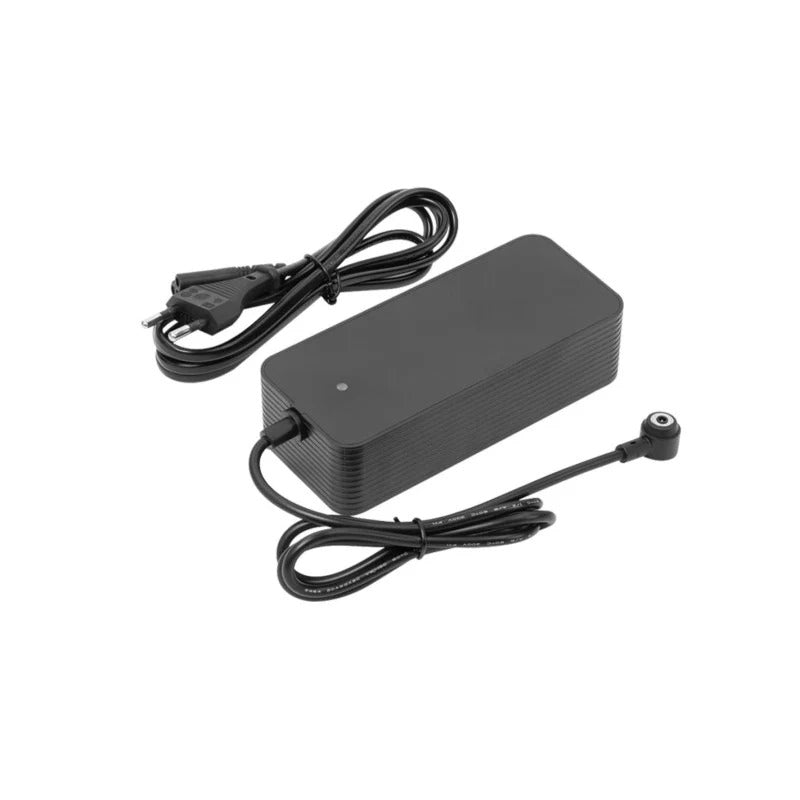

Which electric scooter charger fits is one of the most common questions we get, usually when the original charger has broken, been left at work, or when someone wants a spare. The problem is that many chargers look alike and have the same connector but deliver different voltages. Here we go through how to read the label, which voltage belongs to which battery, what amps mean for charging time and how to tell that the connector is right.
Which charger do I need? The short answer
The one with the same output voltage as the original charger, the same connector and a charging current the battery is built for. A 36 V battery charges at 42 V, 48 V at 54.6 V, 52 V at 58.8 V, 60 V at 67.2 V and 72 V at 84 V. Amps only decide the speed. Read the old charger's label before you order.
How to read the label on the charger
Every charger has a label with two lines that matter. Input is what the charger draws from the wall, usually 100–240 V alternating current, and you do not need to worry about that line in Europe. Output is what goes to the battery, for example 42 V and 2 A. That is the line that has to match.
The voltage must be exactly what the battery is built for. The current in amps is the most the charger can deliver and decides how quickly it goes. Next to the figures there is often a small symbol with a circle, a plus and a minus that shows the polarity of the connector, meaning whether positive sits in the centre or on the outside. On chargers with a multi-pin connector, a diagram shows which pin is which.
If you no longer have the original charger, the same information can be found in three other places: in the manual, on the rating plate by the charging port or under the deck, and in the Battery row of the specification on our product page.
Volts: the battery's voltage decides
The battery in an electric scooter is not a single cell but many small ones, connected in series to reach the right voltage. Battery University explains that a lithium-ion cell has a nominal voltage of 3.60 V, the midpoint between fully charged and empty. In its walk-through of lithium-ion charging, the same source describes how the cell is normally charged to 4.20 V, with a tolerance of only 50 millivolts, and how manufacturers are strict about the setting because lithium-ion cannot accept overcharge.
That is why the number on the charger is always higher than the one on the battery. A battery sold as 36 V has ten cells in series: ten times 3.6 V is 36 V nominal, and ten times 4.2 V is 42 V fully charged. Rider Guide spells out exactly that example in its technical guide to scooter batteries: a 36 V pack with ten cells in series runs from 30 V when empty up to 42 V when full. The other rows in the table follow the same sum, with examples of models from our range.
| Battery (nominal) | Cells in series | Charger output voltage | Example models |
|---|---|---|---|
| 36 V | 10 | 42 V | iScooter i9 Max, i10 and i12, Ninebot E2 Pro |
| 46–46.8 V | 13 | 54.6 V | Ninebot MAX G3 and GT3 |
| 48 V | 13 | 54.6 V | KuKirin G2, G2 Pro and G2 Max, iScooter iX4 and iX8, Dualtron Togo |
| 52 V | 14 | 58.8 V | KuKirin G2 Master and G3 Pro |
| 60 V | 16 | 67.2 V | KuKirin G4, Kaabo Mantis King GT, Teverun Fighter Eleven+ |
| 72 V | 20 | 84 V | Kaabo Wolf Warrior King GTR, Dualtron Thunder 3 |
Source: Wheelyshop product data (the Battery row in the specification), November 2026. Cell count and charging voltage are our own calculation: number of cells × 4.2 V.
Two things in the table are worth pausing on. The first is that 46.8 V and 48 V are the same type of battery with 13 cells; the manufacturers simply count 3.6 or 3.7 V per cell. The charging voltage is the same, but the connectors differ between brands. The second is that 48 V and 52 V sit close together but are not interchangeable. A 54.6 V charger will never fill a 52 V battery, and a 58.8 V charger will overcharge a 48 V battery.
That last point is why the voltage is not negotiable. The UK's product safety regulator, the Office for Product Safety and Standards, writes in its guidance on avoiding e-bike and e-scooter fires that connecting the wrong charger to a battery can pose serious fire risks, and that not all batteries and chargers are safe together. The charity Electrical Safety First describes the mechanism: an incompatible charger can supply the battery with the wrong voltage, which can overheat it and lead to thermal runaway. The battery's management electronics should cut off if the voltage gets too high, but they are a last line of defence, not a setting to lean on.
Amps: how to work out the charging time
Once the voltage is right, the current decides how long you wait. The rule of thumb is simple: divide the battery's capacity in amp-hours by the charger's current in amps. A 15 Ah battery and a 2 A charger give 7.5 hours. Then add a good hour, because charging slows down towards the end.
Battery University describes why: the charger first holds a steady current until the cells reach full voltage, at around 70 per cent, and after that the current gradually falls during a saturation phase. A stronger charger shortens the first part but not the second. Figures from the e-bike world show the same thing: in a TechRadar piece on battery care, a Shimano technician says a 504 Wh battery on a 4 A charger takes two and a half hours to reach 80 per cent and five hours to fill completely.
Is a fast charger bad for the battery?
Not at the currents we are talking about here. Battery University gives 0.5–1C as the recommended charging current for energy cells, and says manufacturers recommend 0.8C or lower for longer life. The C-rate is the current in relation to the capacity: for a 15 Ah battery, 1C is a full 15 A. By our own reckoning, an ordinary 2 A charger is far below that limit, and even a 4–5 A fast charger has a comfortable margin.
That does not mean more is always better. In its article on fast and ultra-fast chargers, Battery University notes that charging lithium-ion above 1C reduces service life and advises using a slower charge when you can. Our position: use a fast charger when you need it and only if it is intended for the model, and let the standard charger handle everyday use. If your scooter has two charging ports, two standard chargers are a gentler way of halving the time than a single powerful one.
The connector: the same plug is not the same charger
This is where it most often goes wrong. There is no common standard for charging connectors on electric scooters, so the same type of connector is used for several different voltages. The most common types are a round DC plug with a pin in the centre, a metal multi-pin connector with a screw collar, and the brands' own connectors. The fact that the plug goes in tells you nothing about whether the voltage is right.
Our own range of chargers shows what this looks like in practice. Several Ninebot series share a charger. Within KuKirin, the G2 Max, G3 and G3 Pro each have their own. Several of the larger Ninebot models have the charger built into the scooter, and then only a mains cable is plugged in. So always search by model name, not by what the connector looks like, when you look among the electric scooter chargers.
Check the polarity as well if you buy a compatible charger. On a round DC plug, positive normally sits in the centre, but there are exceptions, and on multi-pin connectors the pins can be wired differently between brands even though the connector looks identical.
Original or compatible charger?
The official advice is consistent. The Department for Transport's battery safety guidance for e-scooter users says to use only the charger supplied with the scooter or a replacement authorised by the manufacturer, and to look for the CE or UKCA mark when buying. London Fire Brigade gives the same message: use the charger that came with the battery or one recommended by the manufacturer, since the wrong charger can overload the battery and raise the risk of overheating and fire. It adds that most fires involving e-bikes and e-scooters happen while the battery is charging.
A compatible charger can work just as well, provided four things are right: the output voltage, the connector, the polarity, and a CE mark together with a named manufacturer or importer within the EU. The last one is not a formality. Electrical Safety First warns in its safety advice for e-bikes, which applies equally to scooters, that counterfeit and substandard chargers can be lethal, and advises against buying a replacement from market stalls, social media or third-party sellers on online marketplaces. The National Fire Chiefs Council makes a similar point in its Charge Safe campaign: very cheap chargers and components may not meet safety requirements, and batteries and chargers should not be mixed and matched unless they are designed to work together. A product can look well made and still work despite serious faults, and when you buy directly from a seller outside the EU there is nobody here who answers for its safety.
Signs that the charger is faulty
The warning signs are much the same wherever you look. The Office for Product Safety and Standards says to stop using a charger or battery straight away if it overheats, deforms, hisses, smells, smokes or performs poorly, and the fire chiefs add a battery that takes longer than usual to charge or never gets full. From our own bench we would add: a charger that rattles when you shake it, has cracks or gaps in the casing, or hums loudly. A damaged cable should be replaced at once.
The lamp on the charger is the quickest way to troubleshoot. On most chargers it is red while the battery is charging and switches to green when it is full. If it is green straight away even though the battery is empty, no current is flowing: check that the plug is pushed fully home and that the charging port is clean. If it does not light at all when the charger is plugged into the wall, the charger has given up. If you have a multimeter you can measure at the plug with nothing connected; a sound charger then shows roughly the voltage printed on the label.
If the charger works but the battery still will not take a charge, the fault lies further in. Then our guide to the battery in an electric scooter is the next step, and among the batteries and charging cables there are charging ports and cables as spare parts.
Common mistakes
Right connector, wrong voltage. The most common error, and the only one that is really dangerous. Always compare the Output line with the original charger or with the table above.
Charging straight after a cold ride. Battery University is clear: lithium-ion must not be charged below freezing. The battery appears to charge normally, but metallic lithium plates onto the anode and causes permanent damage. Bring the scooter indoors and let it reach room temperature first. There is more about the cold months in our guide to winter storage.
Charging overnight out of habit. The Department for Transport's advice is to charge only when you are awake and alert, never when you are asleep or away from home, and never to cover the charger or the battery. The rest of the advice is in our guide to electric scooter fire risk.
Carrying on with a charger that has become hot or smells. Replace it. A new charger costs a fraction of a new battery.
Thinking higher amps require higher volts. They do not. A 54.6 V, 4 A charger charges the same battery as a 54.6 V, 2 A one, only faster.
Does the battery last longer with the right habits?
Yes, and it has more to do with how full you charge than with which charger you have. Battery University gives a rule of thumb in its guide to prolonging lithium-based batteries: a cell charged to 4.20 V typically manages 300–500 cycles, while 4.10 V gives 600–1,000. Each tenth of a volt off the peak voltage is said to double the cycle life, in exchange for slightly less energy per charge. ERideHero's battery guide turns the same idea into an everyday habit, the 80/20 rule: charge to 80 per cent and avoid dropping below 20 for a longer life.
In practice this means you do not need to charge to full after every ride. Unplug the charger when you have what you need for the next day, and save one hundred per cent for the days you are going far. The full reasoning, with storage and temperature, is in our guide on how to charge an electric scooter battery properly, and what a charge costs is worked out in what it costs to charge an electric scooter.
What we do when someone asks
Most people who contact us about chargers know which scooter they have but not what voltage the battery is. So we ask for three things: the model name, a photo of the label on the old charger if it still exists, and a photo taken straight into the charging port. With those three it is almost always possible to point out the right charger at once.
If there is no label and no manual, we read the voltage from the Battery row in the specification and compare the connector with the picture. If the model is unusual, or the battery has been swapped for something other than the original, we advise against guessing. Then it is better to measure the battery's voltage or send a photo to our customer service than to experiment with a charger that happens to fit the port.