
It’s the question that comes up in every dirt bike group: electric or petrol? The answer has less to do with the motor than with where you’ll ride, how long each session lasts and who’ll be on the bike. We go through it with figures from our own range and from a magazine that put an electric bike through a proper test.
Electric or petrol dirt bike – which should you choose?
Go electric if you ride shorter sessions, want to skip engine servicing, are teaching a child or a beginner, and can charge at home or at the track. Go petrol if you want long days without charging breaks, want to race a full-size bike in the usual classes or ride where there’s no power. Think about size, too: most of the electric dirt bikes in our range are lighter and smaller than a full-size 125 or 250, so compare with the right class before you decide.
Compare the right class – size, weight and power
The most common mistake is putting a light electric dirt bike up against a full-size petrol bike. Compare bikes with the same wheel size and a similar weight instead – it’s a good rule of thumb even if you only ride for fun.
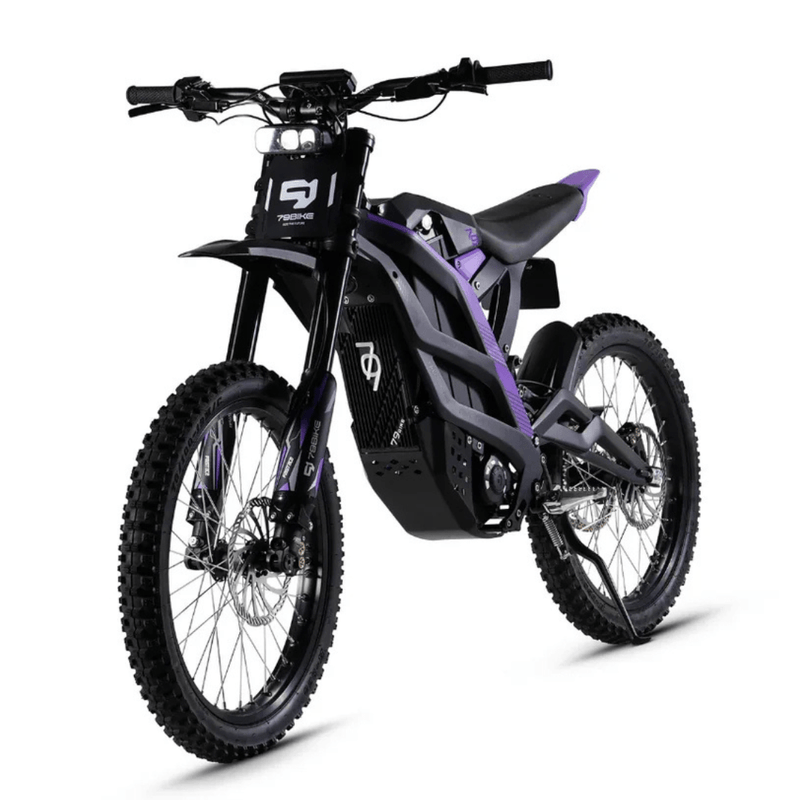
- Wheels: many of our electric dirt bikes have a 14-inch front and a 12-inch rear wheel – the same sizes as a typical 65 cc youth motocross bike or a pit bike. For an adult rider, a pit bike is often the fairest comparison. The bigger models have 15–20-inch wheels.
- Weight: our electric dirt bikes for teens and adults weigh 42–62 kg, and the kids’ models 10–23 kg. That’s far lighter than a full-size motocross bike.
- Power: rated power is 1–5 kW on the models for teens and adults. An electric motor delivers full torque straight away, so an electric dirt bike feels stronger off the line than the figure suggests. Top speed – 50–85 km/h in our range – says little about how it copes with a long climb in loose sand.
Full-size electric dirt bikes exist too, but they weigh about as much as a petrol bike. The KTM Freeride E-XC that Motocross Action put through its race test weighs 245 lb (about 111 kg) – 4 lb more than Suzuki’s RM-Z450 petrol bike.
How an electric dirt bike feels on the track
The biggest difference is in your hands. An electric dirt bike has no clutch and no gears: you twist the throttle and it pulls straight away, just as hard out of every corner. Beginners get going faster, and riders who can already ride have more attention left for lines and jumps.
- It’s on even when it’s silent. Without engine noise, it’s easy to twist the throttle by mistake while you’re standing still. Switch it off when you get off, and teach children the same habit from day one.
- You hear more of the ground. With the engine noise gone, you hear the chain, the tyres and the dirt hitting the mudguards, and it’s easier to hear when the rear wheel starts to slide.
- Riding modes replace the gears. Our models for teens and adults have three or four riding modes, and some have a limited 25 km/h mode – handy when someone is learning.
The petrol bike has its points here too. With a clutch and gears, an experienced rider can control the power precisely in technical sections, and for many riders the sound and the feel are half the fun.
Riding time and charging – think in Wh, not km
The range on a product page is the manufacturer’s figure. On a motocross track with jumps, sand and lots of throttle, the battery runs out sooner, so look at the battery’s energy in watt-hours (Wh) instead. You work it out by multiplying volts by amp-hours: 48 V × 23 Ah ≈ 1,100 Wh.
- Our electric dirt bikes for teens and adults have batteries of about 750–2,500 Wh; the kids’ models are under 200 Wh.
- How long it lasts depends more on the rider than on the battery. In MXA’s test, the same KTM Freeride E-XC lasted 35 minutes with a pro on a track, about an hour and a half for experienced riders on trails and jumps, and three hours for a beginner in the mildest mode. Soft dirt and sand drain it fastest.
- Charging takes 3–12 hours on our models, most of them 6–10 hours. A tank of petrol takes a minute.
- If the battery is removable, a charged spare can stretch the day, but check the price first – a spare battery can cost a large share of what the whole bike costs. For most riders, charging breaks are simpler.
- Charging at the track: use the spot the track or club gives you, and never leave a charging battery unattended.
Charge the battery indoors at room temperature, and don’t leave it flat over the winter. The advice in our guide on how to charge an electric scooter battery applies to an electric dirt bike too.
Maintenance – what you skip and what remains
This is where the electric dirt bike has its clearest advantage. There’s no engine oil, air filter, spark plugs or carburettor, and no piston or valves to keep an eye on. But it isn’t maintenance-free:
- Chain and sprockets need lubricating, tensioning and replacing, just as on a petrol bike.
- Brakes, tyres, bearings and suspension wear just as much – they don’t care what drives the wheel.
- Gear oil is still used on some electric dirt bikes. MXA notes that the KTM Freeride E-XC takes 155 cc of oil that needs changing every 50 hours – so read the manual for your model.
- Connectors and wiring need to stay clean and dry. Never pressure-wash the motor, controller or battery. The IP rating – IPX4 to IP67 on our models for teens and adults – shows what it can take; more on that in our guide to IP ratings and water.
Wear parts differ between models. Contact customer service with the make and model, and we’ll find out what fits your electric dirt bike.
Noise – where the electric bike wins big
A petrol dirt bike can be heard a long way off, which is why many tracks and races test noise levels. An electric dirt bike isn’t silent – MXA’s testers still heard the motor buzz, the chain slap and the tyre knobs – but it bothers the neighbours far less, and you can talk to whoever is standing by the track.
Quiet doesn’t mean you can ride anywhere, though: unless it’s approved and registered for the road, a dirt bike stays off public roads, and where you may ride off-road depends on local rules – so in practice you ride at a track.
What does it cost to run?
Electricity is almost free by comparison. At the EU average household price of €0.29/kWh in the second half of 2025 (Eurostat) and with ten per cent charging losses, a full charge of our models for teens and adults costs about €0.24–0.80. A single litre of petrol cost €2.09 on EU average on 21 September 2026, according to the European Commission’s Weekly Oil Bulletin – roughly as much as two and a half to nine full charges. How much a petrol bike uses depends on the engine and how you ride, and a two-stroke also needs oil in the fuel.
To work it out for your own bike, do as in our guide to what it costs to charge an electric scooter: the battery’s Wh times your electricity price, plus a little for charging losses.
The big items are the purchase price and the wear parts. Tyres, brake pads, chain and sprockets cost money whatever the drivetrain – with electric, you skip the engine oil, the filters and the engine rebuilds.
When petrol is still the better choice
- Long days without power. If you ride all day at the track or at events with nowhere to charge, a tank is hard to beat.
- Racing a full-size bike. A light electric dirt bike with 14-inch wheels belongs with the smallest classes, not in MX2. If you want to race with the adults, you need a bike of that size – whatever powers it.
- Heavier riders. Our electric dirt bikes for teens and adults have a recommended maximum rider weight of 100–160 kg, depending on the model. If you weigh more, or ride with a lot of kit, a bigger bike may be the safer choice.
- The sound and the feel. For many riders the engine noise is half the fun, and that’s a perfectly good reason.
Common mistakes when choosing an electric dirt bike
- Comparing watts only. Peak power says little. Look at the battery’s Wh, the weight and the wheel size as well.
- Buying too big for a child. With instant torque, a bike that’s too powerful quickly feels unsafe. Choose by height and experience among our electric dirt bikes for kids and adults.
- Forgetting where you’ll ride it. Find the track or club before you buy, not after, and check their rules for electric bikes, membership and insurance.
- Pressure-washing it after a muddy session.
- Putting it away with a flat battery for the winter.
- Skipping the protective gear because it’s “only” electric. A full-face motocross helmet approved to ECE 22.06, goggles, boots, gloves and body armour are needed just as on a petrol bike – a bicycle helmet isn’t enough.
Not sure which model suits you? Send us the rider’s height, weight and experience, and we’ll help you compare.